Tuesday, January 24, 2012

Paul's Conversion from Fear to Hope

Orthodox icon of Sts. Peter and Paul.
The apostles Peter and Paul are frequently paired with each other, particularly in the names of cathedrals, since they are regarded as two founding pillars of the Church.  According to Holy Scripture, Peter was the first among the original twelve apostles, the rock on whom the Western Church was built, while Paul was known as the apostle to the non-Jewish population of the eastern Mediterranean.  In fact, Paul claims in his Letter to the Galatians to have met Peter (or Cephas, as he was also called) and some of the other apostles at the Council of Jerusalem in around 50 CE, and there is an alternative account of this meeting in the Acts of the Apostles that is interestingly much less flattering to Paul.  The Feasts of the Confession of St. Peter and the Conversion of St. Paul are thus unsurprisingly quite close together--only a week apart--not only because of the traditional pairing of the two apostles, but also because there is something quite similar about their struggles as people of faith.  If Peter was the faithless apostle that out of fear denied Jesus three times, Paul was the unlikely apostle who had hunted down and murdered Jesus' followers in the early years following the Crucifixion.  Each had a checkered past.  Each had denied Jesus and had worked against His divine mission and yet was transformed into a key supporter of this same mission and proclaimed Him as Lord.  But in Paul's case, what is the nature of this "conversion" that we observe today?

St. Paul by Masaccio.
Contrary to popular understanding, Paul did not convert from Judaism to Christianity.  The man's name change from Saul to Paul does not signify some transference of allegiance from one institutional religion to another.  This is mainly because the Judaism of the first century CE was not one monolithic entity, but a combination of many sects, perspectives, and priorities that defied easy oversimplification.  What we know as Christianity, moreover, did not yet exist as either a consolidated identity or as a distinct alternative to contemporary Judaism of any stripe.  Followers of Jesus were known as adherents to "the Way," but many of them considered themselves faithful Jews, as did the apostle Paul, who was also a Pharisee.  Current Pauline scholarship has attempted to reclaim the Jewish identity of Paul, which one will discover is well supported by reading Paul's undisputed epistles:  Romans, 1 and 2 Corinthians, 1 Thessalonians, Galatians, Philippians, and Philemon.  The authorship of the other epistles attributed to Paul are generally in dispute, but almost certainly are not his original work.  A good introduction to Paul's Jewish identity and the epistles is Pamela Eisenbaum's 2009 book, Paul Was Not a Christian:  The Original Message of a Misunderstood Apostle.

Caravaggio's take on Paul's conversion.
My belief is that Paul's conversion is rather one that opened his eyes to a larger perspective on humanity's future to which he had been blind.  Like Caravaggio's painting to the left suggests, Saul's encounter with the risen Jesus on the road to Damascus unbalanced him, threw him off his high horse, and knocked the wind out of him.  This unseating was necessary and purposeful, for his narrow and limited viewpoint had made him an opponent of Jesus and a vicious persecutor of his disciples. He needed to learn to see differently.  This condition is emphasized in Acts 9 by the blindness that afflicts Saul for three days following his unexpected meeting with Jesus.  It is only when the disciple, Ananias, lays hands on him at Jesus' command, that Saul receives the Holy Spirit and regains his sight, which inspires him immediately to be baptized and embrace a different path.  Peter's previous faithlessness and Paul's former violence against the followers of Jesus should remind us to remain open to the ever unfolding truth that God wishes to communicate to us, however frightening it might seem to be at first.  The scariness of crucifixion and the threat posed by Jesus' followers to the status quo should encourage us, like Peter and Paul, to avoid reacting out of fear.  Fear can be a very powerful force that leads us away from God.  In moments when fear blinds us and encourages us to persecute like Saul, we must resist the urge toward violent acts and speech and rely on the hope offered by the risen Christ.  If the Gospel really is good news, then we should respond as Peter and Paul ultimately did, and preach a message of good news that is gracious and seasoned with salt, as Colossians commends.  With this in mind, I can think of no better way to end than to quote the collect for this feast of Paul's conversion:

"O God, who through the preaching of the blessed Apostle Saint Paul, hast caused the light of the Gospel to shine throughout the world : grant, we beseech thee; that we, having his wonderful conversion in remembrance, may show forth our thankfulness unto thee for the same, by following the holy doctrine which he taught.  Through Jesus Christ our Lord, who livest and reignest with Thee in the unity of the Holy Ghost, ever one God, world without end. Amen."

Wednesday, January 18, 2012

Confession and Confession

"Christ Handing the Keys to St. Peter,"
Pietro Perugino,  1481.
Those of you who read my blog with any regularity have probably noticed that I rely heavily on the Church's calendar for my reflections, while many of my blogger colleagues focus primarily on current events, social issues, politics, the media, or family life.  This is not because I think these issues are trivial compared to observing St. So-and-So's feast, or because I lack imagination, am insufficiently activist, or am overly entangled in the institution of the Church.  I would like to suggest rather that it is because the cyclical nature of the Church year brings me into regular contact with a vast witness of people with struggles, failures, and integrity that keeps me grounded as a Christian.  In reading the stories of these flawed and yet faithful people, I often stumble upon some statement, image, or theological notion that is so compelling that it invites me to engage it in a very personal way.  Today is no different.  Today we observe the Confession of St. Peter the Apostle, which is also known as the Commemoration of the Chair of St. Peter at Rome.  As I read the Divine Office this morning, I encountered that critical verse in the Gospel of Matthew that Catholic Christians regard as the basis for the Church's authority and divine sanction.  Jesus declares, "And I tell you, you are Peter, and on this rock I will build my church, and the gates of Hades will not prevail against it.  I will give you the keys of the kingdom of heaven, and whatever you bind on earth will be bound in heaven, and whatever you loose on earth will be loosed in heaven" (Matt. 16:18-19).

If one reads the two preceding verses, one discovers that this powerful statement is a response to a pivotal event:  Simon Peter's profession of Jesus as the Messiah, the Son of the living God.  This declaration, in fact, serves as Peter's answer to Our Lord's essential question, "But who do you say that I am?" (Matt. 16:15-16).  The back-and-forth dialogue of this passage illustrates the fundamental mutuality embedded in the relationships fostered within the Church.  It is a covenant in which the Church proclaims for all time that Jesus is the Messiah, the Son of the living God, a proclamation that requires something from us.  As a matter of fact, it is my belief that this confession of faith is closely linked to another confession, the confession of sins.  Many Anglicans--as well as many Roman Catholics--have little experience of the sacrament of confession, or reconciliation as it is sometimes called, perhaps conjuring up some old-fashioned black-and-white image from the 1950s that would seem to have little relevance to life in the twenty-first century. "After all," I have heard some friends argue, "we have a general confession and absolution in the mass.  Doesn't that do the same thing?" 

The confessional where I go to monthly
confession, whether I need it or not.
Well, my answer is "yes" and "no."  I would not argue that the priest's absolution in the mass is less effectual than in auricular (private) confession.  But I would say that my experience of each is different.  A couple of years ago, I had several conversations about my spiritual formation with an elderly priest, who told me that I should get a confessor, which I did.  It was literally a life-changing move for me.  The sacrament stirred something deep within me when I named for this priest the specific sins I had committed, engaged in conversation about them, received moral guidance, received absolution, and then performed the penance he assigned me.  The penance was usually to recite a particular psalm, and I was struck by how relevant the content of that psalm was to the issues weighing on my conscience--so much so, that I often returned to that psalm in the weeks that followed.  My very seasoned confessor apparently knew exactly what I needed to reflect upon.  I was equally struck by his advice, not only because it was so helpful and insightful, but mainly because it was usually not what I would have expected.  I know that there are many people who are nervous about revealing the most closely guarded secrets of their hearts to a priest, for fear of being judged harshly, but as I have been repeatedly reminded, we come to confession for forgiveness, not condemnation.  And if that doesn't make you feel better, it is also likely true, as I have been told, that there are few sins a person can reveal that an experienced priest has not heard before or been guilty of himself or herself.  Indeed, Peter was subject to many lapses of faith, fidelity, and courage, so who better to absolve us than one who has been where we are many times?  It is absolution from the position of the priest's own humility, not moral superiority.  That is what it means for Peter, or the priest, to loose on earth and in heaven.  Those keys are a way back to the covenantal relationships that we violate and from which we stray from time to time.  To be anonymous and forgiven in the mass is one experience, and to be known in all one's complexity in the confessional and be forgiven, is yet another.  I would invite those who have not done so to venture into the confessional to risk the encounter with a confessor and oneself and learn how far the Messiah's forgiveness goes.

Thursday, January 12, 2012

The World through the Eyes of My Dog

A noble countenance.
Since adopting Becket this past spring, I have learned that dogs have an extraordinary ability to expand human beings' worldview beyond the narrow field of vision we usually inhabit.  This may sound like a rather grandiose claim, but people with dogs will get what I'm talking about.  What interests and concerns them is often quite different from the things that captivate humans.  I had one of these grounding moments of clarity yesterday morning, while Becket and I were out for a walk and he was dragging me frantically down the block toward one of his favorite trees. I said to him--yes, I talk to my dog like he were a person--"I don't know, Becket. I think it's a little too early for the squirrels to be out."  Well, he was going to check that tree anyway.  After all, this is where he was used to seeing them.  In the last several months, taking walks has become a major part of my life, one that has forced me to focus my attention in different ways.  Before Becket, I never gave any thought to where the squirrels were or when they came out to forage for food, and I certainly never cared if one crossed my path.  But when I see one now, Becket and I chase it as if this moment were the most important event of earthly existence.  Barreling down the sidewalk at full speed, we chase it up some tree and skulk below vigilantly waiting for it to come down.  Some of my neighbors who witness me running and laughing may think me insane or undignified, but I can tell that many find it amusing and delightful.  To be quite honest, it's fun.  Running with Becket is refreshing and enlivening, because it gives me permission to play and be silly in ways that I haven't done since I was a child. 

At St. Joseph, Michigan with the pup.
Now, let me just say that I am not turning into one of those people who become obsessed with their pets.  But I am grateful that Becket has forced me to see differently.  His eye-level is not my eye-level, so I am learning to shift my eyes downward to where he lives most of his life, as well as far upward to the treetops where the squirrels are.  This has helped me to notice things to which I had previously been oblivious, or at least, neglectful:  the beauty of the trees and sky, the vibrant life of birds and squirrels, and the hazards of broken glass and garbage on the pavement.  I realize that as I write this, my reflection has a kind of saccharine and childish quality to it.  As an academician, theologian, and soon-to-be cleric, this is not writing that I am used to.  But, then again, I am noticing that I need a bit of a break from all the seriousness to appreciate simple things, which are no less important than the matters and concerns that usually dominate my thoughts and actions.  Unfortunately, we adults often unlearn how to appreciate simple joys and to play extravagantly as if nobody were watching.   Becket acts as a corrective influence, forcing me several times a day to stop the serious work I'm doing to play fetch with him in the hallway of our apartment building--he especially likes squeaky tennis balls--whether I like it or not.  Becket is quite vocal in pointing out that it is not all about me.

Becket having a good therapeutic romp in the grass.
In all this frivolity of squirrels and running and playing fetch, there is a serious theological opportunity.  I know that this undercuts my argument for less seriousness, but it is actually a rather simple message.  My walks with Becket provide sobering reminders that the human point-of-view is not the only one in Creation.  One of the great sins of human existence is the anthropocentric arrogance that we often adopt with respect to the rest of the created order.  The notion of humanity's stewardship of Creation, often practiced as domination and exploitation, is indeed supported by the Book of Genesis and other texts, but it is not the only Biblical perspective on Creation.  The psalms, for example, offer a different account of who speaks and acts and responds to God's promptings.  Psalm 104, in particular, portrays Creation as being active and responsive to God: "You make springs gush forth in the valleys; / they flow between the hills, / giving drink to every wild animal; / the wild asses quench their thirst. / By the streams the birds of the air have their habitation; / they sing among the branches. / From your lofty abode you water the mountains; / the earth is satisfied with the fruit of your work" (Ps. 104:10-13).  The canticle, The Song of the Three Young Men, moreover, exhorts the natural world to praise and exalt God forever, including the mountains and hills, waters and streams, and the animal kingdom.  "Glorify the Lord, O beasts of the wild, and all you flocks and herds," it declares (Book of Common Prayer 1979, 89).  It is a simple message that acts as a corrective for strip mining, ozone depletion, and overlogging the rainforest.  It calls us into relationship with other creatures and forces us to consider perspectives other than our own.  I could pontificate further on this point, but Becket is urgently thrusting his nose into my face, reminding me that it's time to go outside for a walk.


Thursday, January 5, 2012

Unveiled Faces

This week has been full of predictions about, or at least musings on, the future:  New Year's resolutions, the new Anglican Ordinariate, winners and losers in the Iowa Caucus, Mayan prophecies for the end of the world, and so on.  I too have been reflecting, in my own self-involved way, on how different 2012 will be, although I admit that most of my time has been spent slogging through this week's General Ordination Exams, planning my ordination to the transitional diaconate, engaging movers, and trying to decide on paint colors for the curate's flat in the S. Clement's rectory.  In my free moments, though, I have been compelled by the overwhelming mystery of this new year that will bring so much change for me.  This mystery inspires both excitement and raw terror.  And it is probably no coincidence that I am writing about this experience on the Feast of the Epiphany, when we contemplate the manifestations of Christ's divinity.

It must have been terrifying and upending to realize that this human Jesus was also divine, and that because of this revelation, life would never be the same again.  When one's eyes are opened to such a profound truth, one is forced to live in a different way, to take risks, to relinquish control, and to let the mystery unfold.  One hopes that everything will turn out alright, that one will do the right things at the right moments, but the outcomes remain unknown.  Perhaps what the Epiphany is encouraging us to do is to muster the courage to trust that God will help us to live in this new way.  Just as we are bidden to see Jesus in a new and enhanced light, God calls us to see ourselves and each other in this new and enhanced light.  It may mean letting go of places of safety and comfort, but it may also mean that God is leading us into new places that will be even more nourishing and life-giving.  To stay forever in the same place is to halt the fundamental dynamic of living and, well, imitate death.  2 Corinthians declares that "all of us, with unveiled faces, seeing the glory of the Lord as though reflected in a mirror, are being transformed into the same image from one degree of glory to another; for this comes from the Lord, the Spirit."  We can only trust that God knows something we don't, and that we will remain ourselves even as we are challenged, stretched, and changed.

Monday, December 12, 2011

Eavesdropping on the El Tracks

Last Saturday afternoon, I was standing on the Belmont El platform waiting for a brown line train to arrive, huddled in a small heated nook of the platform with about half a dozen other people. The cold wind whipped mercilessly across the platform and cut through the shivering crowd as we tried to retreat further into our scarves and coats.  We seemed to be waiting rather a long time, so I eventually noticed that a young woman behind me was talking quite loudly on her cell phone.  Considering how tightly we were packed into this small space, it was impossible not to eavesdrop, and I unintentionally began to attend breathlessly to her conversation.  The brief snippets I heard behind me didn't give me much to go on, but I knew it was about religion, and the tone was not positive.  "Well, I used to go to church, because I was raised Catholic," she announced, "but it was . . . I don't know . . . like fake."  I waited for the next damning line.  "Uh huh.  People seemed so hypocritical . . .  uh huh . . . but yeah, they were totally fake.  But she goes there, and so I told her . . . "  I have no idea who the "she" was, but as a churchy person, I instinctively rallied to this unnamed woman's side against the naysayers.  Then the conversation took on a surprisingly theological tone.  "The Dalai Lama was reincarnated, but Jesus died and came back to life."  This was quite a chat, and I almost wanted to turn around and ask the young woman what her friend was saying so I could get the full play-by-play.  But I didn't.  I faced the other direction and kept my big mouth shut.

It was a fascinating conversation, at least the little of it that I heard while waiting under the heat lamp.  I wonder what this woman would have thought, though, if I had told her that I was waiting for a train to take me to church to watch a colleague get ordained to the priesthood.  I'm sure it would have been an instructive chat, and I would have welcomed an opportunity to talk about this church experience that she so indicted with the word fake.  It's an indictment that I take seriously and to which I am very sympathetic.  I have visited several congregations, for example, that have described themselves as friendly and hospitable, and yet nobody from these churches said one word to me or even gave me a nod of recognition while I was there.  I was invisible.  It is too bad that this young woman and many others view the church as fake, hypocritical, judgmental, elitist, and a host of other attributes that conflict with the understanding of koinonia, Christian community experienced as communion or participation.  

Photo courtesy of Sue Cromer.
When I arrived at the ordination at All Saint's Episcopal Church, the feeling was the complete opposite of what the young woman had described.  Here was church that was authentic, instead of fake.  In retrospect, I wonder if I should have invited her to come with me--although she was clearly on her way somewhere else--to offer her a different vision of this Christianity that had so failed her.  Perhaps she would have nodded her head when the preacher talked about the many ways Christians are called to look the hurts and needs of the world in the face and respond through active ministry.  Citing the prayer for the feast of St. Nicholas whom we were commemorating that day, she would have heard the preacher emphasize that the Church's mission is to "work for the happiness of children, the safety of sailors, the relief of the poor, and the help of those tossed by tempests of doubt or grief."  At communion, she would no doubt have been stunned to watch the deacon pop the corks off of bottles of champagne and empty their contents into the chalice as a sign of the celebratory hope and joy embodied in the life of the Church.  And someone would have certainly welcomed her and asked her her name.  What would she have thought?  Would it have made a difference?

I have always said that theology begins at the front door, which is why I am usually to be found before mass on Sunday on the front steps greeting people as they enter.  But I am aware that this is profoundly inadequate.  No one is ever going to revise his or her experience of the Church as fake or hypocritical if we never bring this alternative vision of welcome, joy, celebration, and sincere compassion to the El platforms and other public places, where we encounter people who wouldn't dream of darkening the doorways of our churches.  That is why I am so grateful to those Christians who provide a visible witness of their faith as a force of justice, mercy, and peace in places where others would not expect to see it, such as in administering ashes to commuters on the El tracks and downtown plazas on Ash Wednesday.  Surely we can engage in more moments like this.  I am not suggesting, of course, that every congregation start popping bottles of champagne, but rather to embody, in their own authentic ways, the spirit of new life that can come with belonging in the Church. 

Wednesday, November 2, 2011

Patrons and Companions: An All Saints' Sermon for Seminarians

St. Nicholas was the church that I attended when I first came to Christianity in 2004, and it attracted a lot of wounded people.  We seemed to be a beacon for people dying of cancer, recovering alcoholics, gays and lesbians, and especially, disaffected Roman Catholics, who made up the majority of the congregation.  In many ways, our spirituality was very traditional and very Catholic for an Episcopal Church, including a shrine to the Blessed Virgin Mary and veneration of the saints.  This latter devotion was so profound that the walls of the church were filled, absolutely crammed, with icons of the holy ones who had gone before us.  Among them were familiar faces: the 4 evangelists, the 12 apostles, Mary Magdalene, Benedict, Francis, and Dominic.  But they also depicted more contemporary luminaries, such as Harvey Milk, Dorothy Day, Martin Luther King, and Mahatma Gandhi.  Over the course of my years at St. Nick, we gradually developed a vision of saintliness that took on a less rarified quality and assumed dimensions that were far earthier.
 
Yet the Feast of All Saints, which occurs today (November 1st), still invokes for many people images of distant, mystical figures etched in stained glass that walked stoically toward gruesome martyrdom, or practiced extreme asceticism, or founded monasteries.  Some saints undoubtedly did these things, but this traditional characterization is a bit of a stereotype, and I would like to suggest a more expansive understanding of what makes a person saintly, and hence, worthy of veneration and emulation by future generations of the faithful.  It was this understanding that led us on one All Saints' Day to intersperse pictures of every member of the congregation among the icons of the saints to indicate the fellowship of ordinary people in the work of making the world holy.  Now, I realize that most of you belong to denominations that do not have a history of intensive devotion to the saints.  So, in my reflections this morning, I would like to do three things: first of all, to explain a little bit about the history of this feast, then unpack some of the key themes in the Scripture readings appointed for this day, and finally conclude with some thoughts about the role I think the saints can play in shaping our understanding of our vocation as seminarians, and ultimately, as ministers of the Church, whether as ordained or lay leaders. 

The Pantheon, Rome
A feast to commemorate all the saints began in the eastern Church in the 4th century, and was originally restricted to martyrs, to those who had suffered death for the sake of the faith.  In the first few centuries, the date for the feast moved around considerably and varied by geography.  The Feast of All Martyrs initially occurred on the first Sunday after Pentecost in the Western Church and Greece; but in Syria, it was held on the Friday after Easter.  In the 7th century, Pope Boniface IV moved it again when he transformed the pagan temple of the Pantheon in Rome into a church, and according to a contemporary account, filled it with relics of the martyrs that supposedly filled 28 wagons.  Since the dedication of the building as a church occurred on May 13, 610, that day was fixed for its perpetual observance.  It is suggested, however, that the difficulty of obtaining food in the spring for the floods of pilgrims who descended en masse into the city for the feast caused Pope Gregory IV to transfer the feast once again to its current date of November 1st, when the fall harvest would have made food more plentiful in the city.  It was only at this point in the 9th century that the pope extended the observance to all of the saints.  Now, I offer you this brief historical note not just to provide you with some background information, but also to underscore the widespread and enduring popularity of the feast with the Christian faithful over the centuries and down to our own day.  There is something in this commemoration that resonates strongly with the understanding of Christian vocation as an endeavor that is done in community, and in communion with generations past, present, and future. 

It is a powerful idea, and it is the vision presented to us in our reading from the Revelation of John, which declares that “there was a great multitude that no one could count, from every nation, from all tribes and peoples and languages.”  These great crowds of people are assembled with all the company of heaven to offer God praise and worship.  We are told that they are accorded this place of honor in heaven, because “these are they who have come out of the great ordeal; they have washed their robes and made them white in the blood of the Lamb.”  This description clearly articulates two key features of the early years of the Christian community, the eschatological expectation of Jesus’s imminent return, and the omnipresent threat of persecution and martyrdom for the faith.  The Jesus these saints encounter in the image of the Lamb is one who responds with love and compassion to their suffering and sacrifice, relieving them from hunger, thirst, scorching heat, and offering them comfort.  In this beatific vision, Revelation assures us that “God will wipe away every tear from their eyes.”

The second reading from the First Letter of John expresses hope for this beatific vision, which has yet to be revealed.  In this moment of revelation, the faithful will see God as God actually is in heaven, but in the meantime, the saints must remain patient and steadfast in the faith in the midst of this waiting, this expectation, of Christ’s imminent arrival in the parousia.  The author of the epistle affirms that “all who have this hope in him purify themselves, just as he is pure.”  This leaves us with the question of what such purification looks like or entails.  Is it self-mortification by scourging, or fasting, or penance, or some other penitential discipline? 

A preliminary answer to this question may be found in the Beatitudes in Matthew, which is the Gospel reading appointed for today.  To experience purification then is to be poor in spirit, to mourn, to be meek, to hunger and thirst for righteousness, to be merciful, to be pure in heart, to make peace, to be persecuted for righteousness sake, and to suffer persecution on Jesus’s account.  In other words, to be pure as Jesus is pure is, first, to embody the justice and mercy that I would argue are part of the essence of God, and second, to be willing to risk and endure the worldly consequences of this way of living.  Faithfulness to godliness, to holiness, to the beatific vision of revelation is to suffer persecution in the here-and-now.  It might smack some of you as cold comfort for the evangelist to end the Beatitudes with the words, “Rejoice and be glad, for your reward is great in heaven,” with the prospect of so much human suffering before us.  I imagine it may have appeared so to many of the first saints when they heard it, as well.  And we as Chicago Theological Seminary students, have become hyper-aware of the ways the promise of bliss in the afterlife can be a dodge, a cop out, for ending human suffering and oppression here on earth.  So, what are we to do?

St. Mother Théodore Guérin
A couple of days ago I ran across an article by James Martin in the most recent issue of the Catholic weekly, America, which examines the pitfalls of the two ways Roman Catholics have traditionally understood their relationship to the saints.  The saint as patron often suffers from a moral idealization that fails to honor the ways in which the holy man or woman displayed gritty human foibles, defied and ran afoul of the institutional church, and messed things up as all humans generally do.  The saint as companion, on the other hand, suffers from the opposite tendency, to focus so narrowly on the earthly life of the holy person that his or her saintly qualities become obscured.  The trick, Martin says, is to steer a course between these two extremes.  “A healthier (and more accurate) model,” he says, “is to see the saint as both patron and companion: the manifestly human being whose earthly life shows that being a saint means being who you are, but who now enjoys life in heaven and intercedes for us.”  Martin then gives us a couple of very colorful examples of women saints who resisted these extremes.  St. Mother Theodore Guérin, the most recent American saint, fought incessantly with her bishop, who attempted to have her ejected as the superior of the religious community she founded, because he did not like the fact that a woman was successfully building convents all over his diocese.   The nuns were so defiant in supporting Mother Guérin that the bishop, in an act of desperation, actually locked her in his house, until the Vatican stepped in and had him replaced.  On the other end of the spectrum is St. Bernadette Soubirous, the saint who first received visions from Our Lady in Lourdes.  It may sound wacky in this day and age to believe in miraculous visions and healings effected by the prayers of saints, but then again, numerous are the accounts of healings for which scientific and medical professionals can give no other explanation.  Besides if we believe that Jesus raised Lazarus from the dead, and we ask our family and friends to pray for us here on earth, why not St. Bernadette, or Grandma in heaven?  God is God after all, and having created the entire universe, why could God not receive the prayers of a saint on behalf of a person with cancer?

Jesus preaches the Beatitudes in
the Sermon on the Mount

So, with these two paradigms of sainthood before us, how are we as seminarians to purify ourselves as Christ is pure, and yet still honor our full humanity?  I would suggest, for a start, that we make our peace with the notion that our lives may be beset by more suffering and sacrifice than other people.  If we are called to be ministers of the Church, we are called to work with the saints to bring the beatific vision of John’s Revelation into being here on earth by pursuing the justice and mercy that Jesus commends to us in the Beatitudes.  Such a prophetic commitment will require that we risk more than many of those outside the Church, and that we accept the repercussions of defying worldly powers and vanities that seek to keep the status quo firmly in place.  A second step might be to model Martin’s middle course of being who we are and interceding for others through the prayers of our lips, our hands, and our feet.  We must not be merely icons on the walls, but icons in the world.  Yet if we are to be icons in the world, there must be something conspicuously holy, and at times even counter-cultural, about how we live our lives, while still holding on to the earthy ordinariness of our common experience as human beings.  Being both a patron and a companion is the way we purify ourselves to resemble the purity of Jesus, in whom divinity and humanity were fully united and expressed.  This is what the saints, as the Church has traditionally understood them, have sought to model for the rest of us that we might emulate in our own bodies and contexts their struggles to resemble Jesus. 

In one of his own sermons for this day, the Venerable Bede said, “Only in this short and scanty life is there wrestling and working, but the crown and the prize endureth for a life which is eternal.  The work is soon over, but the wage is paid forever.”  But this is hard work, for which we need the prayers of this great cloud of witness, to sustain and assist us in this transformation within ourselves and within the world.  So, I would like to conclude by inviting you to join me in the prayer appointed for the Feast of All Saints:

Almighty God, you have knit together your elect in one communion and fellowship in the mystical body of your Son Jesus Christ our Lord: Give us grace so to follow your blessed saints in all virtuous and godly living, that we may come to those ineffable joys that you have prepared for those who truly love you; through Jesus Christ our Lord, who with you and the Holy Spirit lives and reigns, one God, in glory everlasting. Amen. 


Tuesday, October 4, 2011

10 M-arks of Anglo-Catholicism

Last week, I spent four days at the Society of Catholic Priests' annual meeting in Detroit, during which we explored the future of Anglo-Catholicism in the Episcopal Church and the Anglican Church of Canada.  We attended educational workshops, prayed the daily office together, celebrated mass, and engaged in joyful fellowship and collegiality.  But mostly we shared with each other what it meant for us to be Anglo-Catholics, and from these conversations, it became clear that Anglo-Catholicism is a diverse movement that embraces a wide range of local contexts, cultures, and concerns.  I was delighted by this rich variety, as well as by the markers of our faith that we held in common.

At one point during a discussion, a seasoned priest playfully invoked a well-known list of attributes of Anglo-Catholicism, all of them beginning with the letter 'M'.  My friends and I then had a good deal of fun brainstorming to expand the list and reflect seriously on what it means to be an Anglo-Catholic, both historically and in the twenty-first century.  The following 10 markers is hardly a definitive or rigid description of Anglo-Catholic identity, but it's a starting point, and I encourage others to add to it. I should also offer the caveat that some of these may not be limited to Anglo-Catholic piety and practice, but may indeed apply to other congregations and sensibilities.

1. Matins- The Daily (or Divine) Office provides the anchoring rhythm of the Anglo-Catholic prayer life, whether it is practiced according to the Book of Common Prayer, the Anglican Breviary, the Roman Catholic Liturgy of the Hours, or another devotional book.  Morning Prayer was formerly known among Anglican Catholics as Matins, which is the earliest morning office in communities that still practice the old monastic offices.  I myself adhere to the daily offices of the Anglican Breviary, saying Lauds, Sext, Vespers, and Compline, supplemented by the Angelus and the Rosary.
2. Mary - The devotion to Our Lady recognizes the pivotal and unique role the mother of Jesus played in God's plan of salvation for humanity.  The Angelus and the Rosary are a concrete recognition of the primacy of the Mother of God among the saints who intercede for us with the Father, our Creator.
3. Mass - The mass is the central act of worship in which we continually plead the sacrifice of Christ, who offered himself as both priest and victim, on our behalf to the Father.  In the mass, we also offer a sacrifice of praise and thanksgiving for our redemption, that renewed through the Body and Blood of Christ, we are sent bearing God's healing and love into a broken world.
4. Monstrance - Eucharistic adoration, particularly Benediction of the Blessed Sacrament, has long been associated with Anglo-Catholic devotion as a recognition that Jesus is truly present to us in the Sacrament of the altar.  It is a response of gratitude to the extravagant generosity and selflessness of Jesus.
5. Maniple - Lest we forget, the Oxford Movement that brought about a Catholic revival of Anglicanism in the nineteenth century ultimately restored many of the outward signs of the Catholic sacramental life, including eucharistic vestments, such as the chasuble and maniple, a short strip of cloth worn on the celebrating priest's left forearm.
6. Mea culpa - In an age that expresses discomfort around the concept of sin, stepping into a confessional may seem antiquated.  However, Anglo-Catholic piety embraces the Sacrament of Reconciliation (or Penance) as a way to restore ourselves to right relationship with God and each other.  Repentance requires contrition, confession, penance, and amendment of life, and although there is a general confession and absolution in the mass, there is no substitute for the deep soul-searching and admission of specific sins that happen through auricular or private confession with a priest.  I can say without exaggeration that monthly private confession has fundamentally changed my life.
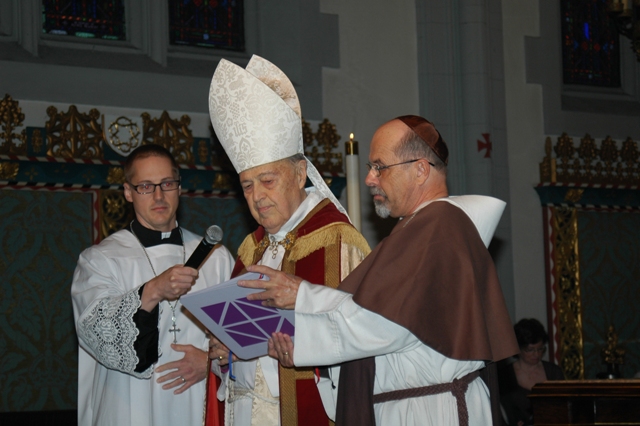
7. Miter - Anglo-Catholics have always regarded bishops as of the very essence of the Church, even when these same bishops have opposed Anglo-Catholic worship and devotions.  Bishops ensure the continuation of the sacraments of the New Covenant, and as the successors to the apostles, they preserve Church order, teaching, and authority from one generation to another.
8. Melisma - This is just a fancy word to indicate that a composer has set a long series of notes to a single syllable of a word in a musical work.  The Anglo-Catholic musical tradition, through luminaries such as John Mason Neale, has been characterized by lush and extravagant music, including hymnody, Gregorian chant, and classical settings of the mass, among other forms.  A rich musical setting is an appropriate accompaniment to the mass, which lifts us humans into the heavenly places where we participate with the angels and archangels in the worship of God.
9. Monasteries - One of the magnificent achievements of Anglo-Catholicism has been the restoration of religious and monastic communities to Anglicanism, which has deepened Anglican spirituality and service in response to the needs of the world.

10. Mission - Stereotypes of Anglo-Catholicism often omit the great commitment of the movement to service among the poor and the spreading of the Gospel into new places.  Anglo-Catholic priests were known far and wide for their ministry among the poor in the urban slums of the industrial cities of Britain and America.  Anglo-Catholic bishops, moreover, were responsible for much of the evangelism that occurred as the nation expanded westward.  It is for this reason that the Midwestern United States has been known as the Biretta Belt.

Ending this reflection on mission is an intentional reminder that everything we do in the Church calls us into mission in the world.  I would argue that a faithful living out of Catholic identity requires an embodied commitment to not just worship and prayer, but also to movements of peace and justice in compassion and solidarity with the oppressed, the poor, and the marginalized.  That, too, is a mark of true catholicity.