Showing posts with label catholicity. Show all posts

Wednesday, November 4, 2015

All Souls' Day: A Storehouse of Consolation

A Sermon for All Souls' Day.  A link to the audio recording can be found here.

In the name of the Father, and of the Son, and of the Holy Spirit. Amen.

A young man sat across from me last Tuesday on the Red Line train during the evening rush hour. We’ll call him Phil.  Phil was in his mid- to late-20s, with a shaggy ginger beard and huge headphones over his ears. He looked up at me every now and then, and after several stops, finally leaned forward and ventured tentatively:

“You’re a priest, right?”

“I am,” I stated pithily, smiling.

“So, do I call you, Father or Pastor, or what?”

“Those are fine. Or you can just call me Ethan.”

“OK. Can I ask you a question?”

“Sure. Go ahead.”

“I’m not a Catholic or anything, Father, but …”

“Neither am I, actually. I am a priest in the Episcopal Church,” I hastened to clarify.  (I decided not to muddy the waters by explaining Anglo-Catholicism. I knew what he meant.)  Phil’s face brightened with a look of recognition.

“The Episcopal Church. OK, so you don’t have confession, then?”

“Actually, we do,” I said encouragingly.  “But we often call it reconciliation.”

“Hmm. Really?  Well, do you think that the sins and bad stuff we do can affect our physical health? ‘Cause I’ve been feeling kind of sick, lately,” Phil confided. “I’m wondering if there’s a spiritual cause for it?”

“Absolutely,” I agreed.  “I firmly believe that the things that weigh on our consciences can affect our whole selves, emotionally, spiritually, and physically.” Phil seemed genuinely engaged, so I continued. “They damage our souls, and they can turn toxic and work on us over the long haul, if we don’t process them through therapy or sacramental confession.  In fact, I do both, and I highly recommend them.  They can make a huge difference.” Phil’s face, which had been intensely serious, relaxed into a smile.

“OK, thanks,” he said reflectively, as we shook hands and I got off the train.

To those who say that sin is an outmoded, medieval concept, my brief conversation with Phil would suggest, on the contrary, the world is still in desperate need of God’s mercy.  And that’s because sin is real, however much our society might deny its existence.  Sin is a difficult sell these days, because we would prefer to focus on God’s estimation of the created order, including us, as very good, as the book of Genesis records.  But the recognition of human sinfulness does not invalidate God’s original blessing.  Rather, it acknowledges our complexity: that the human experience is fraught with moral failings that we cannot resolve by ourselves.  We may be inherently good, but we are not sufficient unto ourselves.  We need God.

It may be hard for us to discern this hopeful message in the Requiem’s severe language. Contemporary sensibilities are not attuned to the Requiem’s central theme of the wrath and vengeance of divine judgment.  But to really appreciate the extravagant gift of God’s mercy and deliverance from sin, we need to engage equally extravagant language around human brokenness.  If the human condition were expressed in lukewarm terms, then God’s remedy would seem far less dramatic, far less redemptive.  What is deeply beautiful about the Requiem liturgy is the notion that however far we may fall, however much we might deserve divine retribution, God, out of his endless love for us, offers us abundant mercy.  And this is where the liturgy ends up, with the balm of divine absolution.

This evening’s readings are aligned to this hopeful outlook.  They are meant to provide reassurance in the face of fear and despair, doubt and failure.  The Dies irae expresses the intensity of human terror in the face of death and final judgment, and, yet in the Recordare there is a note of humility and tenderness that acknowledges God’s promise of redemption through Jesus’s once-for-all sacrifice on the Cross.  “Remember, kind Jesus, / my salvation caused your suffering; / do not forsake me on that day. / Faint and weary you have sought me, / redeemed me, suffering on the cross; / may such great effort not be in vain.”

A wise priest said to me one day, while instructing me how to hear confessions, “Remember that we come to confession, not for condemnation, but for forgiveness.”  In the face of deserved judgment, God offers forgiveness to those who seek it out in a spirit of sincere repentance.  It is a pity that so few people nowadays avail themselves of the sacrament of confession, because I think it would provide a baseline for understanding how the Requiem amplifies on a cosmic scale the assurance of God’s mercy the priest offers the penitent in life.  In death, too, we are assured of mercy.  We may be broken, but God intervenes to make us whole.  And we are insufficient unto ourselves, not only because we must rely on God, but also because we must rely on each other.  That is what it means to be the Body of Christ and to participate in the great cloud of witness we call the Communion of Saints, which we celebrated yesterday.

The Communion of Saints, however, is often practiced as a one-way street, rather than the mutual relationship of intercession and encouragement that it is.  Yesterday, as we recited or sung the Litany of the Saints, we asked the holy ones who have gone before us for their intercession as we face the strife of our lives here on earth.  Yet, the saints are not just charged with the ministry of conveying our repentance to God, and pleading on our behalf.  They are also sinners with their own brokenness and pain, seeking wholeness and ultimate union with God, for whom we pray.  One theological tradition of the Church has argued that whatever brokenness we have acquired through sin during our lives on earth, we must face it after death in a reality that precedes Heaven.  I have imagined this myself not so much as working off our sins, but God granting us the space to repair the damage to our souls through healing, and learning, and new spiritual insight, so that we may achieve a more intimate union with Him.  In the end, who knows?  What is fairly certain is that we each meet our Maker with a certain amount of woundedness.  So, the living in turn pray for the departed on All Souls’ Day, asking God to show them mercy and heal their brokenness.  The Communion of Saints is about solidarity in the midst of shared sinfulness and vulnerability and hope.

John Mason Neale
The great luminary of the Oxford Movement, John Mason Neale, offered the following guidance in his sermon on All Souls’ Day 1856 to the sisters of the Society of Saint Margaret, of whom he was the founder and first chaplain.  He said,
“But for the great multitude of those who have been redeemed to God … they without us shall not be made perfect.  And it is they, the true Servants of God, but not his Saints, whom we keep in memory to-day.  And what then?  Between them and us is there no fellowship?  Is there such a great gulf fixed, that no prayers, no power or grace of the Church can overleap it?  God forbid!  This it is to hold the Catholic faith; this it is to derive the untold comforts of her storehouse of consolation.  Think now each of you, of the dear ones whom you have lost, and believe this earnestly: that, if they have slept in the Lord, your prayers still avail for them, as much as (or more than) if they were still present in the flesh.  Let it be so, that we cannot tell what their needs are; that we know not what especial increase of grace they lack; in what particular way they desire to be helped.”
The saints, whom Neale calls simply servants, to remind us of our kinship with them, are bonded to us in common care and prayer across the ages. We share in the untold comforts of the Church’s storehouse of consolation in prayer, the sacraments, and our relationships with each other, the living and the departed.
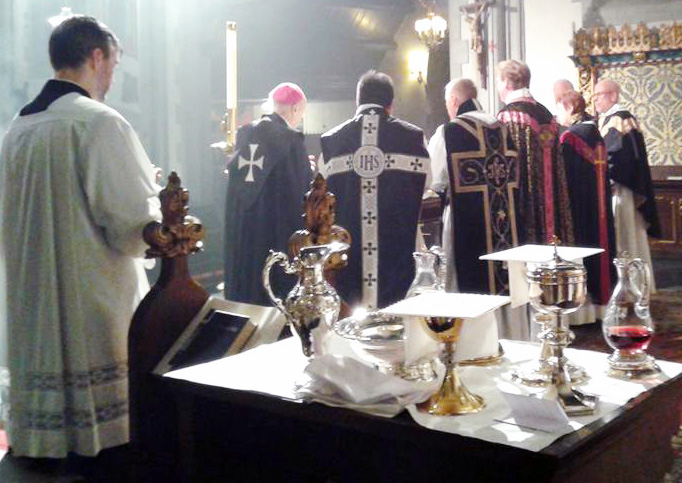
In fact, the prayers of the living and the dead for each other across the ages drives the Church’s core identity as one, holy, catholic and apostolic.  From the apostles, martyrs and confessors of the primitive Church down to Phil, and you and me in this day, we are united in God’s promise of mercy and new life.  “Very truly, I tell you,” Jesus proclaims in the Gospel of John, “anyone who hears my word and believes him who sent me has eternal life, and does not come under judgment, but has passed from death to life.”  The Eucharist that we are about to celebrate is our regular affirmation of this promise of eternal life, when human brokenness is redeemed, ours and the servants who have gone before us.  Bread broken that, in the fullness of God’s time, we might be whole.

Rest eternal grant unto them, O Lord.  And let light perpetual shine upon them.
May they rest in peace.  Amen.

In the name of the Father, and of the Son, and of the Holy Spirit. Amen.

Monday, September 21, 2015

#TractSwarm Four: The Heart of Anglican Catholicity

Justin Welby, 105th Abp of Canterbury
The Archbishop of Canterbury announced a proposal last week to deal with the schism within Anglicanism by dismantling the Anglican Communion and replacing it with a looser network of provinces connected to the See of Canterbury. The big change would be that, while these provinces would remain in communion with Canterbury, they would not necessarily remain in communion with each other. I considered this distressing news in light of the most recent Society of Catholic Priests TractSwarm on the heart of catholicity for the 21st century Anglican. To what extent can Anglicanism claim catholicity when it proposes to pursue schism for short-term relief, rather than to hold out for long-term unity?

It is probably clear from the way I framed this question that I do not think this is a wise approach to our current difficulties. But it's not because I disagree with the Lord Archbishop of Canterbury about the impossibility of bringing progressives and conservatives to consensus on human sexuality, the consecration of women bishops, or other controversial issues. It's not because I have a solution he and his predecessors haven't yet thought of. And it's not because I don't think folks just haven't tried hard enough. There is a deeper reason. It is because the decision we make now has repercussions for generations that come after us. We cannot simply make decisions for ourselves, but must take the long view of the implications of walking away from each other. Diplomacy and patience over time--perhaps even several lifetimes--is the only answer.

Michael Cerularius
Imagine if the rigid and hotheaded Papal Legate, Humbert of Silva Candida, and the Patriarch of Constantinople, Michael Cerularius, hadn't succumbed to anger and namecalling and anathematized each other in 1054. Might the Great Schism have happened anyway? Perhaps. But perhaps if everyone had known how irreversible and devastating this exchange of tempers would be for all of Christendom, they would have taken one more deep breath, gone away to cool off, or just agreed to disagree for the time being. Or maybe the Pope would have sent a more irenic and levelheaded representative than Humbert to Constantinople to speak on his behalf. Once the one, holy, catholic and apostolic church was shattered, like Humpty Dumpty, there was no putting the pieces back together again.

Later in the week, after the Welby proposal had aired, I was re-reading a passage in William Sydnor's  The Prayer Book Through the Ages, about the first General Convention of the Episcopal Church in 1789, where there were serious divisions over the draft of the first American Book of Common Prayer and the consecration of Samuel Seabury. Sydnor observes, 

In that company the tensions were great. In addition, those in positions of power were difficult to deal with, and some of them could not get along with certain others. The possibility that this band of apparent irreconcilables might reach any consensus looked dim. But the seemingly impossible was brought about by the patience and statesmanship of those in key positions, principally William White and William Smith. Moreover, it was accomplished without breaking off communion with the Church of England (Sydnor, 61, emphasis mine).

Bishop William White
There are consequences of both giving in to impatience and frustration and of practicing patience and diplomacy. It is heartening to remember how the efforts of the Episcopal Church's first Presiding Bishop, William White--not to mention many others--enabled the American Church to be born and to remain in communion with the See of Canterbury. The heart of Anglican Catholicism for me, then, is the recognition that we need each other when we don't agree with each other, or even when we dislike each other. But instead of slapping a bull of excommunication on the high altar of Hagia Sophia like Humbert, we should accept the fact that unity is out of reach for the present, and yet not walk away. We should realize that unity is not an entitlement, something that should come easily, but something that is hard-won after generations of labor and faithfulness.

In the early Church, schism was one of the worst sins a Christian could commit, and it's not hard to see why, the effects are devastating to the Body of Christ. In the polemics and politics of the Anglican Communion, we should set aside our expectations of immediate gratification and take the long view, the one that Jesus offered us in the Sermon on the Mount: "Blessed are you when people revile you and persecute you and utter all kinds of evil against you falsely on my account. Rejoice and be glad, for your reward is great in heaven, for in the same way they persecuted the prophets who were before you." Our time is not God's time. We cannot predict when the unity of the Church will become apparent and we will be able to enjoy the fruits of that unity.

Abundant Blessings,
Fr. Ethan+