Showing posts with label vocation. Show all posts

Thursday, January 25, 2018

A Full Week and a Full Life

This past Sunday, I had a very enjoyable conversation with a two of the teen girls in the parish and their mother. We were sitting around one of the tables in the Anderson Room after Mass, eating snacks, and one of girls suddenly perked up and said puzzled, "so, this is your only job? What do you do all week?" I used to be a bi-vocational priest, so I'm used to the notion of having to juggle more than one career, but the question took my by surprise. It was a good reminder that most people don't know that the bulk of a parish priest's work is invisible and unglamorous, and takes place on the other six days of the week. So, I explained to her that a usual week contains some fundamental tasks: preparing the Sunday bulletin, composing the weekly email newsletter, updating the parish website and social media, cleaning and organizing the building, taking care of administrative work in the office, preparing my homily, visiting parishioners in their homes and the hospital when they're sick, coordinating business with the musicians and vestry members, attending diocesan meetings and trainings, and much more. And then there are things that vary. Last week, I cleaned out filing cabinets and polished brass. This week, I created a new manual for the altar guild with a comprehensive task list and lots of cool pictures. Even though my desk is tidy on Sundays, during the week, it goes through various stages of messiness.
Every week is a full week, and a full life. A very satisfying life. So, I am incredibly grateful that donors in the Diocese of Chicago and our bishop, Jeff Lee, have provided funding that will allow me to move from 3/4 time to full time for the next two years. This will permit me to devote myself fully to the joy of growing this church, with its many weekly tasks, both glamorous and mundane. I feel blessed to be supported by you and by our diocese to fulfill the potential that God has instilled in us.

Abundant blessings,
Fr. Ethan+

Wednesday, April 13, 2016

Twelve Years

The readings during Eastertide have showcased the disciples' difficulty in recognizing the Risen Lord. Mary Magdalene mistakes him for the gardener when he appears to her in the empty tomb. Thomas is highly skeptical until he puts his hand in the wounds in Jesus' hands and side. The disciples don't recognize Jesus on the beach until they cast their nets and lug them out of the water heavy with fish--153 of them, to be exact. What is extraordinary about these stories is that the experience of new life is greeted initially with uncertainty, and even suspicion. Instead of shouting the good news from the rooftops, everyone is a little tentative. Haziness and confusion surround the truth of Jesus' resurrection. No one seems to see what's right in front of their eyes. Saul of Tarsus, as a matter of fact, emerges from his encounter with Jesus on the road to Damascus blind as a bat, completely helpless and vulnerable. 

Last Sunday, as I stood at the altar celebrating Mass, I was also celebrating the 12th anniversary of my baptism, recalling my own experience of profound vulnerability in the chilling water of the font. Like Saul, I had assumed a new identity. I hadn't, of course, been in the middle of a murderous rampage when the call to follow Jesus came, but it was no less transformative for me. It was a pivotal step in a lifelong struggle to know God that has always been characterized by failures, mistakes, and cluelessness, as well as grace. For twenty years, I walked away from God out of hurt and anger, and I languished in my perception of his absence. Maybe it's good to have time to cool off, so that when God calls again, we are receptive to the divine urging. That's what happened to me. Fr. Steve Martz asked me one Sunday, "are you not receiving communion because you're not baptized?" I responded, "yes," "Well, would you like to be?" he continued. "Yes," I said without skipping a beat, shocking myself. "Now, where did that come from?" I puzzled. I had been sought; and I had been claimed. I knew that God was speaking to me the first time I heard in the hymn that "Jesus sought me when a stranger wandering from the fold of God; he to rescue me from danger interposed his precious blood." 

And I was rescued. Twelve years ago I wouldn't have thought it possible that I would spend my time the way I do. My baptism ultimately led to a new life that has given me so many moments of joy and fulfillment. In the past few days, I have celebrated the Eucharist in my parish and in the chapel of our cathedral, offered counsel to people struggling with homelessness and spiritual barrenness, enjoyed the preaching voices of some really insightful parishioners, and shared coffee with friends learning about their vocations. I have also continued to learn about myself, about my own tentativeness and blindness, about the ways I fail to see both the crucified and risen Jesus around me. I think we spend our whole lives trying to know Jesus better. It begins in baptism, in promising to "continue in the apostles' teaching and fellowship, in the breaking of bread, and in the prayers." And in repentance, proclaiming the Good News of God in Christ, serving Christ in all persons, and respecting the dignity of every human being. It is in doing these things that we like Peter attempt to convince Jesus, "you know, Lord, that I love you." It is a daunting and overwhelming call, but I am thankful for the 12 years that I have been saddled with it. Thank you, Lord, for the grace of a new life, and thanks to the many people that have helped me shoulder the burden along the way. I am truly grateful. I pray that you will be there for me for another 12 years, as I will try to be there for you.

Easter joy and blessings,
Fr. Ethan+

Monday, August 10, 2015

Queen of Miscellany

When I was first discerning my call to the priesthood, the Diocese arranged for me to meet with three seasoned clergy to learn about the working life of a parish priest. One of these priests was the Rev. Suzi Holding, Rector of the Church of Our Savior in suburban Elmhurst, Illinois. We sat in her office, and she told me a lot about her journey to ordination, her hard-fought success in moving the flags out of the chancel, and the rhythm of her week, with its regular tasks and impromptu demands. The image from the conversation that has stuck with me, though, was that of a doll. If I remember the story correctly, Suzi had received the doll as an ordination gift from a clergy colleague, and was duly named the "Queen of Miscellany," for that is what the life of a priest is like, her friend said.  Suzi, if you're reading this, feel free to correct and elaborate the story.

Volunteers setting up for the community breakfast.
In the three years that I've been ordained, I've found that Suzi's doll is an excellent metaphor for priestly ministry, and no more so than this last week. I've heard many times the joke that it must be nice to have to work only one day a week. So, what does a priest do the rest of the week? Well, in the first eight days as Interim Rector of Grace Place Episcopal Church of Chicago, much of the work has fallen under the miscellany category: administrative and staffing issues; meeting with the parish administrator, music director, and accountant; pastoral care visits with homeless residents; and introducing myself to the building's tenants. In the evenings, meeting with the church wardens and with a young couple to help them plan their upcoming wedding. On Saturday morning, unexpectedly staffing the dessert table at the weekly community breakfast hosted by a Methodist church. And just today, I had a delightful lunch with the head or our liturgy committee, proofed this week's Sunday bulletin, made an appointment to administer last rites, and of course, wrote my weekly blog. It is wonderful to see the building almost always full and busy; and I am grateful for every one of these interruptions or surprises, as well as for the things I had planned to do.

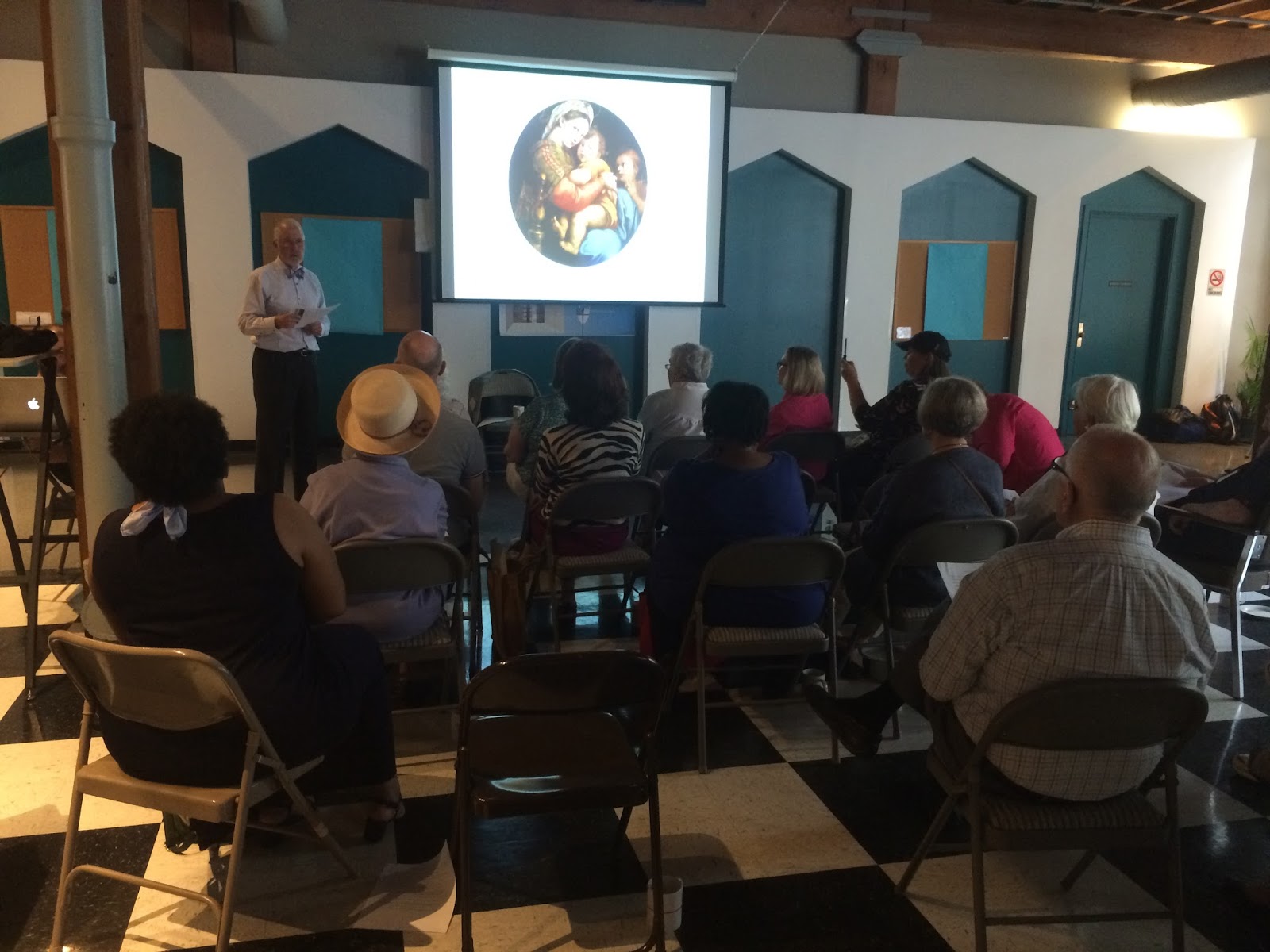
Sunday forum at Grace on Caravaggio's "Supper at Emmaus."
This will come as no surprise to many of my clergy colleagues, for whom this miscellany is the bread and butter of their week. Sermon preparation and presiding at worship are, of course, key responsibilities of the priest, but they often comprise a small part of the job. The nuts-and-bolts of keeping a building running when the boiler breaks (which happened before the first service on Sunday) or printing worship bulletins is just as important to me as being out in front breaking the bread. Sharing lunch or a cup of coffee on a Tuesday is just as important to me as sharing the chalice on Sunday. In fact, I have lunch and coffee appointments every day this week, just to get to know people in a way that I can't on Sunday morning. So, to everyone who's asked what I do all day in this new job, it's a very mixed bag of prayer and process, administration and conversation.  And to the people of Grace, thank you for making time for me to learn about your hopes for the future of the parish and for sharing what's important to you. I hope more of you will do the same.  At the heart of all of this work is a love for God's people and gratitude for all the miscellany and interruptions that come my way. So, keep them coming.

Abundant blessings,
Fr. Ethan+


Wednesday, July 6, 2011

Apprentice priests: abide in the essentials

I just arrived home this evening after attending a beautiful service at St. James Cathedral, Chicago to receive a Roman Catholic priest into the clergy of the Episcopal Church, what might in Roman parlance be called "incardination." As I approach my own ordination and first call as a priest, I think about how I have been prepared for the priesthood and the many gaps in my formation that will affect how well I practice my vocation.

Many may not know that I have spent the last four years as a member of our diocesan Congregational Development Commission, which has been an incredible formation experience, schooling me in a wide range of models for congregational growth and vitality. It has also brought me into contact with congregations and clergy that have struggled to survive under some very trying circumstances, many not of their own making. Although we in the Episcopal Church continually stress the ministry of all the baptized, I have witnessed congregations rise and fall on the strengths and weaknesses of the priests that lead them. That is a terribly unsettling thought: that a congregation's future depends so much on my abilities, my gifts, my pathologies. To have that kind of responsibility is unnerving, to say the least.

Lack of financial and administrative skills in a priest can bring a parish to the brink of disaster, but I have also met priests, who are excellent bureaucrats that lack pastoral sensitivity and spiritual depth. Unfortunately, seminaries don't teach us everything we need to know. They can teach us Greek and biblical exegesis, Church history and liturgy, and yet nearly every day I encounter some skill set or ability that I know would make me a better priest: Web development skills, training in accounting and marketing, community organizing, Jungian analysis, new spiritual disciplines and devotions, and the list goes on and on. The range is mind-boggling. So, how is a new priest to wrangle with this unending litany of demands?

In some ways, seminary education has missed the mark. "Why is it," I would often muse, "that seminary doesn't teach me what I want to know?" Recently I have been thinking that the old apprenticeship model of priestly formation has a lot to recommend it. As Seminarian-in-Residence at the Church of the Atonement in Chicago, I have been blessed to be surrounded by about a dozen priests, many of whom are retired, who have offered me insights on saying mass or transferring a feast or hearing confession or doing a funeral that I would never have learned in seminary even if I had thought to ask. And there was a time, moreover, when a priest's first curacy was designed to give him--at that time, it was always a him--indispensable on-the-job training to fill in the gaps left by the seminary. Comments from fellow seminarians have helped me to appreciate that few people nowadays receive this good old-fashioned apprenticeship. Last Sunday in the sacristy, a seasoned priest, Fr. Dunkerley, said to me with great passion that he was so glad that I would learn to celebrate the old Tridentine Mass in my first curacy, because it had shaped his entire spirituality and priesthood forever. Needless to say, I was surprised and awed by this statement.

And I was deeply grateful. How wonderful it is to sense one's own inadequacy for the challenges of the priesthood in this day and age and then be surrounded by mentoring priests who are willing to support the apprentice with their collective wisdom and experience. I realized that as much as the world calls us to develop new skills and stretch ourselves, we must be grounded in something solid. As usual, I had been making things too complicated, and my mentors guided me back to what was important: saying the Daily Office, going to Confession, attending early morning masses, proclaiming the Word of God, theological study, and listening empathetically to peoples' stories of joy and anguish. These are among the anchors of our faith.

One particularly powerful moment of my apprenticeship emerged on a cold January day at Seabury-Western Theological Seminary. After listening to one of my rather fervid rants about some theological fine point that was distressing me, my Anglican theology professor, Fr. McMichael, looked at me bemused and said simply, "Ethan, abide in the essentials." I was stunned by the pure simplicity of it, and yet it made sense and brought me so much comfort. I heaved a great sigh of relief. Stressing myself out by doing too much and never getting caught up with everything on my to-do list had caused me to lose sight of what was really important. Faithfulness, not perfection, as a priest. "Ethan, abide in the essentials," he said. Here endeth the Lesson.