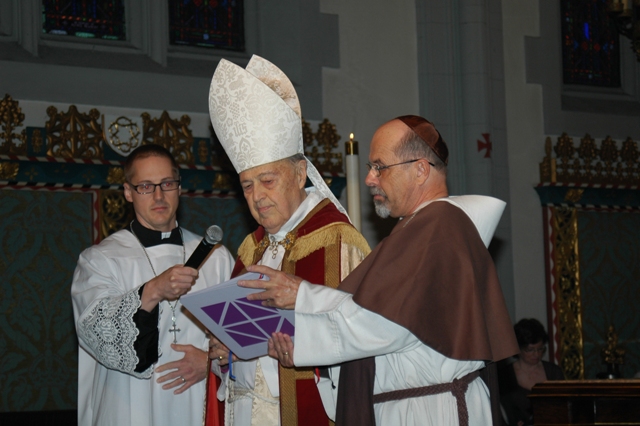
Wednesday, November 2, 2011

Patrons and Companions: An All Saints' Sermon for Seminarians

St. Nicholas was the church that I attended when I first came to Christianity in 2004, and it attracted a lot of wounded people.  We seemed to be a beacon for people dying of cancer, recovering alcoholics, gays and lesbians, and especially, disaffected Roman Catholics, who made up the majority of the congregation.  In many ways, our spirituality was very traditional and very Catholic for an Episcopal Church, including a shrine to the Blessed Virgin Mary and veneration of the saints.  This latter devotion was so profound that the walls of the church were filled, absolutely crammed, with icons of the holy ones who had gone before us.  Among them were familiar faces: the 4 evangelists, the 12 apostles, Mary Magdalene, Benedict, Francis, and Dominic.  But they also depicted more contemporary luminaries, such as Harvey Milk, Dorothy Day, Martin Luther King, and Mahatma Gandhi.  Over the course of my years at St. Nick, we gradually developed a vision of saintliness that took on a less rarified quality and assumed dimensions that were far earthier.
 
Yet the Feast of All Saints, which occurs today (November 1st), still invokes for many people images of distant, mystical figures etched in stained glass that walked stoically toward gruesome martyrdom, or practiced extreme asceticism, or founded monasteries.  Some saints undoubtedly did these things, but this traditional characterization is a bit of a stereotype, and I would like to suggest a more expansive understanding of what makes a person saintly, and hence, worthy of veneration and emulation by future generations of the faithful.  It was this understanding that led us on one All Saints' Day to intersperse pictures of every member of the congregation among the icons of the saints to indicate the fellowship of ordinary people in the work of making the world holy.  Now, I realize that most of you belong to denominations that do not have a history of intensive devotion to the saints.  So, in my reflections this morning, I would like to do three things: first of all, to explain a little bit about the history of this feast, then unpack some of the key themes in the Scripture readings appointed for this day, and finally conclude with some thoughts about the role I think the saints can play in shaping our understanding of our vocation as seminarians, and ultimately, as ministers of the Church, whether as ordained or lay leaders. 

The Pantheon, Rome
A feast to commemorate all the saints began in the eastern Church in the 4th century, and was originally restricted to martyrs, to those who had suffered death for the sake of the faith.  In the first few centuries, the date for the feast moved around considerably and varied by geography.  The Feast of All Martyrs initially occurred on the first Sunday after Pentecost in the Western Church and Greece; but in Syria, it was held on the Friday after Easter.  In the 7th century, Pope Boniface IV moved it again when he transformed the pagan temple of the Pantheon in Rome into a church, and according to a contemporary account, filled it with relics of the martyrs that supposedly filled 28 wagons.  Since the dedication of the building as a church occurred on May 13, 610, that day was fixed for its perpetual observance.  It is suggested, however, that the difficulty of obtaining food in the spring for the floods of pilgrims who descended en masse into the city for the feast caused Pope Gregory IV to transfer the feast once again to its current date of November 1st, when the fall harvest would have made food more plentiful in the city.  It was only at this point in the 9th century that the pope extended the observance to all of the saints.  Now, I offer you this brief historical note not just to provide you with some background information, but also to underscore the widespread and enduring popularity of the feast with the Christian faithful over the centuries and down to our own day.  There is something in this commemoration that resonates strongly with the understanding of Christian vocation as an endeavor that is done in community, and in communion with generations past, present, and future. 

It is a powerful idea, and it is the vision presented to us in our reading from the Revelation of John, which declares that “there was a great multitude that no one could count, from every nation, from all tribes and peoples and languages.”  These great crowds of people are assembled with all the company of heaven to offer God praise and worship.  We are told that they are accorded this place of honor in heaven, because “these are they who have come out of the great ordeal; they have washed their robes and made them white in the blood of the Lamb.”  This description clearly articulates two key features of the early years of the Christian community, the eschatological expectation of Jesus’s imminent return, and the omnipresent threat of persecution and martyrdom for the faith.  The Jesus these saints encounter in the image of the Lamb is one who responds with love and compassion to their suffering and sacrifice, relieving them from hunger, thirst, scorching heat, and offering them comfort.  In this beatific vision, Revelation assures us that “God will wipe away every tear from their eyes.”

The second reading from the First Letter of John expresses hope for this beatific vision, which has yet to be revealed.  In this moment of revelation, the faithful will see God as God actually is in heaven, but in the meantime, the saints must remain patient and steadfast in the faith in the midst of this waiting, this expectation, of Christ’s imminent arrival in the parousia.  The author of the epistle affirms that “all who have this hope in him purify themselves, just as he is pure.”  This leaves us with the question of what such purification looks like or entails.  Is it self-mortification by scourging, or fasting, or penance, or some other penitential discipline? 

A preliminary answer to this question may be found in the Beatitudes in Matthew, which is the Gospel reading appointed for today.  To experience purification then is to be poor in spirit, to mourn, to be meek, to hunger and thirst for righteousness, to be merciful, to be pure in heart, to make peace, to be persecuted for righteousness sake, and to suffer persecution on Jesus’s account.  In other words, to be pure as Jesus is pure is, first, to embody the justice and mercy that I would argue are part of the essence of God, and second, to be willing to risk and endure the worldly consequences of this way of living.  Faithfulness to godliness, to holiness, to the beatific vision of revelation is to suffer persecution in the here-and-now.  It might smack some of you as cold comfort for the evangelist to end the Beatitudes with the words, “Rejoice and be glad, for your reward is great in heaven,” with the prospect of so much human suffering before us.  I imagine it may have appeared so to many of the first saints when they heard it, as well.  And we as Chicago Theological Seminary students, have become hyper-aware of the ways the promise of bliss in the afterlife can be a dodge, a cop out, for ending human suffering and oppression here on earth.  So, what are we to do?

St. Mother Théodore Guérin
A couple of days ago I ran across an article by James Martin in the most recent issue of the Catholic weekly, America, which examines the pitfalls of the two ways Roman Catholics have traditionally understood their relationship to the saints.  The saint as patron often suffers from a moral idealization that fails to honor the ways in which the holy man or woman displayed gritty human foibles, defied and ran afoul of the institutional church, and messed things up as all humans generally do.  The saint as companion, on the other hand, suffers from the opposite tendency, to focus so narrowly on the earthly life of the holy person that his or her saintly qualities become obscured.  The trick, Martin says, is to steer a course between these two extremes.  “A healthier (and more accurate) model,” he says, “is to see the saint as both patron and companion: the manifestly human being whose earthly life shows that being a saint means being who you are, but who now enjoys life in heaven and intercedes for us.”  Martin then gives us a couple of very colorful examples of women saints who resisted these extremes.  St. Mother Theodore Guérin, the most recent American saint, fought incessantly with her bishop, who attempted to have her ejected as the superior of the religious community she founded, because he did not like the fact that a woman was successfully building convents all over his diocese.   The nuns were so defiant in supporting Mother Guérin that the bishop, in an act of desperation, actually locked her in his house, until the Vatican stepped in and had him replaced.  On the other end of the spectrum is St. Bernadette Soubirous, the saint who first received visions from Our Lady in Lourdes.  It may sound wacky in this day and age to believe in miraculous visions and healings effected by the prayers of saints, but then again, numerous are the accounts of healings for which scientific and medical professionals can give no other explanation.  Besides if we believe that Jesus raised Lazarus from the dead, and we ask our family and friends to pray for us here on earth, why not St. Bernadette, or Grandma in heaven?  God is God after all, and having created the entire universe, why could God not receive the prayers of a saint on behalf of a person with cancer?

Jesus preaches the Beatitudes in
the Sermon on the Mount

So, with these two paradigms of sainthood before us, how are we as seminarians to purify ourselves as Christ is pure, and yet still honor our full humanity?  I would suggest, for a start, that we make our peace with the notion that our lives may be beset by more suffering and sacrifice than other people.  If we are called to be ministers of the Church, we are called to work with the saints to bring the beatific vision of John’s Revelation into being here on earth by pursuing the justice and mercy that Jesus commends to us in the Beatitudes.  Such a prophetic commitment will require that we risk more than many of those outside the Church, and that we accept the repercussions of defying worldly powers and vanities that seek to keep the status quo firmly in place.  A second step might be to model Martin’s middle course of being who we are and interceding for others through the prayers of our lips, our hands, and our feet.  We must not be merely icons on the walls, but icons in the world.  Yet if we are to be icons in the world, there must be something conspicuously holy, and at times even counter-cultural, about how we live our lives, while still holding on to the earthy ordinariness of our common experience as human beings.  Being both a patron and a companion is the way we purify ourselves to resemble the purity of Jesus, in whom divinity and humanity were fully united and expressed.  This is what the saints, as the Church has traditionally understood them, have sought to model for the rest of us that we might emulate in our own bodies and contexts their struggles to resemble Jesus. 

In one of his own sermons for this day, the Venerable Bede said, “Only in this short and scanty life is there wrestling and working, but the crown and the prize endureth for a life which is eternal.  The work is soon over, but the wage is paid forever.”  But this is hard work, for which we need the prayers of this great cloud of witness, to sustain and assist us in this transformation within ourselves and within the world.  So, I would like to conclude by inviting you to join me in the prayer appointed for the Feast of All Saints:

Almighty God, you have knit together your elect in one communion and fellowship in the mystical body of your Son Jesus Christ our Lord: Give us grace so to follow your blessed saints in all virtuous and godly living, that we may come to those ineffable joys that you have prepared for those who truly love you; through Jesus Christ our Lord, who with you and the Holy Spirit lives and reigns, one God, in glory everlasting. Amen. 


Tuesday, October 4, 2011

10 M-arks of Anglo-Catholicism

Last week, I spent four days at the Society of Catholic Priests' annual meeting in Detroit, during which we explored the future of Anglo-Catholicism in the Episcopal Church and the Anglican Church of Canada.  We attended educational workshops, prayed the daily office together, celebrated mass, and engaged in joyful fellowship and collegiality.  But mostly we shared with each other what it meant for us to be Anglo-Catholics, and from these conversations, it became clear that Anglo-Catholicism is a diverse movement that embraces a wide range of local contexts, cultures, and concerns.  I was delighted by this rich variety, as well as by the markers of our faith that we held in common.

At one point during a discussion, a seasoned priest playfully invoked a well-known list of attributes of Anglo-Catholicism, all of them beginning with the letter 'M'.  My friends and I then had a good deal of fun brainstorming to expand the list and reflect seriously on what it means to be an Anglo-Catholic, both historically and in the twenty-first century.  The following 10 markers is hardly a definitive or rigid description of Anglo-Catholic identity, but it's a starting point, and I encourage others to add to it. I should also offer the caveat that some of these may not be limited to Anglo-Catholic piety and practice, but may indeed apply to other congregations and sensibilities.

1. Matins- The Daily (or Divine) Office provides the anchoring rhythm of the Anglo-Catholic prayer life, whether it is practiced according to the Book of Common Prayer, the Anglican Breviary, the Roman Catholic Liturgy of the Hours, or another devotional book.  Morning Prayer was formerly known among Anglican Catholics as Matins, which is the earliest morning office in communities that still practice the old monastic offices.  I myself adhere to the daily offices of the Anglican Breviary, saying Lauds, Sext, Vespers, and Compline, supplemented by the Angelus and the Rosary.
2. Mary - The devotion to Our Lady recognizes the pivotal and unique role the mother of Jesus played in God's plan of salvation for humanity.  The Angelus and the Rosary are a concrete recognition of the primacy of the Mother of God among the saints who intercede for us with the Father, our Creator.
3. Mass - The mass is the central act of worship in which we continually plead the sacrifice of Christ, who offered himself as both priest and victim, on our behalf to the Father.  In the mass, we also offer a sacrifice of praise and thanksgiving for our redemption, that renewed through the Body and Blood of Christ, we are sent bearing God's healing and love into a broken world.
4. Monstrance - Eucharistic adoration, particularly Benediction of the Blessed Sacrament, has long been associated with Anglo-Catholic devotion as a recognition that Jesus is truly present to us in the Sacrament of the altar.  It is a response of gratitude to the extravagant generosity and selflessness of Jesus.
5. Maniple - Lest we forget, the Oxford Movement that brought about a Catholic revival of Anglicanism in the nineteenth century ultimately restored many of the outward signs of the Catholic sacramental life, including eucharistic vestments, such as the chasuble and maniple, a short strip of cloth worn on the celebrating priest's left forearm.
6. Mea culpa - In an age that expresses discomfort around the concept of sin, stepping into a confessional may seem antiquated.  However, Anglo-Catholic piety embraces the Sacrament of Reconciliation (or Penance) as a way to restore ourselves to right relationship with God and each other.  Repentance requires contrition, confession, penance, and amendment of life, and although there is a general confession and absolution in the mass, there is no substitute for the deep soul-searching and admission of specific sins that happen through auricular or private confession with a priest.  I can say without exaggeration that monthly private confession has fundamentally changed my life.
7. Miter - Anglo-Catholics have always regarded bishops as of the very essence of the Church, even when these same bishops have opposed Anglo-Catholic worship and devotions.  Bishops ensure the continuation of the sacraments of the New Covenant, and as the successors to the apostles, they preserve Church order, teaching, and authority from one generation to another.
8. Melisma - This is just a fancy word to indicate that a composer has set a long series of notes to a single syllable of a word in a musical work.  The Anglo-Catholic musical tradition, through luminaries such as John Mason Neale, has been characterized by lush and extravagant music, including hymnody, Gregorian chant, and classical settings of the mass, among other forms.  A rich musical setting is an appropriate accompaniment to the mass, which lifts us humans into the heavenly places where we participate with the angels and archangels in the worship of God.
9. Monasteries - One of the magnificent achievements of Anglo-Catholicism has been the restoration of religious and monastic communities to Anglicanism, which has deepened Anglican spirituality and service in response to the needs of the world.

10. Mission - Stereotypes of Anglo-Catholicism often omit the great commitment of the movement to service among the poor and the spreading of the Gospel into new places.  Anglo-Catholic priests were known far and wide for their ministry among the poor in the urban slums of the industrial cities of Britain and America.  Anglo-Catholic bishops, moreover, were responsible for much of the evangelism that occurred as the nation expanded westward.  It is for this reason that the Midwestern United States has been known as the Biretta Belt.

Ending this reflection on mission is an intentional reminder that everything we do in the Church calls us into mission in the world.  I would argue that a faithful living out of Catholic identity requires an embodied commitment to not just worship and prayer, but also to movements of peace and justice in compassion and solidarity with the oppressed, the poor, and the marginalized.  That, too, is a mark of true catholicity.

Friday, September 9, 2011

The Public Role of Religion after 9/11

The press this week has been abuzz regarding the role of religion in the public sector, and evangelicals in particular have been perturbed for being left out of some of the events marking the ten-year anniversary of the 9/11 attacks.  New York Mayor, Michael Bloomberg, for example, has been accused of treating the United States as if it were a secular state, and Washington National Cathedral was criticized for having no evangelicals scheduled to speak before the venue was moved to the Washington Hebrew Congregation.  I am not here to contradict or to endorse evangelical claims on this issue, but merely to indicate that this event has underscored Americans' fundamental uncertainty about the role that religion is supposed to play in public life.  During the heyday of American Christianity in the 1950s and 1960s, no one would have contested how religious institutions were supposed to engage in the public sphere.  They were unapologetically front and center.

Evangelicals are certainly correct that the United States has become increasingly secularized, especially when compared to the 1950s.  The current pluralist ethos, moreover, has broken the monopoly that mainline Protestantism had enjoyed for so long, even though evangelical Protestants have worked hard to fill the void and can claim some noteworthy successes in the 1980s and thereafter.  The critical question this leaves us with is:  What do churches have to offer a grieving nation that nobody else can provide? Religion's loss of prominence in the public sphere means that our churches have to earn what was once taken for granted as an entitlement. I must thank Fr. Dave Hedges for pointing me to the photograph at right of a solemn high mass among the urban rubble of World War II.  It poignantly declares the need for the Church to be present as a locus of stability and strength in the midst of chaos and destruction.  The altar in the image stands as a sign of Christ's victory over death, of his affirmation of peace over war.  This is a message that still has resonance within American society, even in its most secularized incarnation.  The flood of people that sought refuge in our churches during the harrowing trauma and carnage of 9/11 proves that religion still functions as it always has in life's most critical moments.  May we envision this anniversary of our national tragedy as an opportunity to do what religion does best, to offer a place of stability and strength where grieving people can encounter the hope and promise of Christ's resurrection.

Thursday, September 1, 2011

Struggling with Traditional Language in Postmodernity

Recently at a seminarians' retreat, a colleague asked me how I could stomach the traditional language of thees and thous in worship and private prayer, what in the Episcopal Church we call Rite I.  She was respectful, but challenging, both from the perspective of Elizabethan English's relevance to contemporary spirituality and to its sometimes outmoded or objectionable theological and anthropological content.  No one talks like that anymore, and surely words like "heathen" and "Gentiles", which she had encountered in the historic Coverdale Psalter, perpetuate an othering that is demeaning and highly offensive.  I saw her point, and even sympathized.  In fact, I come from and currently serve in parishes that use contemporary English for everything, except perhaps for the Lord's Prayer, so that when I began to say my Daily Office using the traditional language of the Anglican Breviary, I had not only to adjust to a plethora of words ending in -eth that still tend to make me tongue-tied, but also to engage content, including exclusively male language for God, that chafed against my inclusive and liberative ethos.

Rabbi Fish and I at my bar mitzvah when I was 13.
So, how do I defend the use of traditional language in this day and age?  Well, first of all, as I said to my seminarian friend, every kind of language has its strengths and its limitations.  It depends on what we privilege.  For example, I grew up in a synagogue that belonged to the Conservative branch of Judaism, in which worship was conducted almost entirely, except for the sermon, in biblical Hebrew, rather than in the English vernacular of the worshippers.  Because my synagogue had a very strong connection to tradition, using the tongue of their ancestors--which is different from modern Hebrew--reinforced the worshippers' sense of rootedness in the eretz Yisrael, the land of Israel, and their spiritual, ethnic, and linguistic kinship with the patriarchs, matriarchs, prophets, and other figures of the Hebrew Bible. So, biblical Hebrew served as a mark of continuity with the identity of their forebears, and among a people that has repeatedly suffered exile, diaspora, pogroms, and refugee status, fostering continuity among generations is a critical religious priority.  Language is only one tool among many in this effort.  But this Hebrew is not the modern language spoken in Israel; it is a purely liturgical language, just as ecclesiastical Latin is within the Roman Catholic Church, among other contemporary examples.  I would contend that Elizabethan English, like these languages, is set aside for a special, distinctive purpose and is distinguished by its function from the everyday language we use for everything else.  It connects us to our earlier Anglican roots, allowing us to affirm continuity with the generations of English-speaking Christians who came before us.

A schema for French registers of language
But even this contention, that we use our vernacular uniformly for everything else, is spurious.  When I was studying French at the University of Caen in France, we Americans were especially targeted for our failure to recognize what the French call niveaux and registres de langue, levels and registers of language, which are strictly enforced in French society and its educational institutions.  Sparing you the exhaustive detail, common French is divided into intellectual, middle, and popular levels, each of which can be adjusted according to the situation, as the figure at the right illustrates, into familiar, very familiar, and vulgar on one side, and polished and very polished on the other. My basic point here is that the kind of vocabulary, sentence structure, and other linguistic patterns we employ vary depending on the context and setting.  Writing, in general, tends to be more formal than speaking.  With our friends, we use a great deal of slang that we would never think of employing at work.  In academic and professional settings, many people use technical jargon specific to their disciplines that would be out of place in ordinary conversation.  Newspapers and journalists limit to varying degrees (think of the difference between People magazine and the New York Times) the educational level of the language they use in order to be accessible to a wide reading public. So, even what we describe as "contemporary English" is not uniform.

Now, of course, all this techno-babble does not provide adequate justification for language that people experience at oppressive or offensive.   It is simply meant to demonstrate that language is extremely diverse and fluid, even among forms we think of as fixed.  When I encounter a word like "heathen", for example, in the Coverdale Psalter, I consciously remind myself of the context (historical period, place, cultural outlook and attitudes, social context, etc.) in which the translation was rendered and look upon it as a dated interpretation that I take into account as I recite the verses.  In some instances, I cut the language some slack and recognize it for what it is: a limitation.  In others, I replace the word with a more palatable translation, such as "peoples" or "nations", which I regard as a more faithful translation within my own historical context.  Since language is adaptable to context, I do not feel bound, particularly in private devotions, to accept everything as is or to let it get in the way.  Above all, I try to remain focused on what a particular language makes possible theologically and spiritually.  Unlike the New Revised Standard Version translation, the Coverdale Psalter may indeed contain some objectionable language, but it is also sublimely poetic and lyrical, evocative of a particular time and place in our history as Anglican Christians, and allows us to affirm a connection to our roots that really reinforces the communion of the saints, the great cloud of witnesses that came before us and join their ongoing prayers with ours in the great liturgy of Heaven.


Tuesday, August 30, 2011

Jesus' Extreme Makeover: An Alter Christus Indeed


This past Sunday, the Guardian newspaper came out with an article entitled, "A very muscular brand of Christianity: Why Jesus has undergone a macho makeover." I thank my friend, Ron Emrich, for passing this item on to me, because as a self-professed gym rat, I have always struggled with the notion of a pure and sanitized Jesus, stripped of every hint of grit, edge, and masculine hardness. So, to imagine Jesus as a buff biker dude with tattooed guns restores a certain authenticity in my mind to the Word made flesh. If Jesus were to appear among us today, he might very well look quite unlike some of the traditional depictions of the Savior that we are used to: the doe-eyed, airbrushed Good Shepherd of our illustrated Bibles, or the icon vested in the magnificent robes of Christ the King or Jesus Christ the Great High Priest. The graphic and unsettling embodiedness of the crucified Jesus is suggested in artist Stephen Sawyer's evocative images, such as the one above. This is not to say that I have any problem with the traditional images of Jesus; in fact, I cherish them, and the walls of my study are adorned with Orthodox icons of Christ Pantokrator, Christ the Great High Priest, and the Madonna and Child.

But above my computer for many years has hung a picture of a man's back tattoo of the Crucifixion. This picture has served as a reminder that the the Christian faith would not be what it is without the raw, enfleshed suffering of the Crucifixion by which humanity was saved from sin and restored to right relationship with God. I was deeply moved when I first saw this picture, for I perceived that to carve an image of this event in one's own flesh is to share in the suffering of Jesus' own passion. It is to proclaim Christ crucified, died, and risen. As one who has endured the intense pain of the tattooing process several times, I can tell you without any hint of melodrama that I have never experienced so poignantly or personally the physical suffering of Christ as when I'm getting inked. In fact, the pain was so blinding during my first tattoo that I spent the two-and-a-half hours in the chair reciting the Sorrowful Mysteries of the Rosary through clenched teeth. Later on, I also discovered a certain resonance between this experience and the Shewings of the medieval mystic, Blessed Julian of Norwich, who described in rather gory detail her sharing of our Lord's physical and spiritual suffering through a series of visions. Julian's accounts seem gratuitously bloody and even pathologically masochistic to modern sensibilities, but there is something in them that truthfully expresses the depth of the connection between Our Lord's passion and human suffering. Suffering and sacrifice is a raw truth of human existence.

To be sure, I did not get ink because I relish suffering, but because I wanted some way to publicly and indelibly declare my commitment to becoming a priest, so I got a Celtic cross on my right arm when the bishop made me a postulant and a dove of the Holy Spirit on my left arm when I entered seminary. As a believer in the sacrificial nature of the priesthood, I never wanted to forget that my vocation was supposed to cost me something, that the priesthood was a difficult life and identity to take upon oneself. As odd as it may sound, the painful process of the inking had something sacramental about it, making the sacrificial commitment truly enfleshed, not just abstract. The pain-memory of the tattooing has followed me as a reminder of my commitment throughout the formation process in seminary, during the search for a call, in the radical reordering of my life. I know that, especially for some of my traditionalist friends, the idea of having a tattooed priest, may lead you out of your comfort zone, and that's OK.

But if the Catholic understanding of priesthood is true, as I believe it is, that at ordination the priest becomes an alter Christus, another Christ, then we may need to expand our understanding of what a priest looks and acts like. Instead of only being icons of airbrushed holiness, priests (and I would argue all the baptized) should also embrace the grittier and more embodied dimensions of our personhood that may not cohere with a narrow vision of pure and sanitized sanctity in a cassock and chasuble. I am not suggesting replacing one image or persona for another, but rather the healthy and authentic integration of identities that honors the fullness of who we are and who Christ was and is. I have so admired friends and colleagues that have modeled for me the authentic both/and approach over the traditional either/or paradigm. They are both gay AND Christian, priest AND marathon runner, traditional AND progressive, morally holy AND prophetically embodied. For us to be an alter Christus is to honor both Christ the Great High Priest and the biker dude with the tats. The Gospels very clearly illustrate the many ways Jesus rubbed against the grain of the respectable establishment and power structures of his day by challenging social norms and consorting with the disreputable biker dudes and edgy folks on the margins. So, personally, I dig this new Jesus with the tats. I think Sawyer got something right, but I still like my Orthodox icons and my cassock.

Wednesday, August 24, 2011

I don't wanna mess up my hair!

This week, my friend, Dr. Regina Benjamin, the U. S. Surgeon General, attended the Bonner Bros. International Hair Show, to promote exercise as part of a healthy lifestyle, particularly among African American women. When asked why she attended the event, she said,

"Actually it’s the perfect event. My priority as surgeon general is prevention. Everything that we do is to try to build a healthy and fit nation. What we find when talking particularly with African American women - I’m later finding this with other women, too - was that when we talk about exercise, we hear, 'I don’t want to sweat my hair back or I don’t want to mess up my hairstyle. It cost me too much to get my hair done this week.'”

What I love about Regina's comment is her perspicacity and creativity in approaching a critical barrier to human health and well-being, seeking obstacles and solutions in seemingly trivial places. Hair styles, really? You bet. I've heard the same excuse from priests who have resisted wearing a biretta during mass. "Well, I don't want to mess up my hair."

Regina's interview, which can be seen on CNN Health here, points to a number of practical barriers to doing things that are good for us, whether it's getting to the gym or going to church on Sunday morning. "We haven't been able to make it to church, because . . . fill in the blank (the kids have soccer practice, it's my only day to sleep in, we have a family thing, we're renovating the downstairs bathroom)." I'm not trivializing these reasons/excuses/explanations, but simply suggesting that we should find ways of working around these other demands to make time to nourish and nurture our souls. Is the condition of our spiritual health really less important than soccer practice or the downstairs bathroom? Regina explains that she works out at night, so that if her hair gets messed up, it's no big deal, since she's at home for the rest of the evening anyway. Or you could get a lower maintenance hairstyle like mine, so that neither the gym, nor a biretta, nor hurricane force winds could mess it up.

Besides, there is a great deal of overlap between these different areas of our lives; they all have an impact on each other. When I was working in health care policy, we always promoted the holistic model of human well-being, encompassing the full spectrum of biopsychosocial health, and to this I would add spiritual health, as well. Shouldn't we be looking after our complete selves, without sacrificing any integral component? As a matter of fact, Regina insightfully points out that the hairdresser is the perfect place to talk about health issues, since people will talk about anything with their stylist. "When you’re sitting in the chair," she notes, "it’s a good place to have conversations about sensitive issues, public health issues… about getting HIV testing - everyone should get tested - things like diabetes and heart disease, strokes and getting your blood pressure checked." It's true. People talk to their hairdressers about everything. And on the flip side, I have hairdressers that confide all sorts of things to me, too, particularly when they know I'm training to be a priest. So, the next time I go and sit in the chair, maybe I should ask my stylist what he is doing on Sunday morning . . . or at least invite him to the gym for a workout.

Monday, August 15, 2011

A Jewish son's playful reflection on the Assumption of Mary

It has always seemed odd to me that so many people struggle with the doctrine of the Virgin Mary's assumption into heaven. "This event has no basis in Holy Scripture," they say, as if that statement somehow settles the argument. Scripture, it is true, is a primary source of Christian belief and teaching, but it is not the only one. As a Jewish son myself, I can hardly imagine a faith where Mother Mary is left down here below. That just doesn't make sense to me. I must say with a certain amount of both seriousness and impishness that the stereotypical closeness between Jewish mothers and their sons has a bedrock foundation of truth that cannot be overlooked or dismissed, despite the supposed lacunae of Holy Scripture.

Archbishop of Canterbury, Rowan Williams, has noted that the unity of doctrine is articulated through analogy, which is essential, for example, to integrating the salvific narrative of the Old Testament with that of the New Testament. Our reliance on analogy helps us to see even in our own stories, our own lived experience, the Christian faith and witness in new forms, and yet preserve Christianity as something distinct and identifiable. Williams explains that "'Is it the same God?' is a question not to be answered apart from the question, 'Is it the same hope? or 'Is it the same pattern of holy life?'" (Williams, On Christian Theology, 24) Through this analogical approach, we can perceive whether these potential glimpses of truth are consistent with the underlying story of salvation that God is trying to reveal to us. The doctrine of the Assumption is an excellent example of this process. "To explore the continuities of Christian patterns of holiness," he says, "is to explore the effect of Jesus, living, dying, and rising; and it is inevitable that the tradition about Jesus is re-read and re-worked so that it will make sense of these lived patterns as they evolve" (Williams, 25).

So, as I read the Scriptural accounts of Jesus' relationship with his mother, I draw analogically upon my own experience as a Jewish son, and declare unequivocally, "Well, of course, he brought his mother into heaven. What kind of son would he be if he didn't!" Needless to say, this intuition is not limited to Jewish sons, and even without this cultural background, I think I could get what the doctrine is about. It is about the relationship between mother and son, and the mother's role in the story of human salvation. For example, the wedding feast at Cana in the second chapter of the Gospel of John reminds me of my own Jewish mother's guidance about hospitality and good manners. I smile as I think about Mary chiding Jesus, "The wine has run out. I thought I raised you better than that? Hop to it, Jesus--and you servants, do what he tells you." Jesus at first balks petulantly about his time not having come yet, BUT he complies with Mary's wish and turns the jars of water into wine. Some might consider this Jewish mother a little domineering perhaps, but the nagging is all for the good, and Mary discharges her responsibilities admirably. Her ascension into heaven is but an affirmation of her integral role in the story of Jesus' salvation of humanity. To bear (and raise) the son of God is no small vocation, and it certainly would require a formidable woman to pull it off. No wimps here.

As the old joke goes, "all Jewish mothers think their sons walk on water, but in Mary's case, it just so happened to be true." My mother has always articulated great pride in me. I have her to thank for the solid character-building that I received growing up and that has made me the good person I am today. And goodness knows, I sometimes I lapse into bad manners or thoughtlessness or fail in my filial duties, so I am grateful that my mother still calls me to account. If Mary is anything like the other awesome Jewish mothers I've known, for Jesus to leave Mary down on earth would no doubt result in some pretty harsh and justified rebukes: "You don't call. You don't write. This is the thanks I get for carrying you in my womb for 9 months? After all the sacrifices I've made for you . . . you'd think you'd be a little more grateful." Well, all joking aside, she'd be absolutely right; so despite Holy Scripture's silence on the subject, let's give Mary the place of honor in heaven that she so clearly deserves. After all, would we do any less for our mothers?