Showing posts with label Christianity. Show all posts

Saturday, September 22, 2018

Back to School

I've always loved fall. Back-to-school meant new school clothes, textbooks that SMELLED new and cracked when you opened them for the first time, and relief from the oppressive heat of the Florida summer. So, I'm really happy that I'm going to be getting a hint of that experience again. With the end of summer vacations and the beginning of the parish's program year, we will be launching our exciting new Christian formation program, Hogwarts Academy, based on the magical world of Harry Potter. After attending the Evangelism Matters conference this past March, I realized that the Church has to do a better of job of inspiring people to engage with the Christian faith in a deeper, more personal way.

Back in the day, bookstores organized elaborate midnight launch parties for the latest Harry Potter books that were media events, with lines winding down the block, filled with kids and adults dressed as favorite characters from the wizarding world. The books encouraged a new generation of young people to pick up a book and read, sometimes all night, because they just couldn't get enough of Harry, Ron, Hermione, Hagrid, Dumbledore, and He-Who-Must-Not-Be-Named, Lord Voldemort. The Harry Potter phenomenon tells us something important: that people are ravenous for a world of enchantment and imagination. The contemporary world has starved us of magic, and we need to be fed.

The Church is by nature conservative, cautious, risk-adverse. Stepping outside of established norms is uncomfortable. We sometimes feel that if we give in to popular culture or try to spin who we are in a different way, we are sacrificing essentials, diluting our identity, or dumbing down the faith. But I don't think it has to be that way. I'm not proposing that we give in to fads, but rather that we take a hard look at how well we've communicated our passion for the Christian story and identity. The epic tale of God's salvation of humanity and Jesus's self-giving love for us on the Cross is as compelling as anything J. K. Rowling has put on paper.

So, the fault lies with us, and now that we know that, we can do something about it. And the big advantage for us is that unlike the magical world of Harry Potter, our story really happened. When we gather together as a community, when I dress up in robes of red, purple or gold, when we say incantations over bread and wine or each other, we are not play-acting. We are doing a real thing, for we know that real magic lies in God's infinite, real power to transform us and the world. And this power is not God's alone. God has given us the power to be co-creators with him, by giving us a range of spiritual gifts. As Paul says in his First Letter to the Corinthians, "Now there are varieties of gifts, but the same Spirit; and there are varieties of services, but the same Lord; and there are varieties of activities, but it is the same God who activates all of them in everyone. To each is given the manifestation of the Spirit for the common good."

Those of you who are familiar with the Harry Potter books or films may remember that each of the four houses at Hogwarts is known for specific gifts, based on the virtues of their founders. Hufflepuffs are loyal. Ravenclaws are smart. Slytherins are resourceful. And, of course, Gryffindors are brave. The Christian tradition likewise credits certain people who have gone before us with spiritual gifts, known as charisms, that have inspired and strengthened subsequent generations. We look to these people to serve as exemplars of holiness and companions for us on our own journeys of faith. Their stories help us to understand our stories better, to see where God may be calling us to serve.

Therefore, one of the fundamental goals of our Christian formation this fall is to help each person identify his or her spiritual gifts and to discern how God is asking us to use them. It's not magic, just attentive listening to God's voice and going where it leads us. Our journey of discernment as individuals and as a community of Christians begins today. And for those who will undertake this journey, they should be mindful when the Sorting Hat is placed on their heads that they are making a commitment to learn and grow into a new creation. So, let's ask God to activate our imaginations and get sorted into our houses!

Abundant blessings,
Fr. Ethan+

Thursday, November 10, 2016

Why I Protested and Where We Go From Here

My dear sisters and brothers,

I could call this entry, "Winners and Losers, Part II," since I know that people across the country feel that they fall into one of these two camps in the wake of a nasty and polarizing election. As I noted in my last post, I rarely express political opinions on social media or in the pulpit. In general, I try to be non-partisan, so that I can more easily be a pastor to all people, irrespective of their political views. I don't want to be a source of division within whatever parish I serve. Yet over the last couple of days, extraordinary circumstances have forced me to revisit and revise that position for the time being.

The reason I joined thousands of other people last night in my clerical collar and rainbow stole to protest and march was not because the Democrats lost and the Republicans won. After all, I spent eight years doing public policy quite effectively with the two Republican administrations of George W. Bush. I am quite used to and supportive of working--and often disagreeing--across disparate viewpoints. This disagreement can be a healthy check on my own narcissism, hubris, and self-righteousness. Partisanship is not what this is about.

It is about the election of a man who has said abusive and denigrating things about women, people of color, Muslims, immigrants, people with disabilities, veterans, LGBTQ folk, and many others. This is a man who has consistently lied. This is a man who has bragged on camera about sexually assaulting women. This is a man who has called Mexicans rapists. This is a man who has branded all Muslims as terrorists. This is a man who has stereotyped African Americans as living in hell. This is a man who has openly committed to rolling back civil liberties for LGBTQ people. Our President-elect's rhetoric has inspired and given permission to other citizens to engage in anti-Semitic, homophobic, Islamophobic, misogynistic, and generally bigoted behavior. That is intolerable.

We have not seen this degree of demagogic discourse in the public square for decades, and I believe it is the Church's responsibility to serve as a moral voice to oppose and correct these profoundly dehumanizing words and actions. To those people, who caution that we need to give Mr. Trump some breathing room to demonstrate how he will govern now that he is elected, I say this: Mr. Trump already has much to answer for, and there is nothing in his past behavior that would incline me to give him the benefit of the doubt. Quite the opposite. A relationship between President and people is based on trust; and frankly, I don't trust him. He's given me no reason to trust him. Just because Mr. Trump was a candidate until now doesn't mean that he is not accountable for what he said and did during the campaign. It is because he is now a position to make good on his threats to build a wall, or deport refugees, or rescind marriage equality, that we must gird our loins to resist those boasts and let him know we are being vigilant. These threats may no longer be hot air. They may become real very soon.

As I walked off the El last night toward the protest with my sign in hand and my stole over my shoulders, I made eye contact with a white, middle-aged woman, who became quite tearful and emotional when she saw my sign, which said, "Blessed are those who hunger and thirst for righteousness, for they will be filled. - Matthew 5:6  PRAY FOR PEACE, JUSTICE, AND RESPECT." She nodded toward me and thanked me for being visible and present. I patted her arm and comforted her as best I could. I arrived at the protest in front of Trump International, where we shouted for about an hour, and then processed peacefully down State Street, gathering new marchers from curious onlookers as we passed. Of course, there was anger, mocking, and profanity; and I didn't agree with every message that was voiced. I'm not looking for revolution. I'm not seeking to dismantle the "system". I don't think shouting vulgarities helps the cause for peace and reconciliation. I hoped that my presence and that of Holy Scripture would offer an alternative to more extreme, vindictive messages. In any event, I did affirm the right of all of us to gather and participate in our democracy by peacefully protesting. That's why I was there. We continued all the way down the Magnificent Mile; and as the march turned from Michigan Avenue to Upper Wacker, I noticed a Muslim woman, her head wrapped in a scarf, quietly weeping, clearly moved by the show of solidarity. People were sticking up for her, and it mattered. Later, as I stood on the sidewalk on Wabash Street, a young millennial ran by, and then when he saw my sign, he stopped suddenly, and shouted out, "God bless you, Father, for being here and supporting us. Really, God bless you."

As a priest, there were some opportunities for me to offer pastoral care; and there was actually some healing in all of this. Many young people cautiously asked what church and denomination I represented. We talked about religion and Christianity. I was offered hugs. I was asked to take selfies. A student reporter interviewed me for the school paper. A young woman said cheerfully that she liked my stole. Countless people stopped to read my sign--some obviously, but many surreptitiously out of the corner of their eyes as they passed me. I saw the message register on their faces. Many even read the words from Matthew's Gospel, smiled, and nodded. Finally, after three hours, my back was killing me, so I called it an evening and made my way to the El station at Lake and State, still carrying my sign. Several homeless men stopped me to talk and asked me to pray, and I asked them to do the same. When I boarded the El train, three millennials who had been at the protest--an Asian man, a black man, and a white woman--drew me into their conversation. We debated and shared our experiences. I commended them for their commitment and encouraged them to continue to take their civil responsibilities and our democracy seriously.

That leads me to what I believe the Church and all concerned people need to do next. Be a moral force. Speak out against hate and violence. Seek reconciliation and unity, while respecting diversity. Write letters to your legislators. Vote on election day. March and protest if you have to. I have never really identified as a radical or an activist; but I do identify as a committed Christian. I believe in the words of the prophet, Micah (the message on the other side of my sign): "He has told you, O mortal, what is good; and what does the Lord require of you but to do justice, and to love kindness, and to walk humbly with your God." There is so much fear and distress that the Church needs to offer protection and solidarity to those who stand to lose much, including their liberty, maybe even their lives. Those like me who respect the democratic process, including the peaceful transition of power and the will of the electorate, are still bidden to admonish our government when it threatens to violate the principles on which we are built. Donald Trump will be our next President, and the best way to help him and our nation to succeed is to assume some moral responsibility for shaping the next four years.

May God bless you all.

Fr. Ethan+

Tuesday, March 22, 2016

Holy Week Message 2016: Tragedy in Brussels

My dear sisters and brothers,

In the wake of the terrorist attack on Brussels this morning, we are urged to realize the significance and call of Holy Week, the journey of Jesus' Passion and death on the Cross to his Resurrection. The following video message offers some points for reflection. As we enter the mystery of this journey, may we be mindful of the context of violence and death in which we often live and offer our prayers for those who are grieving and clinging to life, and for those whose lives have been lost. May their souls and the souls of all the departed rest in peace. Amen.
Fr. Ethan+


Tuesday, February 23, 2016

#TractSwarm: The Language of Fasting

On the first Sunday in Lent, I recited the Exhortation from the Book of Common Prayer to emphasize for the parish the penitential character of the season we had just entered. I had never been in a congregation that used the Exhortation, and so this was a new experience for me, as I imagine it was for many of our parishioners. The severe, chastening language of Rite I, including the Exhortation, was a brusque change from our usual affirming and hope-filled outlook. To say in the confession that "we acknowledge and bewail our manifold sins and wickedness" might at times seem over the top and disingenuous for people who believe in the inherent goodness of humanity and see the glass as at least half full.

Yet, it has been useful to step out of our customary ways of praying and theologizing to confront the reality of human brokenness and sin. In a sense, we have been fasting from the normal language that nourishes our prayer and worship, and we miss it. It is a deprivation we feel in our very bones. If the function of fasting is to purify ourselves by dismantling the idols that keep us from a healthy relationship with God, then relinquishing our dependence on our linguistic comfort zone is a step in the right direction. If our customary language obscures the truth about human sin, which we'd rather not face, then it is meet, right, and our bounden duty to take a break from it and use language that forces us to see a different side of ourselves, even if it is our underbelly.

In the midst of all of the harsh "I am a worm and no man" language, however, there is a gentleness that can easily be obscured if one is not attuned to the Lenten theme of God's mercy.  The Exhortation, for instance, emphasizes that humanity is not beyond help or hope. God loves us extravagantly, and for this we are thankful:

Having in mind, therefore, his great love for us, and in obedience to his command, his Church renders to Almighty God our heavenly Father never-ending thanks for the creation of the world, for his continual providence over us, for his love for all mankind, and for the redemption of the world by our Savior Christ, who took upon himself our flesh, and humbled himself even to death on the cross, that he might make us the children of God by the power of the Holy Spirit, and exalt us to everlasting life.

Instead of just abandoning us to our endless wickedness, God's people are given useful strategies for overcoming their shortcomings. The Exhortation tells us to adopt a renewed reverence for the Eucharist, to forgive each other, to scrutinize our consciences, and if we are overwhelmed by guilt and sinfulness, to "open your grief to a discreet and understanding priest, and confess your sins, that you may receive the benefit of absolution, and spiritual counsel and advice; to the removal of scruple and doubt, the assurance of pardon, and the strengthening of your faith." In this way, the disciplines of Lent, such as fasting, confession, and Station of the Cross, prepare us lovingly to receive the joy of the Paschal feast. Fasting may take on many forms: abstaining from food or drink, resisting the temptation to judge or speak harshly of others, or adopting a more disciplined, healthier lifestyle that will honor the body as God's temple. However we fast, the sacrifice should dismantle the idols--even our language--that enslave us and distract us from our relationship with God.

Abundant blessings,
Fr. Ethan+


Tuesday, February 2, 2016

Let the Little Children Come to Me

When I came to the Episcopal Church, after a twenty-year hiatus from organized religion, the congregation in which I landed was full of families with young children. Perhaps this is why I've never understood the angst and resistance many congregations express in heated debates about incorporating children into Sunday-morning worship. Having kids in church is as natural to me as having a priest at the altar. In fact, it seems weird to me not to have children in the sanctuary, with all the delightful chaos and disruption they bring. When I assert this position, I am sometimes met with objections, such as:

  • "Well, the kids are noisy and fussy and disturb other parishioners." 
  • "They don't understand what's going on, and they get bored."
  • "We have a wonderful children's program in the basement."  
Yes, kids can be noisy and fussy. They may cry, or babble, or try to make a break for it and run around the sanctuary. They may get bored by sitting so long in an uncomfortable pew, or by the incessant chattering we adults tend to do--what the children at my current parish call, "talky-talky." So, what? It's not the end of the world. And perhaps your congregation does have a sensational Godly Play, Catechesis of the Good Shepherd, or Sunday School program. Those programs may indeed be very edifying and important. But, in the end, none of that matters to me. The only argument regarding children in worship I really care about comes from our Lord himself:
  • "People were bringing little children to him in order that he might touch them; and the disciples spoke sternly to them. But when Jesus saw this, he was indignant and said to them, ‘Let the little children come to me; do not stop them; for it is to such as these that the kingdom of God belongs. Truly I tell you, whoever does not receive the kingdom of God as a little child will never enter it.’ And he took them up in his arms, laid his hands on them, and blessed them.'" (Mark 10:13-16).  There are similar passages in Matthew and Luke, as well.
In fact, if Jesus weren't a great enough authority on this question, I am absolutely convinced, for what it's worth, that children DO get what's going on. I don't care if the worship is as simple as bread shared around the kitchen table or as rarefied as Solemn High Mass in the Presence of a Greater Prelate presiding from the faldstool. Children get it. And adults may not be able to tell. Kids may not have fancy theological terms to articulate what they are experiencing; they may not intellectually understand what's going on. But they know something special is happening, and they want to be a part of it. I have seen children gaze with rapt awe as the priest consecrates the bread and wine at the altar, and then attempt to imitate the gestures themselves. I have witnessed a six-year-old catechize her three-year-old sister in the sacred mystery of the Eucharist by placing her hands in the shape of a cross to receive the consecrated bread in her tiny palm. I have been surprised to find that the children sitting on the floor shouting remembered some story I told in a sermon about a saint's life, when I was sure their short attention span had led them a million miles away to something far more fascinating. I wouldn't trade these chaotic moments for anything--no matter how polished, choreographed, or talky-talky.

The best way children learn about what it means to be a Christian is to practice, to worship alongside their parents and accept the mysteries that God makes present in whatever ways their developmental stage allows. To practice by doing it over and over again, so that it becomes second nature, embodied. That's what good catechesis looks like. This may include a fair bit of shouting, crying, running around, and general commotion. Perhaps our tendency to blame children for failing to appreciate the very important and serious work we're doing in the sanctuary should be turned back on us. Perhaps we adults should ask ourselves how we've failed to engage children in the joy of the Gospel.  If kids aren't interested in worship, as many adults claim, then maybe we should give them something worth paying attention to. Could it be that they are trying to teach us something important about what worship should or could be? Maybe sometimes worship should be messy and unpredictable. Not a free-for-all, just not tame. Not what adults would have it be. If, as Jesus says, we need to learn how to receive the kingdom of God as a child, we should be trying to learn from children how to to receive Jesus without reserve, without affectation, with the pure joy and commotion of the Hosannas that accompanied his triumphant entrance into Jerusalem on the back of a donkey. I suspect that even then there were children teaching the adults the proper way to behave in our Lord's presence.

Abundant blessings,
Fr. Ethan+

Wednesday, October 14, 2015

Preserving the Nicene Creed

I am just back in the parish after having been on the road for a solid week, first at the Society of Catholic Priests annual meeting in Denver, and then at the Diocese of Chicago's clergy conference. Both events provided a stirring experience of the universality of the Church, the fact that we live out the Christian faith in our own distinct contexts, animated by different cultural traditions, pieties, and musical styles. And our theologies are often varied, as well. We discussed, debated, and even argued about what constitutes solid Anglican teaching. Are hospitality and justice, for example, sufficient reasons to change, say, the Church's official position on the communion of the unbaptized? Do they provide an adequate justification for revising the marriage rite in the Book of Common Prayer to encompass same-sex couples, or is more theological work needed?  And then, there's the Nicene Creed, another topic on which much digital ink has been spilled this week.

The core issue of the Nicene Creed is its status in a revised Prayer Book. Should it be included, and if so, why? In what form should it be retained? Should it remain a normative and integral part of the primary service on Sundays? Regardless of our different ministry contexts, the Nicene and Apostles' Creeds serve as a focal point of unity in the Anglican Communion. It will probably not surprise you to hear that people of good conscience have expressed a variety of views on this subject. And I am among them. So, here are my top five concerns about the Nicene Creed:

1. Restore the original Niceno-Constantinopolitan Creed. My beloved read the words Niceno-Constantinopolitan over my shoulder and said it sounded like an exotic ice cream medley. I laughed and admitted that this blog entry might seem a bit esoteric and pedantic to some, so if it is, my apologies. But, in all seriousness, I think the Nicene Creed is a topic worthy of thoughtful debate. As "Crusty Old Dean," Tom Ferguson, has colorfully argued on his own blog, the Episcopal Church should decisively get rid of the filioque clause in the Nicene Creed that claims that the Holy Spirit proceeds from the Father AND the Son. For one, the filioque muddles and problematizes orthodox Trinitarian theology. Secondly, it was a unilateral decision to counter the Arianism of the Teutonic Christians, who viewed Jesus as inferior to the Father. Originally added at the Council of Toledo in 589 and later enforced by Charlemagne, the reason it was contrived no longer exists. To revert to the original Creed as formulated at the Ecumenical Councils of Nicaea in 325 and Constantinople in 381 would more faithfully recapture the sensus fidelium of the early Church that we embrace and pass on to future generations.

Archbishop Michael Ramsey
2. Pass the torch. Each generation of the faithful is charged with passing on the core tenets of the faith to the next. Archbishop of Canterbury, Michael Ramsey, wrote on the first page of The Anglican Spirit,
"I want to talk about some of the main enduring characteristics of Anglican tradition, the way in which the Anglican Church has in its life and teaching, theology and sacraments, given over that divine paradosis--which is the Greek word for something that has been 'handed over' or 'passed on.' For when we Christians speak of tradition, we mean the experience of the Christian community lying authentically within that which God through Christ has handed over for the revelation of himself and the salvation of men and women everywhere" (Ramsey, 1).
So, for example, what is the point of the catechumenate if we fail to hand over the core beliefs of Christianity as preserved in the Nicene Creed. In the current version of the catechumenate in the Book of Occasional Services, the direction is given that "it is appropriate that the Apostles' (or Nicene Creed) be given to the Candidates for Baptism on the Third Sunday in Lent and the Lord's Prayer be given to them on the Fifth Sunday in Lent." If we dispense with the Nicene Creed, then exactly what faith are we passing on? What statement of belief are they receiving?

3. Prayer Book revision. This leads me to Prayer Book revision. Dr. Derek Olsen has addressed a number of concerns that have arisen from a recent statement on Prayer Book revision from his colleague on the Standing Commission on Liturgy and Music, The Rev. Dr. Ruth Meyers. Dr. Meyers described the Nicene Creed as a stumbling block for many, and proposed that it not remain a standard feature of Sunday worship. This suggestion ignited the blogosphere and occasioned a flurry of responses, such as in the Living Church and on the Smoking Thurible blog. The Nicene Creed, I would argue, forms part of the esse of the Church, and is therefore not dispensable. Olsen argues, moreover, that Meyer's proposal is symptomatic of a cultural shift away from orthodox Christianity toward a variety of heresies aligned with Moral Therapeutic Deism. C. S. Lewis makes the point in Letters to Malcolm, for example, that "first, [common prayer] keeps me in touch with 'sound doctrine.' Left to oneself, one could easily slide away from 'the faith once given' into a phantom called 'my religion.' [...] By the way, that's another thing to be avoided in a revised Prayer Book. 'Contemporary problems' may claim an undue share. And the more 'up to date' the book is, the sooner it will be dated" (Lewis, 12). If you don't believe Lewis, take a look at Eucharistic Prayer C (referred to by people of diverse churchmanship as the "Star Wars Prayer") in the 1979 Book of Common Prayer, and tell me it doesn't seem dated, despite its often lovely, lyrical imagery. As a guy who grew up in the 1970s, it does have a bit of a ''groovy, man" vibe to me.

4. Foster ecumenism. The current version of the Creed with the filioque is a serious obstacle to ecumenical work. Lest we forget, the filioque was one of the primary disagreements that led to the Great Schism between the Western and Eastern Churches in 1054. The Anglican Oriental Orthodox International Commission met last week in Wales, during which the Anglican representatives agreed to remove the filioque and move the two communions closer together. Dean Ferguson clarifies that the removal of the filioque is not meant simply to placate Orthodox Christians, who have long complained about its use among Roman Catholics and others (like us), but because it's a theological aberration that needs to be remedied. More generally, the Nicene Creed is not just an historical artifact. It remains the second component of the Chicago-Lambeth Quadrilateral of 1886/8 shaped by William Reed Huntingdon as the basis for Anglican ecumenical work: "The Apostles' Creed, as the Baptismal Symbol; and the Nicene Creed, as the sufficient statement of the Christian faith" (BCP, 877). I understand that this document, like the Articles of Religion (Thirty-Nine Articles) is housed in the "Historic Documents" section of the Prayer Book, but unless I've been misinformed, the historic Creeds, along with the Holy Scriptures, the dominical sacraments, and the episcopate, are still foundational principles for our ecumenical efforts.

Niceno-Constantinopolitan Creed
5. Creeds are always necessary but not sufficient. During the Diocese of Chicago's clergy conference, the Rev. Dr. Mark McIntosh, Professor of Christian Spirituality at Loyola University Chicago, pointed out that "creeds are always necessary, but not sufficient." I absolutely agree with this statement--at least inasmuch as the Nicene Creed does not speak explicitly on every topic related to God or the Christian experience. There is much that we affirm about God and our lives as Christians that are not mentioned by the historic Creeds, and so I have at times complemented the Nicene Creed on Sunday morning with other affirmations as a way to encourage people to be reflective. The historic Creeds are the starting point of a spiritual journey. The Chicago-Lambeth Quadrilateral defines the Nicene Creed as the sufficient statement of the Christian faith, which I understand to mean that it supplies the essential foundation without being exhaustive like a multi-tomed systematic theology. But it does something else. In being the foundation, the Creed drives our seeking, leading us to be ever more curious, ever more passionate for God.

I realize that for many people reciting the Nicene Creed is difficult, containing certain theological propositions to which they cannot assent. It's tough for me, too. So, I get Dr. Meyer's point. But reciting the Creed is about more than agreeing intellectually with this or that statement. It's about affirming one's belonging to a heritage of faith and practice over many generations and seeking to live into the unfathomable mystery of God that the Nicene Creed expresses. In this way, the Church would not be the Church without it.

Monday, August 31, 2015

Why Episcopal Identity Still Matters: Part I

This Sunday, I will conduct the first in a series of four classes on the Episcopal Church, what are often known as "inquirers classes." Although this is standard practice in Episcopal congregations, many might ask if this is still relevant. In a pluralistic, post-denominational society, does it matter whether we are Episcopal, Lutheran, Methodist, or Presbyterian? Haven't we evolved past these distinctions?

The answer is both yes and no. I firmly believe that ecumenical and interfaith collaboration is vital to the future of the Church, but I also feel very strongly that denominational identity is still worth building and nurturing. This belief is not the result of some abstract, intellectual exercise, but rather, the experience of my own formation as an Episcopalian. Below are five reasons why I think Episcopal identity still matters.

In Washington National Cathedral.
1. Common prayer. At the heart of the Episcopal identity is the notion of common prayer. As the old Anglican maxim goes, lex orandi, lex credendi, the way we pray shapes what we believe. Although many congregations now pray from Sunday bulletins, rather than pew copies of the Book of Common Prayer, worship is still based largely on the forms and rubrics of the Prayer Book. I can't count the number of times I have been in an unfamiliar city for work or vacation and have wandered into the local Episcopal parish for a Sunday Eucharist or weekday Evening Prayer. Whether it is in a country church, like the one my great-great-great-grandmother founded, or Washington National Cathedral, the patterns of worship remain familiar and consistent. In a strange environment, Episcopal worship has offered a locus of stability and belonging that I have greatly valued in a very fluid and tumultuous world.

2. An appeal to intellect, emotion, and the senses. As one elderly parishioner once said to me, "the Episcopal Church is the thinking man's church." The Anglican tradition has relied heavily on deep theological thinking, informed by Scripture, tradition, and human reason. However, the Episcopal Church has also encouraged people to peer beyond theological inquiry and debate to embrace experiential ways of knowing that engage the emotions and the senses. There is something deeply transformative about sitting in deep silence with others, walking the labyrinth, offering up prayers in great clouds of incense, or joining an entire congregation as they chant the Nicene Creed. Episcopal identity and worship engage the whole person.

Let my prayer be set forth in thy sight as incense.
3. Both ancient and modern. The Episcopal Church has been described as a creedal, rather than a confessional, church. This means that the Episcopal Church does not have a checklist of denominationally specific articles of faith to which members are expected to assent. Episcopalians ground themselves rather in the the Nicene and Apostles' Creeds, which articulate a heritage of faith and belief that goes back to the earliest days of the undivided Church. We may struggle to accept some of the content of these ancient creeds, but we recite them as a sign of our relationship with the generations of Christians that have come before us. But that is not all we are. We are also open to the new things the Holy Spirit has to teach us about what it means to be children of God and followers of Jesus in our own unique contexts. In the Episcopal Church, we value the tension between continuity and discontinuity, between tradition and new discoveries about God.

4. A democratic polity. The governance of the Episcopal Church was deeply influenced by the democratic, representative ethos of the United States, which was born in the same era. The Episcopal Church may be organized around the leadership of bishops, but these bishops are elected democratically by the clergy and lay leadership of each diocese.  At the national level, moreover, the Episcopal Church establishes official policy on a wide range of issues through discussion and shared decision-making that includes bishops and elected representatives of both the clergy and laity of each diocese.

Neighborhood peace vigil.
5. A social conscience. One of the reasons that I came to the Episcopal Church was its progressive stances on social justice issues, such as immigration policy, the ordination of women, and the inclusion of LGBTQ people. However, I have also respected that fact that the Episcopal Church is a very big tent, incorporating people who may not agree with me and supporting a diversity of convictions and outlooks: liberal and conservative, traditional and experimental, mystical and intellectual.

The attributes I have just described are not all unique to the Episcopal Church, but in the aggregate, they shape and define our shared identity as Episcopalians. In order for an individual or a congregation to understand who it is, it needs to be steeped in the larger tradition to which it belongs, to identify where there are shared connections, and whether there is divergence.  Next week: Part II.

Blessings,
Fr. Ethan+


Monday, August 3, 2015

Baptism and a Broken Clutch

This past weekend, I had the privilege of participating with family in two major milestones, the baptism of my partner's two nephews on Saturday and my first Sunday as Interim Rector of Grace Episcopal Church in Chicago. Both were events of deep joy for me as a priest. And they both illustrated the truth that as much as we may try to plan, organize, and perfect our lives, circumstances can overtake us and thwart our best efforts. Then, we have to improvise. Fortunately, the Holy Spirit does some of her best work on the fly, and often shows up when we feel things are coming apart.

Welcoming the newly baptized.
We had been talking about Jordan's and Jose's baptism for a while, but the timing and logistics had been difficult, particularly because two of the godparents had been living in Alaska. The planets, however, had finally aligned to get the two boys, their parents, and their grandmother to Chicago for a long visit, during which we would do the baptism. The day before, however, the parish's liturgical coordinator--who is a master of executing complex liturgies despite the hindrances of befuddled, but well-meaning, clergy like me--was unexpectedly admitted to the hospital. I walked into church not knowing if I would find everything I needed, who would assist me, or exactly how the liturgy would unfold. But the rector and parish staff pulled together and stepped into the breach to help me. It didn't go as planned, and yet the Holy Spirit showed up, and the experience was beautiful.

Selfie with nearly stranded parents.
Later that day, I received a phone call. Ever since the start date for my new cure had been set, my mother and stepfather, Randy, had been planning to drive from Florida to surprise me on my first Sunday in my new congregation. I answered the phone, and Randy informed me that they were in Chicago. I was stunned and delighted. He explained that they had hoped to amble in on Sunday morning as I was greeting parishioners before the main service at 10 o'clock. But . . . it turned out that, even after a thorough maintenance check prior to leaving, the clutch started to give out somewhere in Indiana; and by the time, they were within ten miles of their hotel in Chicago, the car just gave up. Fortunately, they managed to get it off of the highway and onto a quiet side street. My parents were understandably disappointed that the surprise hadn't gone according to plan. From my perspective, though, I was grateful that the car hadn't died in the middle of a cornfield or 100 miles from the nearest gas station. They were safe, and I was close enough that I could jump in the car and pick them up in a matter of minutes. And I was granted the pleasure of an unexpected dinner with my family.

The next day, I was, of course, excited to worship with my new parish, with my family sitting in the congregation. Although I had read the service bulletin carefully, I found myself at several points in the service falling into old liturgical patterns. For example, I got confused during the Gloria, defaulted to the traditional Lord's Prayer, and neglected to use the special final blessing printed in the bulletin. But God showed up all the same, and it was beautiful. In a touching gesture, members of the vestry presented me with the former rector's white stole, which I kissed and placed over the green chasuble I was wearing, before gathering the community for the Liturgy of the Table. It is in moments like this that I am reminded that improvisation can be a blessing, allowing us to let go and grant the Holy Spirit space to move among us. The fruits of that movement are often unexpected, but beautiful. They remind us that it is sometimes OK for us to relinquish control. It is fine for things not to go as planned, because the Holy Spirit shows up and compensates for our uncertainty and stumbling. In those moments, we can relax, because God is in charge.


Monday, July 13, 2015

If Jesus Rode the El Train

"Christ Among the Wild Beasts" by Moretto da Brescia
Today's Daily Office readings include the story from the Gospel of Mark about Jesus's preaching tour in Galilee.  In classic Jesus fashion, Our Lord goes out very early into the wilderness to pray--to find a few minutes of peace and quiet before tending to the needs of his demanding band of followers.  Simon (aka Peter) and the other disciples notice he is missing and go in search of him.  The Gospel records that, "When they found him, they said to him, ‘Everyone is searching for you.’ He answered, ‘Let us go on to the neighboring towns, so that I may proclaim the message there also; for that is what I came out to do.’ And he went throughout Galilee, proclaiming the message in their synagogues and casting out demons."

The urgency conveyed by the disciples' report, "everyone is searching for you," is matched by the urgency of Jesus's command to go into the neighboring towns to preach the Good News there also. Call and response. The people call to Jesus, and he goes out to meet them where they are with the message of new life.  This story is a powerful illustration of the missionary zeal that characterized both Jesus's ministry and the fledgling Church in its early years.  I sometimes wonder if we in the twenty-first century can really understand the immediacy and intensity of Jesus's hands-on contact with the average person, particularly the suffering and marginalized.   And then I find Jesus in some unexpected place, continuing to preach the Gospel message and cast out demons.

Like I did today.  This afternoon I took the Red Line downtown to meet a parishioner for coffee.  A
young homeless woman walked up and down the subway car asking commuters for spare change.  I took out my wallet, which was empty, and apologized for not being able to help her.  While many travelers pretended not to hear or see her, the man seated next to me greeted her and told her where she could find work.  He told her that a security company on the south side was hiring, and that if she applied, she would likely be hired.  She thanked him for the information, and then scoured the inside of her backpack for a pen.  I offered her the pink highlighter I was using to underline passages in the book I was reading, and she asked him for a phone number.  The man replied that he couldn't remember, but proceeded to give her detailed directions about how to get to the company, while I tried to look up the phone number on my iPhone.  The young lady hurriedly wrote down his directions, returned my highlighter, and then got off the train at the next stop.

As the train pulled away from the station, I thanked the man for his kindness, who had clearly represented Jesus in this encounter as well as (or perhaps better than) a person in a clerical collar.  He looked down at the floor and said, he knew how rough it could be, and how people sometimes just needed a little help.  I was moved by his sincere compassion and solidarity.  He engaged the woman as a peer, with dignity and respect.  No pity, no condescension, just Good News.  It was a simple, and yet exemplary, model of Christian witness.  As Jesus's hands and feet in the world, average people have the the power to heal the sick and cast out demons, to represent Jesus in places where he may be sought, even the unexpected and unconventional ones.

Blessings,
Fr. Ethan+

Wednesday, July 8, 2015

Rivers in the Desert


"I am about to do a new thing;
now it springs forth, do you not perceive it?
I will make a way in the wilderness
   and rivers in the desert."
Isaiah 43:19

I spent this past Fourth of July weekend in New York City playing the tourist, scarfing dollar pizza and Papaya King hot dogs on the run, and visiting a number of sites I hadn't seen before.  Among these were two magnificent structures, the Cathedral of St. John the Divine and One World Trade Center. These buildings struck me as signs of the almost inexhaustible human aspiration for rebirth and renewal.  As the quote above from the prophet Isaiah suggests, God inspires human beings with a drive to turn a barren desert into an abundant land flowing with milk and honey.  This is God's work, and we participate in it.

The Cathedral Church of St. John the Divine
Among the largest cathedrals in the world, St.John the Divine is wedged into an already cramped piece of Manhattan.  In fact, new condo construction hugs the cathedral's north tower, presenting a jarring juxtaposition of Gothic and contemporary styles.  If the cathedral were a person, it would have very little elbow room, rather like the packed NYC subway. Yet unlike that other great Episcopal monument, Washington National Cathedral, you can't rely on distance to take in the cathedral's full effect.  You can't keep walking back and back and back to capture the whole edifice in one click of your camera.  There's simply no room.  You must satisfy yourself with taking it in, a piece at a time, which is all the more extraordinary, since the building has remained conspicuously unfinished.  But despite its unfinished status, and its heavily soiled facade, the interior is lustrous and peaceful.  As I walked through it, I perused an exhibition in honor of the Dalai Lama, sat in on a lunchtime mass in a side chapel, and marveled at the number of people at prayer.  

One World Trade Center
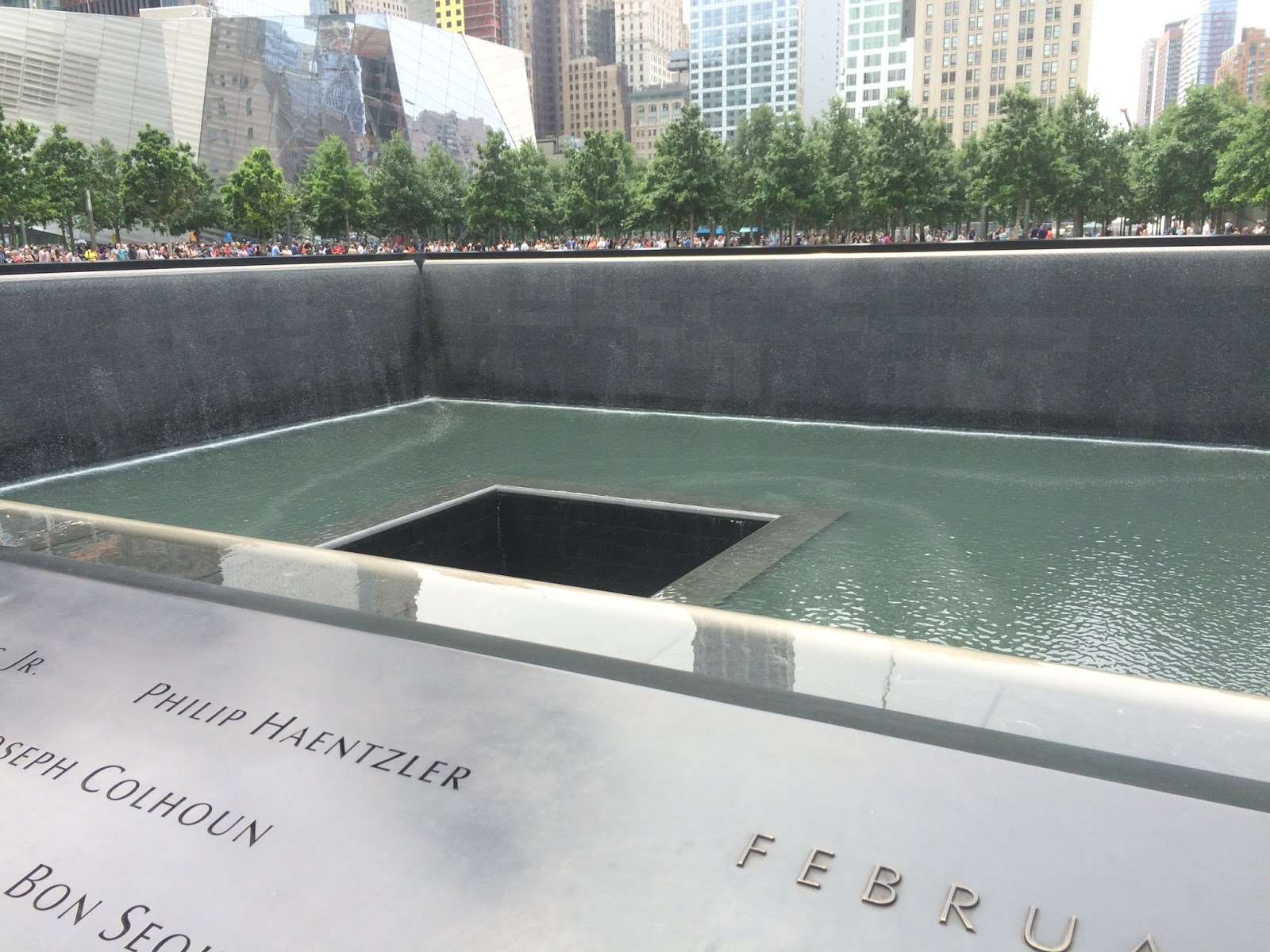
At another point in the trip, I visited One World Trade Center, which had recently opened its observation deck.  It offers an impressive 360-degree panorama of the city.  Most compelling, however, was the view directly down the side of the building.  From the staggeringly high elevation, one cannot help but be awed by the footprint of the absent twin towers. From the top of the new edifice, it looks like a scarred landscape, two stark holes in the earth where the World Trade Center used to be. Back on the ground, however, these holes are transformed into something simple and beautiful, hardly barren or scarred. Two fountains with gushing water draw you in, as if to say, "there is still life here," even as you stand reading the names of the dead encircling the monument.  A new thing has definitely sprung forth, a way in the wilderness, a river in the desert.

Both of these places serve to ground people in the best attributes of human nature: strength, resilience, hope, peace.  They pull us out of a frenetic world and remind us to pray--whether we're religious or not--for deliverance from sin, suffering and death, and to seek a future of abundant life.

Blessings,
Fr. Ethan+


Tuesday, August 30, 2011

Jesus' Extreme Makeover: An Alter Christus Indeed


This past Sunday, the Guardian newspaper came out with an article entitled, "A very muscular brand of Christianity: Why Jesus has undergone a macho makeover." I thank my friend, Ron Emrich, for passing this item on to me, because as a self-professed gym rat, I have always struggled with the notion of a pure and sanitized Jesus, stripped of every hint of grit, edge, and masculine hardness. So, to imagine Jesus as a buff biker dude with tattooed guns restores a certain authenticity in my mind to the Word made flesh. If Jesus were to appear among us today, he might very well look quite unlike some of the traditional depictions of the Savior that we are used to: the doe-eyed, airbrushed Good Shepherd of our illustrated Bibles, or the icon vested in the magnificent robes of Christ the King or Jesus Christ the Great High Priest. The graphic and unsettling embodiedness of the crucified Jesus is suggested in artist Stephen Sawyer's evocative images, such as the one above. This is not to say that I have any problem with the traditional images of Jesus; in fact, I cherish them, and the walls of my study are adorned with Orthodox icons of Christ Pantokrator, Christ the Great High Priest, and the Madonna and Child.

But above my computer for many years has hung a picture of a man's back tattoo of the Crucifixion. This picture has served as a reminder that the the Christian faith would not be what it is without the raw, enfleshed suffering of the Crucifixion by which humanity was saved from sin and restored to right relationship with God. I was deeply moved when I first saw this picture, for I perceived that to carve an image of this event in one's own flesh is to share in the suffering of Jesus' own passion. It is to proclaim Christ crucified, died, and risen. As one who has endured the intense pain of the tattooing process several times, I can tell you without any hint of melodrama that I have never experienced so poignantly or personally the physical suffering of Christ as when I'm getting inked. In fact, the pain was so blinding during my first tattoo that I spent the two-and-a-half hours in the chair reciting the Sorrowful Mysteries of the Rosary through clenched teeth. Later on, I also discovered a certain resonance between this experience and the Shewings of the medieval mystic, Blessed Julian of Norwich, who described in rather gory detail her sharing of our Lord's physical and spiritual suffering through a series of visions. Julian's accounts seem gratuitously bloody and even pathologically masochistic to modern sensibilities, but there is something in them that truthfully expresses the depth of the connection between Our Lord's passion and human suffering. Suffering and sacrifice is a raw truth of human existence.

To be sure, I did not get ink because I relish suffering, but because I wanted some way to publicly and indelibly declare my commitment to becoming a priest, so I got a Celtic cross on my right arm when the bishop made me a postulant and a dove of the Holy Spirit on my left arm when I entered seminary. As a believer in the sacrificial nature of the priesthood, I never wanted to forget that my vocation was supposed to cost me something, that the priesthood was a difficult life and identity to take upon oneself. As odd as it may sound, the painful process of the inking had something sacramental about it, making the sacrificial commitment truly enfleshed, not just abstract. The pain-memory of the tattooing has followed me as a reminder of my commitment throughout the formation process in seminary, during the search for a call, in the radical reordering of my life. I know that, especially for some of my traditionalist friends, the idea of having a tattooed priest, may lead you out of your comfort zone, and that's OK.

But if the Catholic understanding of priesthood is true, as I believe it is, that at ordination the priest becomes an alter Christus, another Christ, then we may need to expand our understanding of what a priest looks and acts like. Instead of only being icons of airbrushed holiness, priests (and I would argue all the baptized) should also embrace the grittier and more embodied dimensions of our personhood that may not cohere with a narrow vision of pure and sanitized sanctity in a cassock and chasuble. I am not suggesting replacing one image or persona for another, but rather the healthy and authentic integration of identities that honors the fullness of who we are and who Christ was and is. I have so admired friends and colleagues that have modeled for me the authentic both/and approach over the traditional either/or paradigm. They are both gay AND Christian, priest AND marathon runner, traditional AND progressive, morally holy AND prophetically embodied. For us to be an alter Christus is to honor both Christ the Great High Priest and the biker dude with the tats. The Gospels very clearly illustrate the many ways Jesus rubbed against the grain of the respectable establishment and power structures of his day by challenging social norms and consorting with the disreputable biker dudes and edgy folks on the margins. So, personally, I dig this new Jesus with the tats. I think Sawyer got something right, but I still like my Orthodox icons and my cassock.