Monday, July 13, 2015

If Jesus Rode the El Train

"Christ Among the Wild Beasts" by Moretto da Brescia
Today's Daily Office readings include the story from the Gospel of Mark about Jesus's preaching tour in Galilee.  In classic Jesus fashion, Our Lord goes out very early into the wilderness to pray--to find a few minutes of peace and quiet before tending to the needs of his demanding band of followers.  Simon (aka Peter) and the other disciples notice he is missing and go in search of him.  The Gospel records that, "When they found him, they said to him, ‘Everyone is searching for you.’ He answered, ‘Let us go on to the neighboring towns, so that I may proclaim the message there also; for that is what I came out to do.’ And he went throughout Galilee, proclaiming the message in their synagogues and casting out demons."

The urgency conveyed by the disciples' report, "everyone is searching for you," is matched by the urgency of Jesus's command to go into the neighboring towns to preach the Good News there also. Call and response. The people call to Jesus, and he goes out to meet them where they are with the message of new life.  This story is a powerful illustration of the missionary zeal that characterized both Jesus's ministry and the fledgling Church in its early years.  I sometimes wonder if we in the twenty-first century can really understand the immediacy and intensity of Jesus's hands-on contact with the average person, particularly the suffering and marginalized.   And then I find Jesus in some unexpected place, continuing to preach the Gospel message and cast out demons.

Like I did today.  This afternoon I took the Red Line downtown to meet a parishioner for coffee.  A
young homeless woman walked up and down the subway car asking commuters for spare change.  I took out my wallet, which was empty, and apologized for not being able to help her.  While many travelers pretended not to hear or see her, the man seated next to me greeted her and told her where she could find work.  He told her that a security company on the south side was hiring, and that if she applied, she would likely be hired.  She thanked him for the information, and then scoured the inside of her backpack for a pen.  I offered her the pink highlighter I was using to underline passages in the book I was reading, and she asked him for a phone number.  The man replied that he couldn't remember, but proceeded to give her detailed directions about how to get to the company, while I tried to look up the phone number on my iPhone.  The young lady hurriedly wrote down his directions, returned my highlighter, and then got off the train at the next stop.

As the train pulled away from the station, I thanked the man for his kindness, who had clearly represented Jesus in this encounter as well as (or perhaps better than) a person in a clerical collar.  He looked down at the floor and said, he knew how rough it could be, and how people sometimes just needed a little help.  I was moved by his sincere compassion and solidarity.  He engaged the woman as a peer, with dignity and respect.  No pity, no condescension, just Good News.  It was a simple, and yet exemplary, model of Christian witness.  As Jesus's hands and feet in the world, average people have the the power to heal the sick and cast out demons, to represent Jesus in places where he may be sought, even the unexpected and unconventional ones.

Blessings,
Fr. Ethan+

Wednesday, July 8, 2015

Rivers in the Desert


"I am about to do a new thing;
now it springs forth, do you not perceive it?
I will make a way in the wilderness
   and rivers in the desert."
Isaiah 43:19

I spent this past Fourth of July weekend in New York City playing the tourist, scarfing dollar pizza and Papaya King hot dogs on the run, and visiting a number of sites I hadn't seen before.  Among these were two magnificent structures, the Cathedral of St. John the Divine and One World Trade Center. These buildings struck me as signs of the almost inexhaustible human aspiration for rebirth and renewal.  As the quote above from the prophet Isaiah suggests, God inspires human beings with a drive to turn a barren desert into an abundant land flowing with milk and honey.  This is God's work, and we participate in it.

The Cathedral Church of St. John the Divine
Among the largest cathedrals in the world, St.John the Divine is wedged into an already cramped piece of Manhattan.  In fact, new condo construction hugs the cathedral's north tower, presenting a jarring juxtaposition of Gothic and contemporary styles.  If the cathedral were a person, it would have very little elbow room, rather like the packed NYC subway. Yet unlike that other great Episcopal monument, Washington National Cathedral, you can't rely on distance to take in the cathedral's full effect.  You can't keep walking back and back and back to capture the whole edifice in one click of your camera.  There's simply no room.  You must satisfy yourself with taking it in, a piece at a time, which is all the more extraordinary, since the building has remained conspicuously unfinished.  But despite its unfinished status, and its heavily soiled facade, the interior is lustrous and peaceful.  As I walked through it, I perused an exhibition in honor of the Dalai Lama, sat in on a lunchtime mass in a side chapel, and marveled at the number of people at prayer.  

One World Trade Center
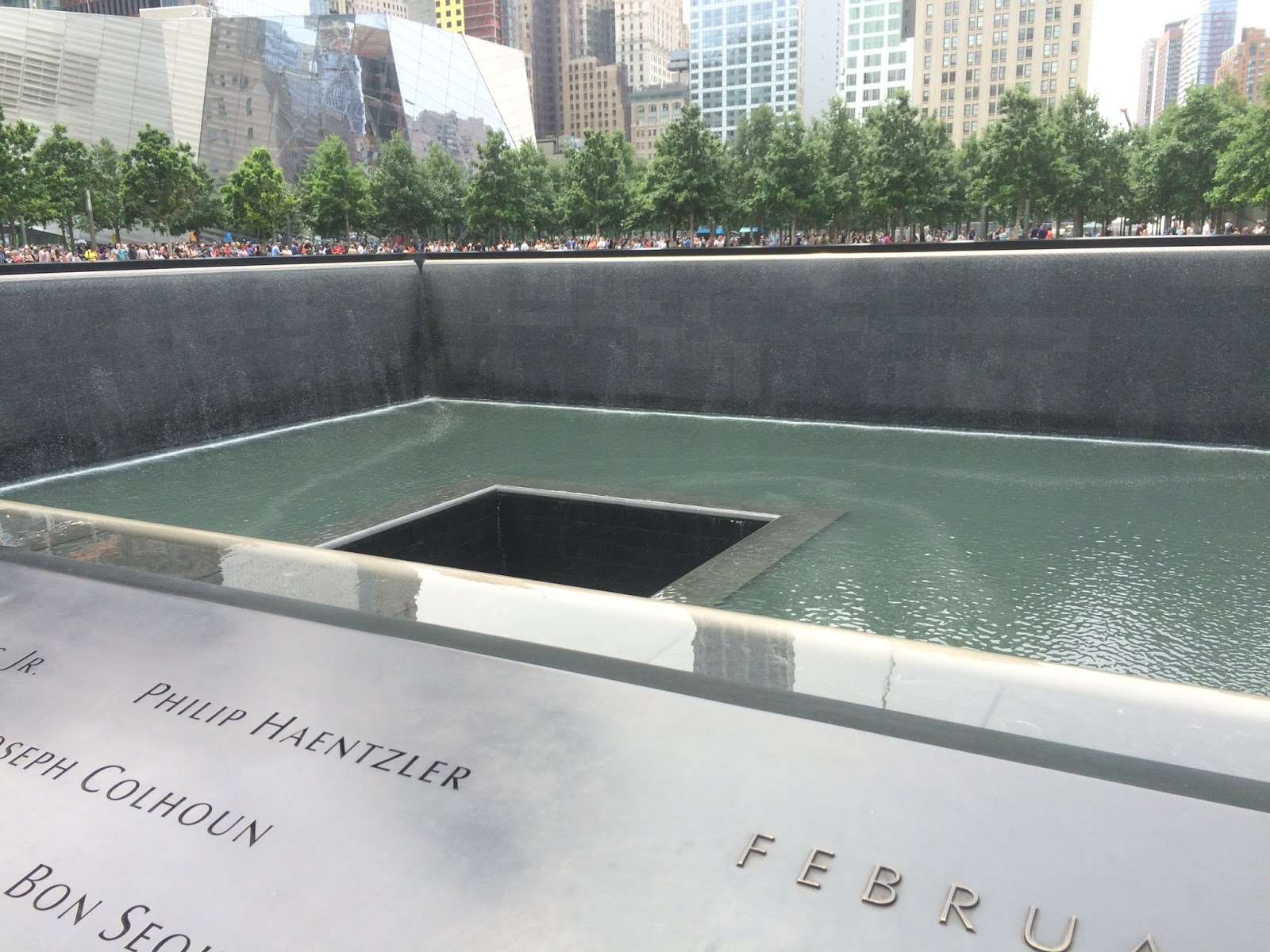
At another point in the trip, I visited One World Trade Center, which had recently opened its observation deck.  It offers an impressive 360-degree panorama of the city.  Most compelling, however, was the view directly down the side of the building.  From the staggeringly high elevation, one cannot help but be awed by the footprint of the absent twin towers. From the top of the new edifice, it looks like a scarred landscape, two stark holes in the earth where the World Trade Center used to be. Back on the ground, however, these holes are transformed into something simple and beautiful, hardly barren or scarred. Two fountains with gushing water draw you in, as if to say, "there is still life here," even as you stand reading the names of the dead encircling the monument.  A new thing has definitely sprung forth, a way in the wilderness, a river in the desert.

Both of these places serve to ground people in the best attributes of human nature: strength, resilience, hope, peace.  They pull us out of a frenetic world and remind us to pray--whether we're religious or not--for deliverance from sin, suffering and death, and to seek a future of abundant life.

Blessings,
Fr. Ethan+


Monday, June 29, 2015

A Ministry of Interruptions

St. Peter's on Chicago Pride Sunday, 2015
For the last month, I've been serving as supply priest at St. Peter's Episcopal Church in the Lakeview neighborhood of Chicago.  We began June with the Feast of Corpus Christi, complete with incense and Our Lord exposed in a monstrance at the Mary Shrine; and we concluded it with Chicago's annual Pride celebration.  It is deeply joyful for me as a priest to witness a congregation understand and embody the connection between these two events.  God really present in the bread and wine, and God really present in the midst of humanity. When I preached on yesterday's Gospel, I explained that the clumsy combination of the stories of the healing of Jairus's daughter and the healing of the hemorrhaging woman reflected how real ministry often works.  Instead of a tidy, seamless narrative that satisfies our need for immediate gratification, we are offered one story that meanders and is interrupted by another story before reaching its end.  Ministry is punctuated by numerous and frequent interruptions.

Ministry is also unpredictable and messy, a bit like Sunday's Gospel reading. Sometimes, we have to improvise and think on our feet. After an early mass, we gathered outside the church and claimed our spots to watch the festivities, while people began to line the parade route.  Some came extravagantly arrayed in rainbow tutus, face paint, and Hawaiian leis,waving gay pride flags.  And there were, of course, those who were wearing very little at all, and others who had clearly had too much to drink.  As they walked by, I wished everyone a "Happy Pride," Most would smile and return the greeting.  Many seemed surprised, but pleased, to see the Church supportive of them.  Then, something happened I did not expect.  People began to ask to take their picture with the priest in his rainbow stole, and eventually young people mobbed the Church steps for selfies and pics for their Facebook, Twitter and Instagram feeds.  Some even shared very emotional testimonies of how moved they were to see the Church on their side.  Crowds of young people whisked by us cheering and offering us fist-bumps and high-fives as a thank you for just being present.  During the parade, people on floats blew us kisses and gave us a thumbs-up.

This was, of course, a joyful and uplifting experience, but it also reinforced for me that the Church is still viewed as a largely absent and oppressive institution by many.  That the Church, or I, as a priest, should be such a novelty at an LGBTQI festival speaks to the many ways we have failed to engage and embrace large groups of God's people.  The day was beautiful, and yet, sobering.  It served as a cautionary reminder to us as Christians to work arduously to correct and repent of our past failings by working for justice and inclusion in both the Church and society.  What a wonderful world it would be if people just expected a congregation or its priest to be present for celebrations like the Pride parade, as if it were just a ho-hum, matter-of-course, routine part of the Church's life and witness.  Not radical at all, just a relevant, integral part of who we are and how we live.  If we take away one message from the day, it is this: the church has a place in society, and society wants us to claim it.

Blessings,
Fr. Ethan+

Wednesday, June 3, 2015

#TractSwarm: Anglican Comprehensiveness and Prayer Book Revision


In preparation for the 78th General Convention of the Episcopal Church, the Society of Catholic Priests has launched the third in its TractSwarm series, this one on the revision of the 1979 Book of Common Prayer.  Let me begin by stating quite clearly that I am in favor of revising the current Prayer Book to reflect the norm that has emerged in the last 35 years.  However, Prayer Book revision is a thorny and controversial process that requires careful thinking and consensus building, where the Devil is truly in the details.  As I struggled with how to approach this daunting topic, I drew up a list of fundamental questions with some examples as a starting point for my own thinking.

  • What's lacking/problematic in the current Prayer Book? Lack of expansive/inclusive language; need for supplemental resources, such as Enriching Our Worship; worshippers' lack of familiarity with how to use the Book of Common Prayer; dated language and metaphors.
  • What are the potential areas of discord and controversy? Revision of the marriage rite; altered theology; removal of Rite I liturgies; elimination of BCP Sunday lectionary.
  • What could a revised Prayer Book make possible? Greater variety of liturgical resources; more flexibility within the rubrics; enhancements to the Daily Office.
  • What would be potentially lost in a new revision? The rich Anglican heritage of Rite I; theological comprehensiveness/orthodoxy/tidiness; prominence of the Daily Office.
  • Given the increased use of supplementary, unofficial, ecumenical, and optional resources, has "common prayer" become a myth? Many parishes are already using non-approved resources and rites (Anglo-Catholic devotions and feasts, non-Anglican eucharistic prayers, non-traditional creeds/professions of faith).  
  • What would be the financial and environmental implications of printing and supplying new prayer books to congregations for worship?  In the digital age, are more sustainable models of dissemination possible? Elimination of print BCPs, and production of digital resources for worship bulletins, mobile devices, etc.

Each of these questions could be the subject of a long and painfully boring expostulation.  My principal concern, however, is how to preserve the principle of Anglican comprehensiveness in any revision process.  For me, our "broad-tent" ethos--embracing evangelicals, Broad Church, Anglo-Catholics, emergent Christians, and others--is a noteworthy strength of Anglicanism, and must be preserved.  During the revision of the 1928 Prayer Book, the process was often characterized by a winner/loser mentality that was deeply divisive.  This adversarial dynamic has also been present in recent controversies over the consecration of gay and lesbian bishops and same-sex unions, which causes me to wonder whether we as a Church are relationally strong enough to enter another fray at this time.  Think about how passionate we can be about the distinctive Sabon font in which the Prayer Book is printed, and you'll get what I mean!  To say that we have very strong opinions is an understatement.  Yes, we LOVE the Prayer Book, every jot and tittle.

But, of course, we are not just people of routine attached to familiar things like fonts and the wording of eucharistic prayers.  The Book of Common Prayer is the vessel that holds our unique theology and identity as Episcopalians.  Are our bonds of trust and affection robust enough to love and include one another as we differ passionately over fundamentals?  Can we come to consensus without imposing our agenda or marginalizing some minority group within the Church?  I am not suggesting that we shy away from the challenge, but rather to be honest about what we are taking on.  If ever the Episcopal Church needed to have a fierce conversation, to use the framework developed by Susan Scott, the Prayer Book would be it.  If, as she says, the conversation is the relationship, then we need to learn to do a better job of communicating with each other while we refine the book that articulates who we are as a community of faith.

Celebration of Rogationtide.
My proposal is this: we approach Prayer Book revision much like we have the sanctoral calendar by being expansive and permissive, essentially a hub-and-spoke model. We begin by devising a Prayer Book (the hub) that provides a mainstream core for the entire Church complemented by authorized  additional resources (the spokes) for local or optional use that respects the comprehensiveness of Anglicanism. This does not mean a Prayer Book that comprises a "lowest common denominator," but rather provides a solid and normative foundation to which other resources might be connected.  With the creation of the 1979 Prayer Book, the liturgical fullness of the Sacred Triduum was restored.  It would be similarly useful, for example, to authorize propers for Corpus Christi or Feasts of Our Lady for parishes that have long celebrated those feasts, whether in Enriching Our Worship, the Book of Occasional Services, or another resource.  Or perhaps we rely deeply on our Native American/First Nation communities for resources to mainstream the Church's observation of the Rogation liturgies.  The possibilities are practically limitless, much like the mystery of God.

The blessing of chalk at Epiphany.
In my own ministry, I have drawn from an abundant store of supplemental resources designed to make worship richer and speak to a wider range of contexts, theological priorities, and pieties.  These include the New Zealand Prayer Book, the St. Augustine's Prayer Book (both the original and revision), the Manual for Priests, the English Missal, and Enriching Our Worship.  They even include liturgical material developed and used by priest colleagues for unusual situations for which the Episcopal Church has not developed materials, such as the blessing of chalk at Epiphany.  Liturgy requires a certain amount of flexibility, creativity, and improvisation to respond authentically and pastorally to the needs of a congregation. A Prayer Book that offers a common foundation, and yet encourages the use of a wider range of authorized, supplemental resources seems to me to be an approach that is both postmodern, as well as grounded in tradition and longstanding practice.  The Episcopal Church has prided itself on fostering unity without uniformity, of delegating some discretionary authority to its bishops, clergy, and other leaders on liturgical matters.  If we're honest, we haven't believed in a "one-size-fits-all" approach for a long time, and this has made us stronger, diverse, and more inclusive as a Church.  After all, we are the Church that has commended belief in the Real Presence without prescribing how exactly this mystery is to be defined.  We are the Church that has declared to the faithful, "all may, some should, none must." This is the great legacy of Anglicanism and the Book of Common Prayer.

Abundant blessings,
Fr. Ethan +


<a href=”http://www.thescp.org/tracts/” target=”_blank”><img border=”0″ src=”http://www.thescp.org/wp-content/uploads/2015/03/tractswarm.jpg” width=”100%” /></a>


Sunday, May 3, 2015

Sermon for Easter 5: "How Can I, Unless Someone Guides Me?"

[Several people have asked me for a copy of this and previous sermons, so I am going to begin posting them online for everyone's convenience.]  Here is a link to the audio:


Philip asked, “Do you understand what you are reading?” the eunuch replied, “How can I, unless someone guides me?” And he invited Philip to get in and sit beside him.

In the name of the Father, and of the Son, and of the Holy Spirit. Amen.

The news cycle this past week has been robust, and perhaps like me, you are numb and bewildered.  On Tuesday, I listened to the two+ hours of oral arguments before the US Supreme Court on marriage equality, followed by Nina Totenberg’s analysis on National Public Radio.  News reports have dissected the earthquake and relief efforts in Nepal, the sentencing of Boston Marathon bomber, Dzokhar Tsarnaev, and of course, the terrible rioting in Baltimore in the wake of Freddie Gray’s funeral.  These reports have been accompanied by countless opinions, commentaries, and diatribes that appear all over social media, including my Facebook feed.  It is overwhelming.  Like the Ethiopian eunuch, it is easy to be perplexed by what we read and hear.  So, to answer Philip’s question, “no, I do not often understand what I’m reading.  How can I, unless someone guides me?” 

The challenge for all of us, whether we are Christians or not, is to become aware of the various lenses through which we view people and events.  On one level, attributes like socioeconomic status, race, gender, sexuality, generation, and political affiliation inform our perspectives and our prejudices.  On another, the framing of media, both the professional media and less-official social media, influences how we perceive the world.  Please understand, I am not naively advocating the shedding of all ideological lenses and agendas, but rather the development of an awareness of what these lenses and agendas are, and to weigh them with a critical eye.

We also use theological lenses to shape our perception of the world, and I think this is a very good thing.  Once upon a time, Christian denominations, and people of faith generally, exerted a formidable moral authority in the public sphere, where ideas and events were debated and decisions were made.  In an increasingly secular society, this authority has waned, but I would argue that it is still “meet, right, and our bounden duty,” to quote the Prayer Book, for Christians to lend their voices and feet to debates on public issues.  I believe that is what today’s Scripture readings are calling us to do.  “Little children,” the First Letter of John declares, “let us love, not in word and speech, but in truth and action.”  This is gutsy and evangelistic talk that calls for more than empty words; it exhorts us to live out the good news of the Gospel.

Although this week’s events largely focus on pain and tragedy, I speak from a hopeful, Eastertide frame-of-mind.  There is ample evidence, it is true, that we do not love each other, but there is also evidence that we do.  One of the most powerful images from this week’s events in Baltimore is a photo I encountered of an African American boy of elementary school age offering a bottle of water to a white policeman decked out in riot gear.  It was poignant to see this little child facing the long line of armed police with a gesture of civility and kindness.  And I would hope that there were civil and kind policemen, too.  The point is that this photo puts a different face on the event, offers another lens for us to use.  

Like Jesus before Pilate, we are faced with that fundamental question, “what is truth?”  Truth as an absolute is hard to come by, if we are honest about the slant of this or that media outlet or our own prejudicial perspectives.  If we are to believe the First Letter of John, one truth we can rely on is God’s love.  “We know love by this,” the writer states, “that [Jesus] laid down his life for us—and we ought to lay down our lives for one another.  How does God’s love abide in anyone who has the world’s goods and sees a brother or sister in need and yet refuses help?”

The truth of God’s love and his command for us to lay down our lives for each other—not to snatch each other’s lives away—is a theological lens through which we need to view the world’s events.  Our theology shapes what we see and hear, and how we interpret it.  The Gospel of John assures us repeatedly that God has given us the resources to deal with future challenges in our lives as people of faith.  Jesus tells us in this morning’s reading, “I will not leave you orphaned; I am coming to you,” by sending another Advocate, whom he calls the Spirit of truth.

Well, who is this Spirit and how does she work?  Is this Sophia, the Wisdom of this week’s Daily Office readings, of whom the author, reputedly Solomon, says “I preferred her to scepters and thrones, and I accounted wealth as nothing in comparison with her.  Neither did I liken to her any priceless gem, because all gold is but a little sand in her sight, and silver will be accounted as clay before her.  I loved her more than health and beauty, and I chose to have her rather than light, because her radiance never ceases.” It is the Spirit of wisdom, I would suggest, to whom the Ethiopian eunuch turns following his baptism.  The Acts of the Apostles attests that “when [Philip and the eunuch] came out of the water, the Spirit of the Lord snatched Philip away; the eunuch saw him no more, and went on his way rejoicing.”  It is curious—no amazing—that the eunuch’s response to Philip’s sudden disappearance is rejoicing, rather than distress.  He was not orphaned.  The eunuch, like all the baptized, was set on a path toward life and abundance, guided by the power of the Spirit, the Spirit of truth and of wisdom, that same Spirit that moved over the inchoate waters of Creation and brought forth a miraculous, ordered universe.  This is a God who loves us and guides us through all our moments of struggle, joy, and yes, even tragedy.

The greatest wisdom the Spirit of God can impart is that we human beings are flawed in judgment and character, and we are lost without her guidance.  As God’s creation, we ARE very good indeed, and yet we see only a narrow piece of the whole picture.  Who we are as individuals limits our perspective and creates lenses though which we see only faintly, only dimly.  The wise thing to do, in such a situation, is to temper our tendency to pass judgment and assert certainty by seeking out people with different viewpoints, with a different frame of reference, with different lenses.  We may not change our minds, but at least, we may learn something in the process that nuances our understanding and makes us kinder, more forgiving, and more loving, as our reading from the First Letter of John encourages us to do.  Developing better theological lenses through collective discernment in community, engagement in debate in the public square, and individual spiritual growth are ways we cooperate with the Spirit in becoming better and wiser disciples of Jesus.

 Peace and justice may or may not prevail in our nation’s capital, in Baltimore, in Boston, or in Nepal, but I believe that that the Spirit of God, in the fullness of time, has a pretty good chance of guiding us there eventually.  And that is the Good News of the Easter Resurrection.  Alleluia, Christ is risen.  And may the people say:  The Lord is risen indeed, Alleluia.

Monday, April 13, 2015

Billy Elliot, Doubting Thomas, and the Resurrection

The Resurrection of Jesus is one of the most challenging Christian tenets to explain and to believe.  In my experience, painstaking argumentation often does a poor job of deconstructing doctrines like the Resurrection, the Trinity, or the Assumption.  Perhaps I'm just not clever enough to pierce the mystery's veil.  Thomas Aquinas I am not, and even he admitted, "all that I have written seems like straw compared to what has now been revealed to me."  Ain't it the truth.

What I have found useful is to tell a story, to share a personal experience of, say, the Blessed Virgin Mary, that will offer insight into why the Church has long venerated her as the God-bearer, the Queen of Heaven and Earth, or Our Lady of Sorrows.  After all, it is no surprise that people would have an easier time connecting with my lived relationship with Mary than with a dry abstraction.  In seminary, I was taught that the Hebrew Bible was the story of one people's attempt to come to some kind of understanding of their identity and their relationship with God.  Scripture, Doctrine, and Tradition--often spelled reverently with those initial capitals that convey authority--are at best a best-guess, an attempt to codify a faithful people's experience over time of mysteries that defy rational explanation.  That is not heresy, but humility before the mystery of God.  We feel, we cogitate, and then we struggle to find words that can capture our deep experience of God.  We want to nail it down, but alas . . .  One my favorite French words is insaisissable, which translates clumsily as "uncapturable" or "elusive."  The translation misses something, maybe its all those s's hissing away musically like air, invisible, and yet perceptible.  Maybe we should rely less on theologians and more on poets, storytellers, artists . . . 

Or dancers.  This weekend, my partner and I went to see a community production of Billy Elliot, the Musical.  It is the story of a young boy in an industrial town in northeastern England during a coal-miners strike in the mid-1980s.  Billy turns out to be an aspiring, albeit reluctant, ballet dancer in a culture where gender roles and expectations were fixed and rigidly enforced.  There is one especially moving scene when Billy dances with his future adult self and takes flight, connecting with the promise of a new life and identity on the other side of his current existence of stagnation and hopelessness.  Even after he succeeds in getting into the Royal Ballet School, he wavers, fearful to leave behind his family and the life he has always known.  He especially grieves the loss of his ballet teacher, Mrs. Wilkinson, who practices tough love by telling him to leave and never come back.  The musical closes with Billy setting out for his new life in London as the rest of the town returns to the dirty, hard-scrabble existence of the mine.

There is no guarantee that what we or Billy will find on the other side of the grave/mine will be all peace and light.  In the example of Jesus' life, crucifixion, and resurrection, we detect a model for our own striving, for reaching beyond places of certain death and despair to grasp the potential for continued growth.  Like Billy, who knows what kind of people we will grow into beyond the mine?  Jesus shows us that giving into death is not an option, and that it is worth the risk to venture into unknown territory, even if it promises uncertainty, the discomfort of growth, and the possibility of failure.  The Resurrection, in this understanding, then, is not a single event, but an orientation of hope built on trust, trust that God is leading us toward something good and that we have what it takes to engage what we find waiting for us, however insaisissable it may be. 

This past Sunday focused on the story of Doubting Thomas.  I always have an easy time relating to him, his skepticism, his demand for empirical proof.  He would make a great patron for postmodern seekers.  What rises to the surface of his story for me is his failure to recognize the risen Christ; and perhaps that's because, Jesus, like us, is changed by his experience of transformation, of crossing the threshold of hopelessness and death and emerging into the light of new life.  His wounds, like ours, remain; they become integrated into us as we mature and grow and learn.  But we become different people.  As our seminarian preached yesterday, these wounds become scars, which remind us of all we have been through, all we have survived, and that is an empowering message.  Thomas's story invites us to put our hands into our own wounds (and those of others) as a sign of our own triumph over the grave.  It may not answer the question about our ultimate destiny following bodily death, but it illustrates nonetheless the striving for hope that Jesus commended us to practice.  Easter is a time to affirm that in the midst of death, life is still possible.  Our wounds serve as reminders that on the other side of suffering, shame, and despair may be a transformed person we don't yet recognize. 

Easter joy and blessings,

Fr. Ethan.+


Wednesday, April 1, 2015

More Than Just A Holy Week

Last Saturday, I drove to rural southwestern Michigan to bury my grandmother.  Although I had conducted her funeral a few weeks before at the Episcopal parish her great-great grandmother had help to found, we had been obliged to delay the burial because snowbanks had barred access to the gravesite.  I tossed clumps of still-frozen ground onto the coffin, "earth to earth, ashes to ashes, dust to dust," and recited prayers in the King James English my Grandma Kib would have found familiar--the Lord's Prayer, the Benedictus, the commital.  I was aware as I watched family and friends bundled against the cold--some praying, all grieving--of the enduring relevance of the Church to the deepest moments of human experience, despite frequent claims to the contrary.  We waited for the casket, encased in its concrete shell mounted with a cross, to be lowered into the ground before dispersing.  Burials are about closure, finality, no going back.  Then, we all returned to the land of the living and had lunch, sharing our favorite stories of the lady to whom we had just offered our final goodbyes.

The next day, I entered Holy Week, palm frond in hand.  I went to confession, dodged the unanticipated hail during the procession down the block, and confected the Sacrament at the altar with my brother and sister priests.  Later that day, I rehearsed the Exsultet for the Great Vigil of Easter and emailed a couple that I am marrying on the Saturday after Easter.  Colleagues at work on Monday began to comment, "this is your big week, right? to which I usually responded, "it's already begun."  But the truth is that Holy Week is not a priest's or even a Christian's big week, even though it is a bit of an endurance test.  Sure, there is that juggernaut of liturgies known at the Holy Triduum: Maundy Thursday, Good Friday, and the Great Vigil of Easter.  And then the Easter Sunday High Mass, which at Atonement, includes an orchestra playing to a packed house.

Exsultet, 2014
BUT Holy Week is really an invitation to a holy life.  What a lot of people miss is that Christianity is meant to be a lifestyle, a pattern of living that shapes identity and faith out of an accumulation of little moments, whether we are in church every Sunday or only come at Christmas and Easter.  As a priest, these little moments are often explicit: presiding at a burial, a wedding, and the Eucharist; reciting the Daily Office; meeting with my spiritual director and confessor; offering comfort to a person in distress.  They are meaningful in isolation from each other, but they also have a cumulative effect, a significance and a relevance that add up to be more than the sum of the parts.  These moments reinforce singly and together the values and commitments we make as Christians.  Holy Week enacts a story, a single narrative, that integrates all of our little moments into the larger chronicle of human redemption and salvation by a loving God.  The text of the Exsultet, which the Church sings at the Great Vigil of Easter, encapsulates this story well.  It puts into perspective and brings into relief the bread and butter of human experience: birth and growth, suffering and struggle, love and commitment, life and death.  What could be more relevant than that?

Abundant blessings for a solemn Holy Week and a deeply holy life,

Fr. Ethan+