Showing posts with label Episcopal. Show all posts

Friday, November 1, 2019

For All the Saints

If you want to know what Episcopalians believe, all you have to do is open the Book of Common Prayer--or as it is more casually known, the Prayer Book or BCP. It takes some practice to know how to flip effortlessly back and forth between the different parts of the Eucharist service, as well as the BCP's other resources. The more you do, however, the deeper an understanding you will gain of the "faith once delivered to the saints," as the Letter to the Hebrews puts it. The same could be said of the Hymnal 1982. It, too, is a good reflection of Episcopal belief, and on a day like All Saints' Day, when we sing so many classic favorites, our theology jumps out from the page.

In churches that only gather for worship on Sundays, it's difficult to differentiate between the two holy days of All Saints' Day (November 1) and the Commemoration of All Faithful Departed (November 2). Parishes with a daily Mass are able to keep them distinct; but for parishes like ours, we have to make the most of that one day when we're all together at the Lord's Table. The hymn we're going to sing at the Gospel on Sunday begins, "I sing a song of the saints of God, patient, and brave and true, who toiled and fought and lived and died for the Lord they loved and knew. And one was a doctor, and one was a queen, and one was a shepherd on the green: they were all of them saints of God--and I mean, God helping, to be one too." The saints comprise a dazzling variety of people, both the lofty and the humble.

All Saints' Day, strictly speaking, commemorates those that the Church over the centuries has seen fit to add to its official Calendar of Saints. As this Sunday's offertory hymn, "By all your saints still striving," notes, it includes "apostles, prophets, martyrs, and all the noble throng who wear the spotless raiment and raise the ceaseless song." Yet it's not only the greats like the Blessed Virgin Mary, St. Luke, St. Francis, or contemporary luminaries like Dorothy Day and Martin Luther King, Jr., but also the unsung heroes who have done great things without official recognition. The verse of the offertory hymn fittingly ends, "for them and those whose witness is only known to you--we give you praise anew."

The Commemoration of All Faithful Departed, on the other hand, remembers all who have died: my Grandma Kibby; my eighth-grade teacher, Mrs. Cortese, and so on. They may not have had a global impact like St. Joan of Arc or St. Thomas Becket--my patron saints--but they made a huge contribution to the person I am, and I am eternally grateful to them. So, it's wonderful that the Church offers a place in its calendar to commemorate them, too. One of the consistent messages of these two days is that we are called to remember both the Church's greats, and the people that were great for us, inspiring us to strive to become the best versions of ourselves, saints in our own way. And it is an expression of the Church's belief in the communion of saints, or as the Letter to the Hebrews calls it, "so great a cloud of witnesses." We pray for them as they reside with God in heaven, as we ask them to pray for us while we continue our earthly journey, hopeful that we will join them some day.

Abundant blessings,
Fr. Ethan+

Tuesday, October 27, 2015

On Church Buildings

I currently serve at the Diocese of Chicago's third oldest parish, which was founded in 1851. If you were to pass in front of the building, you might not think it was a church at all, and certainly not one of such great longevity. Grace is now at its sixth location in a converted commercial building in the South Loop's Printer's Row. It houses not only an Episcopal congregation on Sunday, but a number of not-for-profit organizations, a Lutheran satellite campus, a Korean congregation, the South Loop campus ministry (Lutheran/Episcopal), a weekly community breakfast for 200 homeless men and women, yoga, Alcoholics Anonymous, and a number of other activities that vary from week to week. The building is almost always FULL.

For many congregations, though, their buildings are perceived as a burden, rather than an asset. After several years on the diocesan Congregations Commission, I came to appreciate how pivotal a building can be to a congregation's survival and vitality. Many are faced with huge obstacles posed by deferred maintenance: a roof that needs to be replaced, a parking lot that needs to be resurfaced, tuckpointing to preserve a crumbling facade, foundation or other work to stem flooding, electrical upgrades, plumbing repairs, a new boiler or water heater. The list goes on and on. In every congregation where I have been a leader, both as a layperson and as a priest, there have been major physical plant challenges. As a result, some have argued that we need to get out of our expensive Gothic or Romanesque buildings and relocate to spaces that are more economical and better suited to the kind of work our congregations want to do. They're bleeding us dry, people complain.

A community meeting on the 1st floor meeting space.
While that may be true in many cases, the larger question for me is: what does your building make possible? There is no doubt that Grace, a parish that numbers a steady 65 on Sundays, is able to do disproportionately more than other congregations its size because of its extraordinary building. I know you'll indulge me and allow me to brag a little that the parish has a reach and a reputation in the community that most congregations would envy. But even a contemporary building ideally suited to ministry in the wider community has a variety of associated costs. Tenants provide a steady revenue stream, but they also generate costs. Additional wear and tear on the building from increased usage; staffing to provide building security, custodial services, and setup/break-down of the various meeting spaces; infrastructure repairs and upgrades to the physical plant; and legal fees incurred to negotiate contracts and occupancy agreements can also be part of the equation. There is no doubt in my mind that these expenses are worthwhile; and the relationships the parish builds with its community and ministry partners are inestimable. But they can add up to a sizable fiscal note. So, a parish needs to be informed about what's involved and smart about managing it all.

Saturday's community breakfast.
There is no one-size-fits-all solution to the challenges posed by church buildings. Moving out of an historic Gothic building might be more cost-effective, but relocating to a converted printing warehouse might not support the ethos and aesthetic of the traditional liturgy that is central to a particular parish's identity and reputation. On the other hand, it might be just the thing that allows that parish to grow into a more vibrant and stable version of itself. It might encourage the parish to think of itself in new ways, as its members discover what the new building makes possible. In either case, the parish needs to act strategically to ensure that it has the right leadership, resources, and infrastructure to support its mission. As a priest that spends about half of his time doing administration and management, I value the experience and skills sets I developed as a not-for-profit executive. I couldn't do my job without them. I am aware, however, that if we imagine new ways of being church, including the types of buildings we use, seminaries will have to train clergy differently and congregations will need to recruit particular types of expertise to fill leadership roles on vestries, building committees, and other bodies. Church buildings can be a invaluable asset if we honestly evaluate what they make possible, and what they don't, and what they need from us to make them work.

Blessings,
Fr. Ethan+

Monday, September 7, 2015

Why Episcopal Identity Matters: Part II

Last week's blog offered five reasons why Episcopal identity and practice are still relevant in a pluralistic, post-denominational, and postmodern society. This week, I offer the final five on my list.

St. Augustine of Canterbury
6. A rich theological heritage. The Book of Common Prayer provides a basic framework for Episcopal belief and practice, but Anglicanism boasts a much richer corpus of theological resources. Anglican thought traces its origins back beyond the Reformation to the era of Celtic Christianity and St. Augustine's mission to the English in the late 6th century. The Anglican heritage claims medieval greats, such as the Venerable Bede and Julian of Norwich. It is grounded in the work of major Reformation theologians like Thomas Cranmer and Richard Hooker and the sublime poetry of John Donne and George Herbert, both priests in the Church of England. Anglicanism nurtured the Oxford Fathers who led the Catholic Revival of the mid-19th century, which revitalized Anglican liturgy, hymnody, and architecture. It shaped the Christian Socialism movement later in the century. In this generation, Anglicanism has produced first-rate intellectuals and academicians, such Sarah Coakley, Katherine Tanner, Rowan Williams, and of course, Desmond Tutu.

7. Contemplation and mysticism. Anglicans are not just thinking folk. They are also people open to the deep, internal experience of God. The contemplative life ranges from walking the labyrinth or participating in a centering prayer group to joining one of the professed religious communities of the Anglican Communion, such as the Society of St. John the Evangelist, the Order of Julian of Norwich, or the Brotherhood of St. Gregory.

Chanting the Exsultet at the Easter Vigil.
8. Beautiful music. One of Anglicanism's principal contributions to Christianity is a strong musical repertoire. The Anglican tradition excels in both choral and congregational singing. At an Easter Vigil, you might hear a deacon chant the Exsultet, one of the most ancient and revered pieces of sacred music, followed by a choir performing Anglican chant and plainsong. During the week, you might participate in a Taize service or Choral Evensong with a contemporary setting of the Magnificat. On an average Sunday, you will likely join a congregation in singing hymns written by legendary figures, such as Isaac Watts, John and Charles Wesley, and John Mason Neale.


Map of the Anglican Communion.
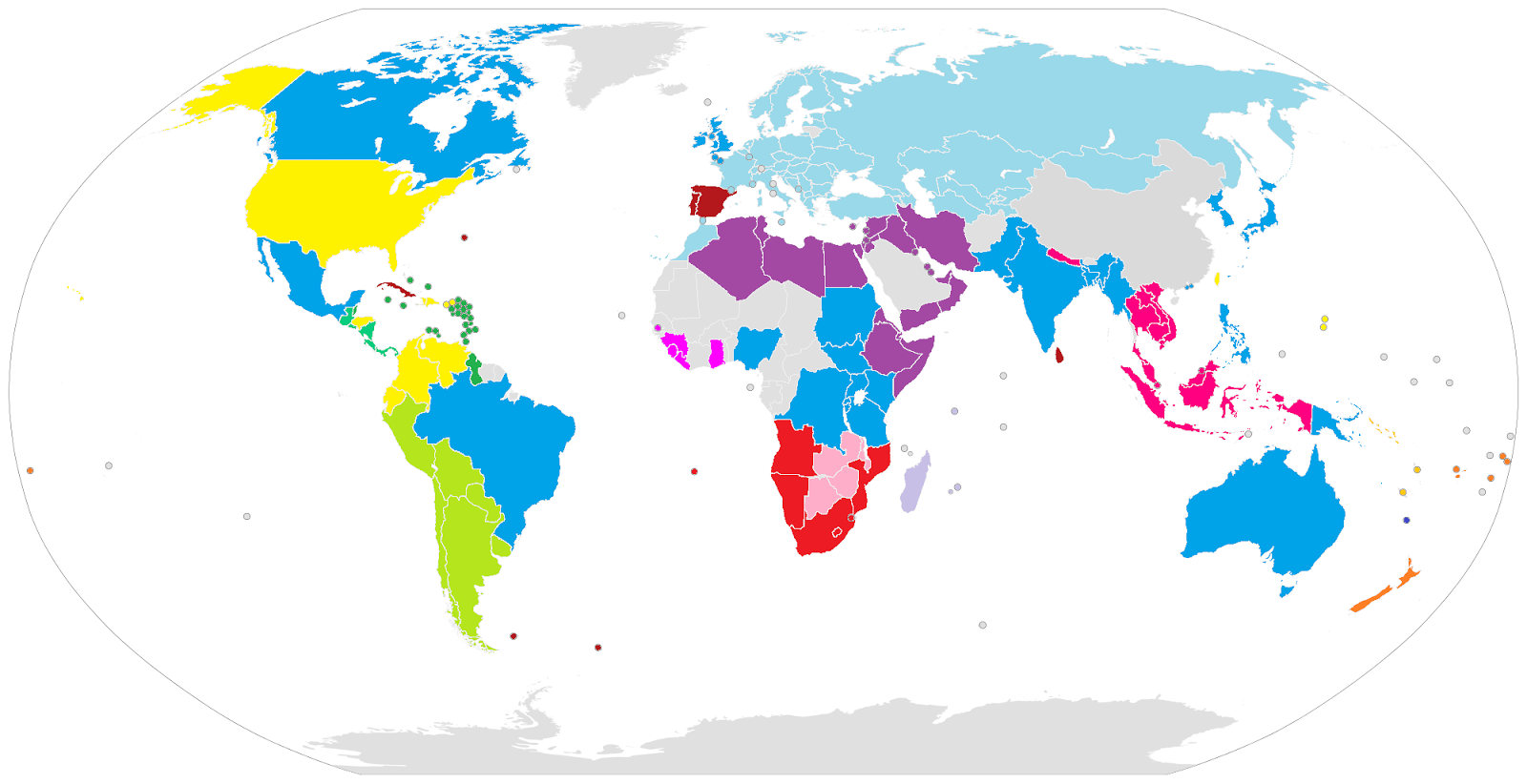
9. A global context of belonging. The Episcopal Church is a member of the Anglican Communion, a worldwide fellowship of 38 national and regional provinces in communion with the Archbishop of Canterbury. The Anglican Communion is the third largest body of Christians in the world, after the Roman Catholic Church and the Eastern Orthodox churches. It consists of about 80 million people in 165 countries. Although sharing a common heritage in the Church of England and the Book of Common Prayer, each of these national churches lives out its Anglican identity differently, according to its unique cultural and social context. Some Anglican provinces are more catholic in their worship, while others are more evangelical or charismatic. Some are more socially and theologically liberal, while others are more conservative. The Episcopal Church engages with these other Anglican provinces through a variety of organizations and partnerships, including Episcopal Relief and Development, which offers support during natural disasters, epidemics, and other emergencies, as well as providing resources for long-term development.

10. An anchor in a turbulent world. Recent research from the Pew Research Center for Religion and Public Life and other thinktanks have demonstrated a resurgence of interest in traditional and liturgical forms of Christianity, such as the Episcopal Church. In a world when everything else is constantly changing, postmodern people are learning to value the spiritual grounding that the ancient traditions of Christianity have to offer.

This list is, of course, neither objective nor exhaustive; it is only my perspective on what the Episcopal Church and Anglicanism contribute to the spiritual life. Are there other reasons? Please respond back with your own suggestions and perspectives and add to this discussion.

Abundant blessings,
Fr. Ethan+
Monday, August 31, 2015

Why Episcopal Identity Still Matters: Part I

This Sunday, I will conduct the first in a series of four classes on the Episcopal Church, what are often known as "inquirers classes." Although this is standard practice in Episcopal congregations, many might ask if this is still relevant. In a pluralistic, post-denominational society, does it matter whether we are Episcopal, Lutheran, Methodist, or Presbyterian? Haven't we evolved past these distinctions?

The answer is both yes and no. I firmly believe that ecumenical and interfaith collaboration is vital to the future of the Church, but I also feel very strongly that denominational identity is still worth building and nurturing. This belief is not the result of some abstract, intellectual exercise, but rather, the experience of my own formation as an Episcopalian. Below are five reasons why I think Episcopal identity still matters.

In Washington National Cathedral.
1. Common prayer. At the heart of the Episcopal identity is the notion of common prayer. As the old Anglican maxim goes, lex orandi, lex credendi, the way we pray shapes what we believe. Although many congregations now pray from Sunday bulletins, rather than pew copies of the Book of Common Prayer, worship is still based largely on the forms and rubrics of the Prayer Book. I can't count the number of times I have been in an unfamiliar city for work or vacation and have wandered into the local Episcopal parish for a Sunday Eucharist or weekday Evening Prayer. Whether it is in a country church, like the one my great-great-great-grandmother founded, or Washington National Cathedral, the patterns of worship remain familiar and consistent. In a strange environment, Episcopal worship has offered a locus of stability and belonging that I have greatly valued in a very fluid and tumultuous world.

2. An appeal to intellect, emotion, and the senses. As one elderly parishioner once said to me, "the Episcopal Church is the thinking man's church." The Anglican tradition has relied heavily on deep theological thinking, informed by Scripture, tradition, and human reason. However, the Episcopal Church has also encouraged people to peer beyond theological inquiry and debate to embrace experiential ways of knowing that engage the emotions and the senses. There is something deeply transformative about sitting in deep silence with others, walking the labyrinth, offering up prayers in great clouds of incense, or joining an entire congregation as they chant the Nicene Creed. Episcopal identity and worship engage the whole person.

Let my prayer be set forth in thy sight as incense.
3. Both ancient and modern. The Episcopal Church has been described as a creedal, rather than a confessional, church. This means that the Episcopal Church does not have a checklist of denominationally specific articles of faith to which members are expected to assent. Episcopalians ground themselves rather in the the Nicene and Apostles' Creeds, which articulate a heritage of faith and belief that goes back to the earliest days of the undivided Church. We may struggle to accept some of the content of these ancient creeds, but we recite them as a sign of our relationship with the generations of Christians that have come before us. But that is not all we are. We are also open to the new things the Holy Spirit has to teach us about what it means to be children of God and followers of Jesus in our own unique contexts. In the Episcopal Church, we value the tension between continuity and discontinuity, between tradition and new discoveries about God.

4. A democratic polity. The governance of the Episcopal Church was deeply influenced by the democratic, representative ethos of the United States, which was born in the same era. The Episcopal Church may be organized around the leadership of bishops, but these bishops are elected democratically by the clergy and lay leadership of each diocese.  At the national level, moreover, the Episcopal Church establishes official policy on a wide range of issues through discussion and shared decision-making that includes bishops and elected representatives of both the clergy and laity of each diocese.

Neighborhood peace vigil.
5. A social conscience. One of the reasons that I came to the Episcopal Church was its progressive stances on social justice issues, such as immigration policy, the ordination of women, and the inclusion of LGBTQ people. However, I have also respected that fact that the Episcopal Church is a very big tent, incorporating people who may not agree with me and supporting a diversity of convictions and outlooks: liberal and conservative, traditional and experimental, mystical and intellectual.

The attributes I have just described are not all unique to the Episcopal Church, but in the aggregate, they shape and define our shared identity as Episcopalians. In order for an individual or a congregation to understand who it is, it needs to be steeped in the larger tradition to which it belongs, to identify where there are shared connections, and whether there is divergence.  Next week: Part II.

Blessings,
Fr. Ethan+


Monday, August 3, 2015

Baptism and a Broken Clutch

This past weekend, I had the privilege of participating with family in two major milestones, the baptism of my partner's two nephews on Saturday and my first Sunday as Interim Rector of Grace Episcopal Church in Chicago. Both were events of deep joy for me as a priest. And they both illustrated the truth that as much as we may try to plan, organize, and perfect our lives, circumstances can overtake us and thwart our best efforts. Then, we have to improvise. Fortunately, the Holy Spirit does some of her best work on the fly, and often shows up when we feel things are coming apart.

Welcoming the newly baptized.
We had been talking about Jordan's and Jose's baptism for a while, but the timing and logistics had been difficult, particularly because two of the godparents had been living in Alaska. The planets, however, had finally aligned to get the two boys, their parents, and their grandmother to Chicago for a long visit, during which we would do the baptism. The day before, however, the parish's liturgical coordinator--who is a master of executing complex liturgies despite the hindrances of befuddled, but well-meaning, clergy like me--was unexpectedly admitted to the hospital. I walked into church not knowing if I would find everything I needed, who would assist me, or exactly how the liturgy would unfold. But the rector and parish staff pulled together and stepped into the breach to help me. It didn't go as planned, and yet the Holy Spirit showed up, and the experience was beautiful.

Selfie with nearly stranded parents.
Later that day, I received a phone call. Ever since the start date for my new cure had been set, my mother and stepfather, Randy, had been planning to drive from Florida to surprise me on my first Sunday in my new congregation. I answered the phone, and Randy informed me that they were in Chicago. I was stunned and delighted. He explained that they had hoped to amble in on Sunday morning as I was greeting parishioners before the main service at 10 o'clock. But . . . it turned out that, even after a thorough maintenance check prior to leaving, the clutch started to give out somewhere in Indiana; and by the time, they were within ten miles of their hotel in Chicago, the car just gave up. Fortunately, they managed to get it off of the highway and onto a quiet side street. My parents were understandably disappointed that the surprise hadn't gone according to plan. From my perspective, though, I was grateful that the car hadn't died in the middle of a cornfield or 100 miles from the nearest gas station. They were safe, and I was close enough that I could jump in the car and pick them up in a matter of minutes. And I was granted the pleasure of an unexpected dinner with my family.

The next day, I was, of course, excited to worship with my new parish, with my family sitting in the congregation. Although I had read the service bulletin carefully, I found myself at several points in the service falling into old liturgical patterns. For example, I got confused during the Gloria, defaulted to the traditional Lord's Prayer, and neglected to use the special final blessing printed in the bulletin. But God showed up all the same, and it was beautiful. In a touching gesture, members of the vestry presented me with the former rector's white stole, which I kissed and placed over the green chasuble I was wearing, before gathering the community for the Liturgy of the Table. It is in moments like this that I am reminded that improvisation can be a blessing, allowing us to let go and grant the Holy Spirit space to move among us. The fruits of that movement are often unexpected, but beautiful. They remind us that it is sometimes OK for us to relinquish control. It is fine for things not to go as planned, because the Holy Spirit shows up and compensates for our uncertainty and stumbling. In those moments, we can relax, because God is in charge.


Monday, July 27, 2015

A Terrifying Leap of Faith

Zip-lining at Loterie Farm in St. Maarten.
I am terrified of heights, a phobia I trace back to the first grade, when I fell off the monkey bars on the playground and landed on my head. Since then, I have largely avoided high places. On occasion, however, I have tried to set aside this fear and taken a leap of faith. I have climbed to the top of Cologne Cathedral on a rickety, rusty ladder in the dead of winter; I have stood 1,353 feet above Chicago on the Sears Tower's clear, plexiglass Ledge; and even now, I live rather counter-intuitively on the fifty-second floor of an urban high-rise. The view from my living room still makes me a bit woozy. No experience, however, has been more terrifying for me than extreme ziplining in St. Maarten this past New Year's Day.

Working my way to the next platform.
The group of tourists and I piled into the back of a pick-up
truck, which clambered up the side of the mountain through virgin rainforest. The most extreme zipline, we were told, was 930 feet long and a dizzying 120 feet above the ground. The view was spectacular, to be sure, but as we climbed higher and higher into the rainforest's canopy, I felt my anxiety rise, too. After some initial instruction on how to use the harness and navigate safely from platform to platform, I clumsily made my first attempt, whizzing diffidently to the next platform. Interestingly, the zipping itself was pretty effortless, once I had gotten the hang of it. What terrified me was the movement between the platforms, which got higher and higher. Most of them were connected by reasonably sturdy bridges made of rope and wooden planks, although I worried that my foot might inadvertently slip between the rungs. At one point, however, I faced--incredulous--nothing more than a thin, steel wire between two platforms--essentially a tight-rope. My only lifeline was a wire above me to which I could attach my harness, and two thin wires on either side to guide me forward. There was no turning back. I had to either walk the tight-rope or be airlifted out.

At the end of the course, bathed in terror-sweat.
In a moment of supreme self-mastery, I mustered up the courage to tread carefully over the wire, slowly guiding myself meticulously step by step over the wire, while I struggled desperately not to focus on the fact that I was hovering a hundred feet above the ground. I slid my hands over the wires in a death-grip as I plodded carefully forward, placing my feet precisely on the wire. After I got about half-way, I began to believe that I might just make it without slipping from the wire and dangling perilously over the rainforest floor. When my foot made the final step onto the platform, I noticed that my hands were raw and pink where the wires had peeled off layers of skin. I also realized that I was bathed in sweat, my t-shirt sticking heavily to my body. This was not ordinary sweat from exertion or the hot, humid weather, I joked. This was terror-sweat.

Ordained leaders discuss congregations in transition.
Last week, I attended a three-day conference for interim rectors and other transition ministers, like me. Although Episcopalians predominated, there were ordained leaders from several Christian denominations. We studied systems theory, reviewed congregational case studies, and debated a variety of complex issues, ranging from appreciative inquiry and learning styles to the dynamics of congregation size and parish life-cycles. We talked a lot about grief and anxiety in parishes going through transition. One of the most valuable insights of this conference was that congregations, once they have reached a stage of maturity, tend to think that decline is the result of programmatic problems, that if they just developed more and better programs, they would begin to thrive again. George Bullard, however, has noted in his congregational development work that the problem is not usually with programs, but with vision.

As congregations, we often cannot imagine our way forward along a path that seems unsteady, leading to a destination so far away to be almost imperceptible. This path is marked with anxiety, even terror, because we fear that life as we know it may end. Instead of focusing on our strengths, we lose confidence in our ability to adapt to new situations and anticipate the worst-case scenario, fearful that we might slip off of the tight-rope we're walking and plummet to our death. A key to successful transitions, then, is to be visionary, to accept uncertainty as a creative space, as a place to explore a congregation's values, to let go of old dreams, and come up with new ones. The way forward may push us out of our comfort zone for a time, but if we can learn to live with a little anxiety--perhaps even some terror-sweat--we may be surprised by what we're able to achieve.

Abundant blessings,
Fr. Ethan+

Monday, July 20, 2015

All Religion is Local

Vie de Jesus Mafa, The Transfiguration
If "all politics are local," as the old adage goes, it's probably equally true that "all religion is local." Or at least we tend to behave as if that were true.  The day-in and day-out of parish life persuades us that the way we do things in our parish is normative for others in our tribe, such as the Episcopal Church.  The way we worship, the language we use, the hymns and music we sing, the way we run our meetings.  Now, even if we don't assent intellectually to this idea, we can often act unconsciously as if OUR way is THE way. We assume quite innocently that this is just how Episcopalians (or Lutherans, or Baptists) do things.  But religion is, at its heart, deeply contextual.

Bishop Lee installs the new vicar.  Photo from Br. Ron Fox.
Which is why I'm really grateful to gather on occasion with other Episcopalians to be reminded that I am part of a community much larger than what I know and do.  Over the last four days, I've been to three different Episcopal congregations to either lead or participate in worship. What is remarkable to me is the way that each of these communities of faith--as unique as they are--embodies the concept of the Church, with a capital "C."  As member congregations of the Diocese of Chicago, all three are firmly rooted in the Anglican/Episcopal tradition, despite the great variety and diversity of worship styles and cultural contexts.  It can be a wonderful experience to be thrown off kilter, pushed out of our comfort zones, and be invited into something unexpected.

On Thursday evening, I participated in the installation of my dear friend, Fr. Robert Cristobal, as vicar of St. George and St. Matthias Episcopal Church, an historically African American and Afro-Caribbean congregation on the south side of Chicago.  Much of the music was unfamiliar to me, and I noticed several visitors surprised by the exuberant engagement of the congregation with the preacher during his sermon.  And yet, here was the fullness of the Anglican tradition: the bishop, the Eucharist, the Book of Common Prayer, clergy and people of the Diocese worshipping together as one.  It was beautiful and joyous, compelling and powerful.

Chicago Chapter-in-Formation of the Society of Catholic Priests
On Saturday morning, I gathered with other members of the Chicago Chapter-in-Formation of the Society of Catholic Priests at the Church of the Atonement, Chicago for a Mass of the Blessed Virgin Mary, followed by the chapter meeting.  The service was a solid Rite II Eucharist from the Book of Common Prayer with the usual Atonement embellishments. We shared our latest news over brown-bag lunches, talked about the contributions we could make to the life of the Diocese, and engaged in a theological reflection based on the words of the new Presiding Bishop-Elect, Michael Curry.  On Sunday, I drove out into rural/suburban Kane County to celebrate Mass with St. James Episcopal Church in West Dundee, IL, which, as a rural parish, was preparing for its upcoming Rogation celebration.  It had been several years since I had done a Rite I Eucharist, and so I tripped over the King James English, which had at one time been so familiar.  Of course, their customs for celebrating the Eucharist differed a bit from mine, and we laughed over the imperfections and miscommunications we committed, such as when the server failed to do the ablutions after communion, and I forgot to return to the chancel following the dismissal for the announcements. We are all a product of our patterns, our routines, our contexts.

St. James window in West Dundee
I picture for myself the scene at Jesus's Transfiguration.  Matthew 17 records that right after Jesus appears transfigured in dazzling white, flanked by Moses and Elijah, "Peter said to Jesus, ‘Lord, it is good for us to be here; if you wish, I will make three dwellings here, one for you, one for Moses, and one for Elijah.’"  One cannot help but wonder what Peter would have come up with if he had been allowed to build those dwellings.  Would they have all been identical?  Would Jesus, Moses, or Elijah have had any say in what their dwellings looked liked, how they were laid out, or how they were decorated?  Would James and John have been included in the design and building?  Would the three apostles have divided up the work and each taken responsibility for one of these dwellings?  Would they have fought for creative control or would they have collaborated harmoniously?

As it happens, each of them is credited with building a version of the Church in various places, all of which look very different from each other.  These apostles too understood that the Church is contextual, shaped by the unique identities, experiences and situations of the people in a particular time and place.  The lesson for us is to embrace the possibility that the Church can look and behave differently than we are used to, and yet we can find a place for ourselves in this new and unfamiliar incarnation of the Body of Christ.

Peace and blessings,
Fr. Ethan.+


.


Wednesday, July 8, 2015

Rivers in the Desert


"I am about to do a new thing;
now it springs forth, do you not perceive it?
I will make a way in the wilderness
   and rivers in the desert."
Isaiah 43:19

I spent this past Fourth of July weekend in New York City playing the tourist, scarfing dollar pizza and Papaya King hot dogs on the run, and visiting a number of sites I hadn't seen before.  Among these were two magnificent structures, the Cathedral of St. John the Divine and One World Trade Center. These buildings struck me as signs of the almost inexhaustible human aspiration for rebirth and renewal.  As the quote above from the prophet Isaiah suggests, God inspires human beings with a drive to turn a barren desert into an abundant land flowing with milk and honey.  This is God's work, and we participate in it.

The Cathedral Church of St. John the Divine
Among the largest cathedrals in the world, St.John the Divine is wedged into an already cramped piece of Manhattan.  In fact, new condo construction hugs the cathedral's north tower, presenting a jarring juxtaposition of Gothic and contemporary styles.  If the cathedral were a person, it would have very little elbow room, rather like the packed NYC subway. Yet unlike that other great Episcopal monument, Washington National Cathedral, you can't rely on distance to take in the cathedral's full effect.  You can't keep walking back and back and back to capture the whole edifice in one click of your camera.  There's simply no room.  You must satisfy yourself with taking it in, a piece at a time, which is all the more extraordinary, since the building has remained conspicuously unfinished.  But despite its unfinished status, and its heavily soiled facade, the interior is lustrous and peaceful.  As I walked through it, I perused an exhibition in honor of the Dalai Lama, sat in on a lunchtime mass in a side chapel, and marveled at the number of people at prayer.  

One World Trade Center
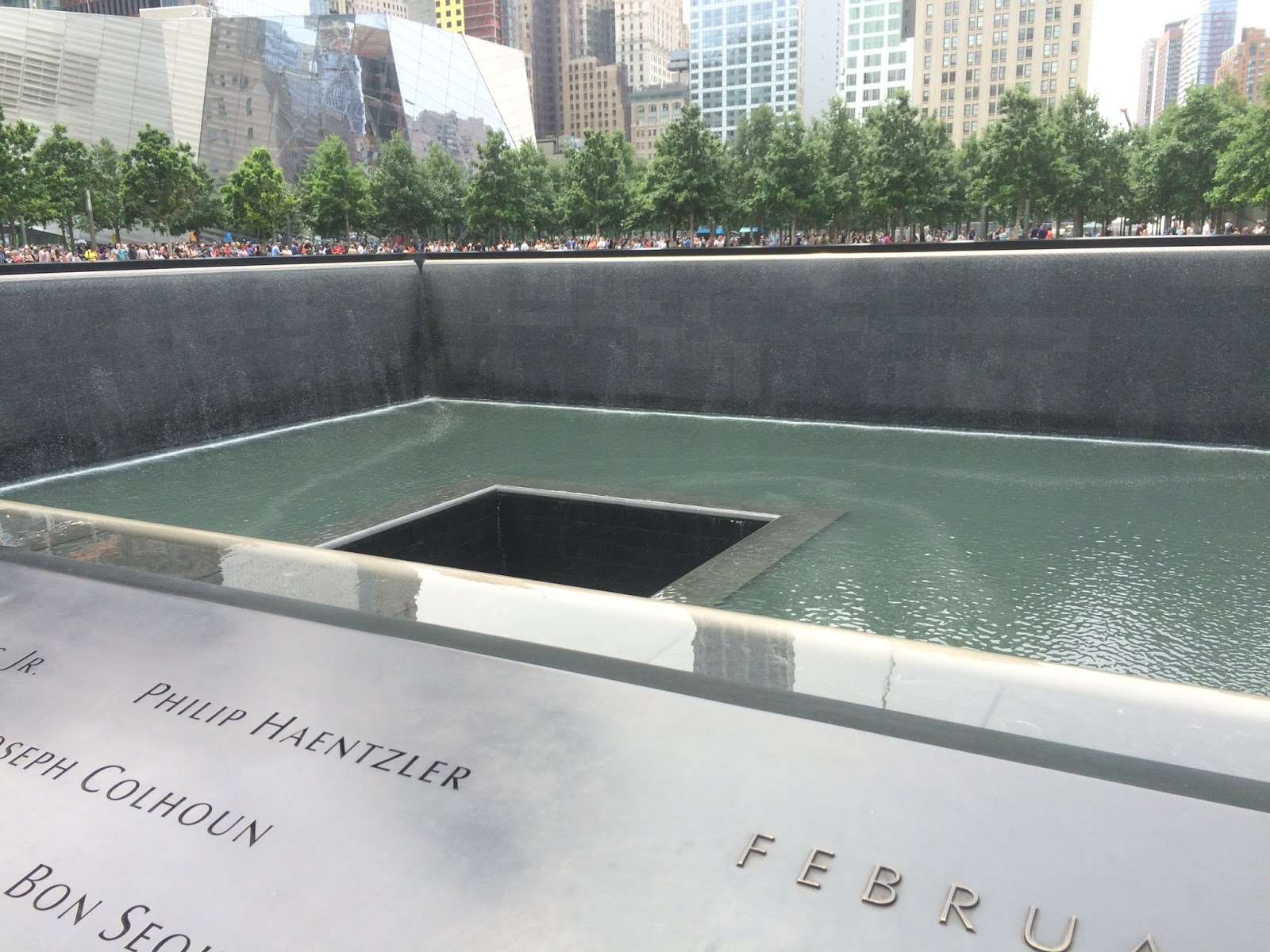
At another point in the trip, I visited One World Trade Center, which had recently opened its observation deck.  It offers an impressive 360-degree panorama of the city.  Most compelling, however, was the view directly down the side of the building.  From the staggeringly high elevation, one cannot help but be awed by the footprint of the absent twin towers. From the top of the new edifice, it looks like a scarred landscape, two stark holes in the earth where the World Trade Center used to be. Back on the ground, however, these holes are transformed into something simple and beautiful, hardly barren or scarred. Two fountains with gushing water draw you in, as if to say, "there is still life here," even as you stand reading the names of the dead encircling the monument.  A new thing has definitely sprung forth, a way in the wilderness, a river in the desert.

Both of these places serve to ground people in the best attributes of human nature: strength, resilience, hope, peace.  They pull us out of a frenetic world and remind us to pray--whether we're religious or not--for deliverance from sin, suffering and death, and to seek a future of abundant life.

Blessings,
Fr. Ethan+