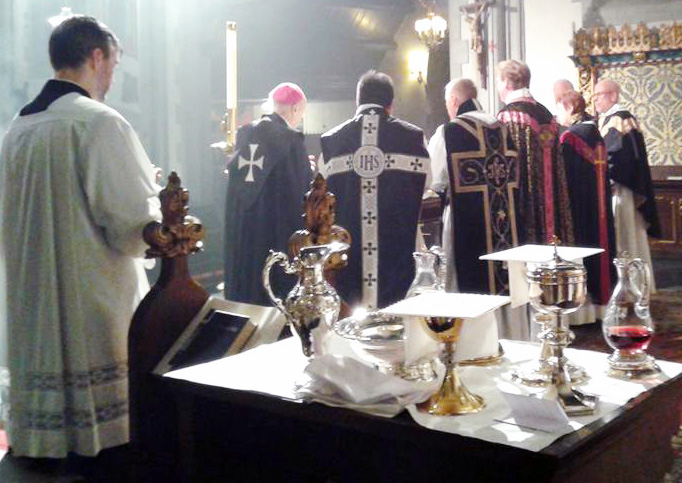
This Sunday, Christians all over the world will observe the Feast of Pentecost, which people often call the Church's birthday. Our reading from the Acts of the Apostles recounts the day that the Holy Spirit alighted on Jesus's followers, equipping them for ministry. The story illustrates what we call the four Notes or Marks of the Church : that the Church is (1) ONE, (2) HOLY, (3) CATHOLIC, and (4) APOSTOLIC. We affirm these qualities every Sunday when we recite the Nicene Creed; but many of us say the words without really reflecting on what they mean.
The statement that the Church is ONE, emphasizes its fundamental unity, such as when St. Paul refers to us as "the Body of Christ." It is often hard to appreciate or even believe that the Church is one, when there are so many divisions among Christians into different denominations, theological views, and worship styles. Nonetheless, we affirm that, however much we human beings may have fragmented the Church over the centuries, God is working through us to restore it to wholeness, which is why ecumenical work, for instance, is so important. Remembering that the Church's essence is to be ONE should impel us to seek out unity where we can.
The Church is also HOLY, in that it calls us into a particular kind of living. This lifestyle is modeled on the example of Jesus, who showed us how to spread peace, justice, and harmony by fashioning mutual, moral relationships with God and among all human beings. The Church's teachings, its sacramental life, and its mission in the world are tools for us to live as Jesus did, so that we can inhabit that holiness.
The Church is CATHOLIC, according to the original definition of the word, which is "universal." The Church is not limited to one locale, one denominational tradition, or one worship style; but rather embraces all Christians everywhere. The Pentecost story in Acts is a testament to the fact that Jesus's disciples were commanded to spread the Gospel to every family, tribe, language, people, and nation, baptising them in the name of the Father, and of the Son, and of the Holy Spirit.
Finally, the Church is APOSTOLIC, meaning that the Christian faith we practice is a legacy from the first apostles that has been handed down from generation to generation. Known as the "Vincentian Canon," St. Vincent of Lérins in the 5th century affirmed the universality of this apostolic faith by claiming that it is "what has been believed everywhere, always, by all." Now, that may seem like a pretty bold and sweeping statement that may not hold up under scrutiny; and yet it is easy to perceive even in our own Sunday services the enduring legacy of the apostles: the reading of Scripture; the blessing and sharing of bread and wine; prayers for the Church and the world. There are still many common features between our faith and that of the apostles, as the Baptismal Covenant in the Book of Common Prayer makes clear.
Although the Church is one, holy, catholic, and apostolic, it is only so in an imperfect way. The Church is often prone to schism and disunity, corruption and vice, denominational prejudice, and theological error. When we recite the Nicene and Apostles' Creeds, there's always a hint that we are making an aspirational statement, that we will work to make the Church a better and fuller embodiment of those four essential qualities that we claim for it. The Acts story is clear that the gift of the Holy Spirit was given to all who were present, without distinction--men and women, slaves and free, old and young, worthy and unworthy. The apostolic ministry has been given to each one of us, and each of us is called to serve. Each one of us is called to embody the one, holy, catholic, and apostolic Church as we go about the ordinary activities of our daily lives. That should give us something deep to reflect on this Sunday, as we recount the descent of the Holy Spirit upon Jesus's followers in the gust of wind that brings God's holy fire.
Abundant blessings,
Fr. Ethan+
Showing posts with label Body of Christ. Show all posts
Friday, June 7, 2019
One, Holy, Catholic and Apostolic
Labels:
Acts of the Apostles,
apostolic,
Baptismal Covenant,
Body of Christ,
Book of Common Prayer,
catholic,
Christian,
church,
faith,
God,
Holy Spirit,
Jesus,
Marks of the Church,
Nicene Creed,
Pentecost,
St. Paul
Friday, July 27, 2018
Plenty to Go Around
Saturday, January 16, 2016
Statement on the Primates' Meeting in Canterbury
My dear brothers and sisters,
The recent news from the Primates' Meeting in Canterbury has generated a lot of controversy, debate, and hurt feelings in the Episcopal Church, particularly among lesbian, gay, bisexual, transgender and other queer people, as well as their heterosexual allies. The resolution by the primates to exclude the Episcopal Church from the governing bodies and activities of the Anglican Communion for three years appears to many a punitive, disciplinary measure designed to pressure the Episcopal Church to retreat from its support of marriage equality by extending marriage rites to same-sex couples.
A number of parishioners have expressed their disappointment and distress to me, and have asked me to offer my perspective. Let me begin by assuring you that I share your feelings of sadness, and perhaps even anger, that the primates have taken this approach to resolving differing views around human sexuality. It does not seem to cohere with what St. Paul tells us in 1 Corinthians, that "the eye cannot say to the hand, 'I have no need of you,' nor again the head to the feet, 'I have no need of you.' [...] If one member suffers, all suffer together with it; if one member is honored, all rejoice together with it." I believe that every member of the Anglican Communion will suffer and be diminished by the primates' choice of a punitive response to the experience of the Body of Christ's fragmentation.
I have no doubt that many people on the opposite side of the issue from me are acting out a sense of real integrity, regarding biblical and historical understandings of marriage. However, we as a Church have to exercise great caution that we do not coerce or bully those who would disagree with us into compliance. It was regrettable that the Archbishop of Canterbury, Justin Welby, chose to apologize to gay and lesbian Christians for hurt caused by the Church only moments after the primates had stigmatized them by disciplining the Episcopal Church for its longstanding commitment to the inclusion of queer people in the full sacramental life of the Church. The primates' failure, moreover, to discipline those Anglican provinces that have failed to observe the Anglican Communion's policy against homophobia and oppression by supporting legislation to persecute or even execute queer people in their countries likewise bespeaks a poor and inconsistent respect for theological difference.
The great gift of the Anglican Communion is that it is not a confessional church and that each province enjoys the autonomy to live out its Anglican identity in its distinctive context. Recent moves from primates, especially those from the Global South, to reframe Anglican polity along a more authoritarian model is deeply distressing. Anglicanism has never had a centralized international structure, such as a curia or magisterium, to enforce doctrinal compliance. The Anglican Communion is not a political and administrative bureaucracy, but rather a family or network of national and regional churches with common spiritual roots. Our longstanding relationships through shared worship, service, and fellowship have made us what we are, not legislated compliance on litmus-test issues. Although the primates' gesture of exclusion is deeply painful to many, it will in no way make the Episcopal Church any less legitimately Anglican. Tomorrow, we will gather to worship God in the Anglican heritage, as we have always done. And we will continue to be the face of the Anglican Communion in the South Loop of Chicago.
Epiphany peace and blessings,
Fr. Ethan+
The recent news from the Primates' Meeting in Canterbury has generated a lot of controversy, debate, and hurt feelings in the Episcopal Church, particularly among lesbian, gay, bisexual, transgender and other queer people, as well as their heterosexual allies. The resolution by the primates to exclude the Episcopal Church from the governing bodies and activities of the Anglican Communion for three years appears to many a punitive, disciplinary measure designed to pressure the Episcopal Church to retreat from its support of marriage equality by extending marriage rites to same-sex couples.
A number of parishioners have expressed their disappointment and distress to me, and have asked me to offer my perspective. Let me begin by assuring you that I share your feelings of sadness, and perhaps even anger, that the primates have taken this approach to resolving differing views around human sexuality. It does not seem to cohere with what St. Paul tells us in 1 Corinthians, that "the eye cannot say to the hand, 'I have no need of you,' nor again the head to the feet, 'I have no need of you.' [...] If one member suffers, all suffer together with it; if one member is honored, all rejoice together with it." I believe that every member of the Anglican Communion will suffer and be diminished by the primates' choice of a punitive response to the experience of the Body of Christ's fragmentation.
I have no doubt that many people on the opposite side of the issue from me are acting out a sense of real integrity, regarding biblical and historical understandings of marriage. However, we as a Church have to exercise great caution that we do not coerce or bully those who would disagree with us into compliance. It was regrettable that the Archbishop of Canterbury, Justin Welby, chose to apologize to gay and lesbian Christians for hurt caused by the Church only moments after the primates had stigmatized them by disciplining the Episcopal Church for its longstanding commitment to the inclusion of queer people in the full sacramental life of the Church. The primates' failure, moreover, to discipline those Anglican provinces that have failed to observe the Anglican Communion's policy against homophobia and oppression by supporting legislation to persecute or even execute queer people in their countries likewise bespeaks a poor and inconsistent respect for theological difference.
The great gift of the Anglican Communion is that it is not a confessional church and that each province enjoys the autonomy to live out its Anglican identity in its distinctive context. Recent moves from primates, especially those from the Global South, to reframe Anglican polity along a more authoritarian model is deeply distressing. Anglicanism has never had a centralized international structure, such as a curia or magisterium, to enforce doctrinal compliance. The Anglican Communion is not a political and administrative bureaucracy, but rather a family or network of national and regional churches with common spiritual roots. Our longstanding relationships through shared worship, service, and fellowship have made us what we are, not legislated compliance on litmus-test issues. Although the primates' gesture of exclusion is deeply painful to many, it will in no way make the Episcopal Church any less legitimately Anglican. Tomorrow, we will gather to worship God in the Anglican heritage, as we have always done. And we will continue to be the face of the Anglican Communion in the South Loop of Chicago.
Epiphany peace and blessings,
Fr. Ethan+
Wednesday, November 4, 2015
All Souls' Day: A Storehouse of Consolation
A Sermon for All Souls' Day. A link to the audio recording can be found here.
In the name of the Father, and of the Son, and of the Holy Spirit. Amen.
A young man sat across from me last Tuesday on the Red Line train during the evening rush hour. We’ll call him Phil. Phil was in his mid- to late-20s, with a shaggy ginger beard and huge headphones over his ears. He looked up at me every now and then, and after several stops, finally leaned forward and ventured tentatively:
“You’re a priest, right?”
“I am,” I stated pithily, smiling.
“So, do I call you, Father or Pastor, or what?”
“Those are fine. Or you can just call me Ethan.”
“OK. Can I ask you a question?”
“Sure. Go ahead.”
“I’m not a Catholic or anything, Father, but …”
“Neither am I, actually. I am a priest in the Episcopal Church,” I hastened to clarify. (I decided not to muddy the waters by explaining Anglo-Catholicism. I knew what he meant.) Phil’s face brightened with a look of recognition.
“The Episcopal Church. OK, so you don’t have confession, then?”
“Actually, we do,” I said encouragingly. “But we often call it reconciliation.”
“Hmm. Really? Well, do you think that the sins and bad stuff we do can affect our physical health? ‘Cause I’ve been feeling kind of sick, lately,” Phil confided. “I’m wondering if there’s a spiritual cause for it?”
“Absolutely,” I agreed. “I firmly believe that the things that weigh on our consciences can affect our whole selves, emotionally, spiritually, and physically.” Phil seemed genuinely engaged, so I continued. “They damage our souls, and they can turn toxic and work on us over the long haul, if we don’t process them through therapy or sacramental confession. In fact, I do both, and I highly recommend them. They can make a huge difference.” Phil’s face, which had been intensely serious, relaxed into a smile.
“OK, thanks,” he said reflectively, as we shook hands and I got off the train.
To those who say that sin is an outmoded, medieval concept, my brief conversation with Phil would suggest, on the contrary, the world is still in desperate need of God’s mercy. And that’s because sin is real, however much our society might deny its existence. Sin is a difficult sell these days, because we would prefer to focus on God’s estimation of the created order, including us, as very good, as the book of Genesis records. But the recognition of human sinfulness does not invalidate God’s original blessing. Rather, it acknowledges our complexity: that the human experience is fraught with moral failings that we cannot resolve by ourselves. We may be inherently good, but we are not sufficient unto ourselves. We need God.
It may be hard for us to discern this hopeful message in the Requiem’s severe language. Contemporary sensibilities are not attuned to the Requiem’s central theme of the wrath and vengeance of divine judgment. But to really appreciate the extravagant gift of God’s mercy and deliverance from sin, we need to engage equally extravagant language around human brokenness. If the human condition were expressed in lukewarm terms, then God’s remedy would seem far less dramatic, far less redemptive. What is deeply beautiful about the Requiem liturgy is the notion that however far we may fall, however much we might deserve divine retribution, God, out of his endless love for us, offers us abundant mercy. And this is where the liturgy ends up, with the balm of divine absolution.
This evening’s readings are aligned to this hopeful outlook. They are meant to provide reassurance in the face of fear and despair, doubt and failure. The Dies irae expresses the intensity of human terror in the face of death and final judgment, and, yet in the Recordare there is a note of humility and tenderness that acknowledges God’s promise of redemption through Jesus’s once-for-all sacrifice on the Cross. “Remember, kind Jesus, / my salvation caused your suffering; / do not forsake me on that day. / Faint and weary you have sought me, / redeemed me, suffering on the cross; / may such great effort not be in vain.”
A wise priest said to me one day, while instructing me how to hear confessions, “Remember that we come to confession, not for condemnation, but for forgiveness.” In the face of deserved judgment, God offers forgiveness to those who seek it out in a spirit of sincere repentance. It is a pity that so few people nowadays avail themselves of the sacrament of confession, because I think it would provide a baseline for understanding how the Requiem amplifies on a cosmic scale the assurance of God’s mercy the priest offers the penitent in life. In death, too, we are assured of mercy. We may be broken, but God intervenes to make us whole. And we are insufficient unto ourselves, not only because we must rely on God, but also because we must rely on each other. That is what it means to be the Body of Christ and to participate in the great cloud of witness we call the Communion of Saints, which we celebrated yesterday.
The Communion of Saints, however, is often practiced as a one-way street, rather than the mutual relationship of intercession and encouragement that it is. Yesterday, as we recited or sung the Litany of the Saints, we asked the holy ones who have gone before us for their intercession as we face the strife of our lives here on earth. Yet, the saints are not just charged with the ministry of conveying our repentance to God, and pleading on our behalf. They are also sinners with their own brokenness and pain, seeking wholeness and ultimate union with God, for whom we pray. One theological tradition of the Church has argued that whatever brokenness we have acquired through sin during our lives on earth, we must face it after death in a reality that precedes Heaven. I have imagined this myself not so much as working off our sins, but God granting us the space to repair the damage to our souls through healing, and learning, and new spiritual insight, so that we may achieve a more intimate union with Him. In the end, who knows? What is fairly certain is that we each meet our Maker with a certain amount of woundedness. So, the living in turn pray for the departed on All Souls’ Day, asking God to show them mercy and heal their brokenness. The Communion of Saints is about solidarity in the midst of shared sinfulness and vulnerability and hope.
The great luminary of the Oxford Movement, John Mason Neale, offered the following guidance in his sermon on All Souls’ Day 1856 to the sisters of the Society of Saint Margaret, of whom he was the founder and first chaplain. He said,
In fact, the prayers of the living and the dead for each other across the ages drives the Church’s core identity as one, holy, catholic and apostolic. From the apostles, martyrs and confessors of the primitive Church down to Phil, and you and me in this day, we are united in God’s promise of mercy and new life. “Very truly, I tell you,” Jesus proclaims in the Gospel of John, “anyone who hears my word and believes him who sent me has eternal life, and does not come under judgment, but has passed from death to life.” The Eucharist that we are about to celebrate is our regular affirmation of this promise of eternal life, when human brokenness is redeemed, ours and the servants who have gone before us. Bread broken that, in the fullness of God’s time, we might be whole.
Rest eternal grant unto them, O Lord. And let light perpetual shine upon them.
May they rest in peace. Amen.
In the name of the Father, and of the Son, and of the Holy Spirit. Amen.
A young man sat across from me last Tuesday on the Red Line train during the evening rush hour. We’ll call him Phil. Phil was in his mid- to late-20s, with a shaggy ginger beard and huge headphones over his ears. He looked up at me every now and then, and after several stops, finally leaned forward and ventured tentatively:
“You’re a priest, right?”
“I am,” I stated pithily, smiling.
“So, do I call you, Father or Pastor, or what?”
“Those are fine. Or you can just call me Ethan.”
“OK. Can I ask you a question?”
“Sure. Go ahead.”
“I’m not a Catholic or anything, Father, but …”
“Neither am I, actually. I am a priest in the Episcopal Church,” I hastened to clarify. (I decided not to muddy the waters by explaining Anglo-Catholicism. I knew what he meant.) Phil’s face brightened with a look of recognition.
“The Episcopal Church. OK, so you don’t have confession, then?”
“Actually, we do,” I said encouragingly. “But we often call it reconciliation.”
“Hmm. Really? Well, do you think that the sins and bad stuff we do can affect our physical health? ‘Cause I’ve been feeling kind of sick, lately,” Phil confided. “I’m wondering if there’s a spiritual cause for it?”
“Absolutely,” I agreed. “I firmly believe that the things that weigh on our consciences can affect our whole selves, emotionally, spiritually, and physically.” Phil seemed genuinely engaged, so I continued. “They damage our souls, and they can turn toxic and work on us over the long haul, if we don’t process them through therapy or sacramental confession. In fact, I do both, and I highly recommend them. They can make a huge difference.” Phil’s face, which had been intensely serious, relaxed into a smile.
“OK, thanks,” he said reflectively, as we shook hands and I got off the train.
To those who say that sin is an outmoded, medieval concept, my brief conversation with Phil would suggest, on the contrary, the world is still in desperate need of God’s mercy. And that’s because sin is real, however much our society might deny its existence. Sin is a difficult sell these days, because we would prefer to focus on God’s estimation of the created order, including us, as very good, as the book of Genesis records. But the recognition of human sinfulness does not invalidate God’s original blessing. Rather, it acknowledges our complexity: that the human experience is fraught with moral failings that we cannot resolve by ourselves. We may be inherently good, but we are not sufficient unto ourselves. We need God.
It may be hard for us to discern this hopeful message in the Requiem’s severe language. Contemporary sensibilities are not attuned to the Requiem’s central theme of the wrath and vengeance of divine judgment. But to really appreciate the extravagant gift of God’s mercy and deliverance from sin, we need to engage equally extravagant language around human brokenness. If the human condition were expressed in lukewarm terms, then God’s remedy would seem far less dramatic, far less redemptive. What is deeply beautiful about the Requiem liturgy is the notion that however far we may fall, however much we might deserve divine retribution, God, out of his endless love for us, offers us abundant mercy. And this is where the liturgy ends up, with the balm of divine absolution.
This evening’s readings are aligned to this hopeful outlook. They are meant to provide reassurance in the face of fear and despair, doubt and failure. The Dies irae expresses the intensity of human terror in the face of death and final judgment, and, yet in the Recordare there is a note of humility and tenderness that acknowledges God’s promise of redemption through Jesus’s once-for-all sacrifice on the Cross. “Remember, kind Jesus, / my salvation caused your suffering; / do not forsake me on that day. / Faint and weary you have sought me, / redeemed me, suffering on the cross; / may such great effort not be in vain.”
A wise priest said to me one day, while instructing me how to hear confessions, “Remember that we come to confession, not for condemnation, but for forgiveness.” In the face of deserved judgment, God offers forgiveness to those who seek it out in a spirit of sincere repentance. It is a pity that so few people nowadays avail themselves of the sacrament of confession, because I think it would provide a baseline for understanding how the Requiem amplifies on a cosmic scale the assurance of God’s mercy the priest offers the penitent in life. In death, too, we are assured of mercy. We may be broken, but God intervenes to make us whole. And we are insufficient unto ourselves, not only because we must rely on God, but also because we must rely on each other. That is what it means to be the Body of Christ and to participate in the great cloud of witness we call the Communion of Saints, which we celebrated yesterday.
The Communion of Saints, however, is often practiced as a one-way street, rather than the mutual relationship of intercession and encouragement that it is. Yesterday, as we recited or sung the Litany of the Saints, we asked the holy ones who have gone before us for their intercession as we face the strife of our lives here on earth. Yet, the saints are not just charged with the ministry of conveying our repentance to God, and pleading on our behalf. They are also sinners with their own brokenness and pain, seeking wholeness and ultimate union with God, for whom we pray. One theological tradition of the Church has argued that whatever brokenness we have acquired through sin during our lives on earth, we must face it after death in a reality that precedes Heaven. I have imagined this myself not so much as working off our sins, but God granting us the space to repair the damage to our souls through healing, and learning, and new spiritual insight, so that we may achieve a more intimate union with Him. In the end, who knows? What is fairly certain is that we each meet our Maker with a certain amount of woundedness. So, the living in turn pray for the departed on All Souls’ Day, asking God to show them mercy and heal their brokenness. The Communion of Saints is about solidarity in the midst of shared sinfulness and vulnerability and hope.
![]() |
| John Mason Neale |
“But for the great multitude of those who have been redeemed to God … they without us shall not be made perfect. And it is they, the true Servants of God, but not his Saints, whom we keep in memory to-day. And what then? Between them and us is there no fellowship? Is there such a great gulf fixed, that no prayers, no power or grace of the Church can overleap it? God forbid! This it is to hold the Catholic faith; this it is to derive the untold comforts of her storehouse of consolation. Think now each of you, of the dear ones whom you have lost, and believe this earnestly: that, if they have slept in the Lord, your prayers still avail for them, as much as (or more than) if they were still present in the flesh. Let it be so, that we cannot tell what their needs are; that we know not what especial increase of grace they lack; in what particular way they desire to be helped.”The saints, whom Neale calls simply servants, to remind us of our kinship with them, are bonded to us in common care and prayer across the ages. We share in the untold comforts of the Church’s storehouse of consolation in prayer, the sacraments, and our relationships with each other, the living and the departed.
In fact, the prayers of the living and the dead for each other across the ages drives the Church’s core identity as one, holy, catholic and apostolic. From the apostles, martyrs and confessors of the primitive Church down to Phil, and you and me in this day, we are united in God’s promise of mercy and new life. “Very truly, I tell you,” Jesus proclaims in the Gospel of John, “anyone who hears my word and believes him who sent me has eternal life, and does not come under judgment, but has passed from death to life.” The Eucharist that we are about to celebrate is our regular affirmation of this promise of eternal life, when human brokenness is redeemed, ours and the servants who have gone before us. Bread broken that, in the fullness of God’s time, we might be whole.
Rest eternal grant unto them, O Lord. And let light perpetual shine upon them.
May they rest in peace. Amen.
In the name of the Father, and of the Son, and of the Holy Spirit. Amen.
Subscribe to:
Posts (Atom)