- "Well, the kids are noisy and fussy and disturb other parishioners."
- "They don't understand what's going on, and they get bored."
- "We have a wonderful children's program in the basement."
Yes, kids can be noisy and fussy. They may cry, or babble, or try to make a break for it and run around the sanctuary. They may get bored by sitting so long in an uncomfortable pew, or by the incessant chattering we adults tend to do--what the children at my current parish call, "talky-talky." So, what? It's not the end of the world. And perhaps your congregation does have a sensational Godly Play, Catechesis of the Good Shepherd, or Sunday School program. Those programs may indeed be very edifying and important. But, in the end, none of that matters to me. The only argument regarding children in worship I really care about comes from our Lord himself:
- "People were bringing little children to him in order that he might touch them; and the disciples spoke sternly to them. But when Jesus saw this, he was indignant and said to them, ‘Let the little children come to me; do not stop them; for it is to such as these that the kingdom of God belongs. Truly I tell you, whoever does not receive the kingdom of God as a little child will never enter it.’ And he took them up in his arms, laid his hands on them, and blessed them.'" (Mark 10:13-16). There are similar passages in Matthew and Luke, as well.

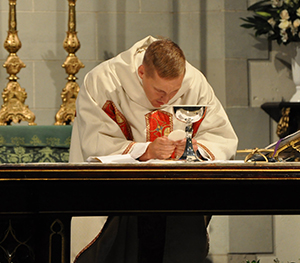
In fact, if Jesus weren't a great enough authority on this question, I am absolutely convinced, for what it's worth, that children DO get what's going on. I don't care if the worship is as simple as bread shared around the kitchen table or as rarefied as Solemn High Mass in the Presence of a Greater Prelate presiding from the faldstool. Children get it. And adults may not be able to tell. Kids may not have fancy theological terms to articulate what they are experiencing; they may not intellectually understand what's going on. But they know something special is happening, and they want to be a part of it. I have seen children gaze with rapt awe as the priest consecrates the bread and wine at the altar, and then attempt to imitate the gestures themselves. I have witnessed a six-year-old catechize her three-year-old sister in the sacred mystery of the Eucharist by placing her hands in the shape of a cross to receive the consecrated bread in her tiny palm. I have been surprised to find that the children sitting on the floor shouting remembered some story I told in a sermon about a saint's life, when I was sure their short attention span had led them a million miles away to something far more fascinating. I wouldn't trade these chaotic moments for anything--no matter how polished, choreographed, or talky-talky.

The best way children learn about what it means to be a Christian is to practice, to worship alongside their parents and accept the mysteries that God makes present in whatever ways their developmental stage allows. To practice by doing it over and over again, so that it becomes second nature, embodied. That's what good catechesis looks like. This may include a fair bit of shouting, crying, running around, and general commotion. Perhaps our tendency to blame children for failing to appreciate the very important and serious work we're doing in the sanctuary should be turned back on us. Perhaps we adults should ask ourselves how we've failed to engage children in the joy of the Gospel. If kids aren't interested in worship, as many adults claim, then maybe we should give them something worth paying attention to. Could it be that they are trying to teach us something important about what worship should or could be? Maybe sometimes worship should be messy and unpredictable. Not a free-for-all, just not tame. Not what adults would have it be. If, as Jesus says, we need to learn how to receive the kingdom of God as a child, we should be trying to learn from children how to to receive Jesus without reserve, without affectation, with the pure joy and commotion of the Hosannas that accompanied his triumphant entrance into Jerusalem on the back of a donkey. I suspect that even then there were children teaching the adults the proper way to behave in our Lord's presence.
Abundant blessings,
Fr. Ethan+