Showing posts with label theology. Show all posts

Tuesday, October 6, 2015

Ritual Notes

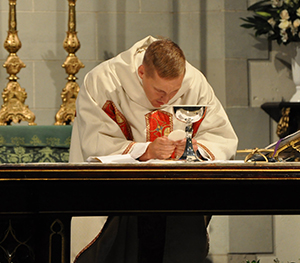
I have been thinking a lot about ritual lately, both as a priest in a new parish and in light of the upcoming annual conference of the Society of Catholic Priests, which begins this week in Denver. As usual, liturgy will be a primary component of the conference. We will come together from our diverse parishes, each with its unique ritual customs, and do our best not to throw each other off or step on each others' feet.

In seminary, I was taught that even congregations and denominations that do not consider themselves "liturgical churches" still have patterns and customs for worship that over time become normative. They are in their own way rituals, or performance. Worship is performance, not in the sense of entertainment, but rather as the way a worshiping community enacts the theological, relational, and cultural values that are foundational to its identity. From week to week, we see a congregation perform an established repertoire of acts, gestures, and statements that say, "this is who we are."

Growing up as a young Jewish kid at Congregation Kol Ami, I came to know and anticipate every core gesture and to blend in with the rhythm and pacing of every practiced word. But I also noticed the places in the service where there was untidiness, even dissonance. The fact that Judith Sobel sang theAlenu an octave higher than everyone else--and not always on key--and that some people bent their knees and bowed at the designated place in that prayer, and some didn't, were also part of the congregation's identity. Every congregation, no matter how uniform it may look from the outside, is diverse: diverse pieties, spiritualities, theologies, and ritual sensibilities. In Episcopal congregations, for example, at the invocation of the Holy Trinity, some people will make the sign of the cross, or bow, or do nothing at all. In some parishes, certain people will kneel during the Eucharistic Prayer, while others will stand. Some adore "bells and smells," while others would prefer it simple and unadorned. And you may find all of this diversity within one congregation.


From the priest's perspective--at least, this priest's perspective--the challenge is to acknowledge and respect this diversity. In every service, the priest hopes that each person will find something that will spirituality nourish him or her. Perhaps it will be the sermon, or the hymns, or the language we use to talk about God. The ritual actions likewise may resonate with one person, and not another, for theological, aesthetic or cultural reasons. And, perhaps unexpectedly, the congregation's diversity also includes the priest. Like the congregation, the priest is a worshiper who brings his or her theology, relationship with God, personality, and ritual sensibilities to the altar. Anglicanism has always striven for unity without uniformity, and I would add, communion without conformity. Ritual should, therefore, make a generous space for "a bit of me" and "a bit of you." At its best, worship will enable both priest and every member of the congregation to bring something of their authentic selves to their shared encounter with God. 

Abundant blessings,
Fr. Ethan+


Monday, September 7, 2015

Why Episcopal Identity Matters: Part II

Last week's blog offered five reasons why Episcopal identity and practice are still relevant in a pluralistic, post-denominational, and postmodern society. This week, I offer the final five on my list.

St. Augustine of Canterbury
6. A rich theological heritage. The Book of Common Prayer provides a basic framework for Episcopal belief and practice, but Anglicanism boasts a much richer corpus of theological resources. Anglican thought traces its origins back beyond the Reformation to the era of Celtic Christianity and St. Augustine's mission to the English in the late 6th century. The Anglican heritage claims medieval greats, such as the Venerable Bede and Julian of Norwich. It is grounded in the work of major Reformation theologians like Thomas Cranmer and Richard Hooker and the sublime poetry of John Donne and George Herbert, both priests in the Church of England. Anglicanism nurtured the Oxford Fathers who led the Catholic Revival of the mid-19th century, which revitalized Anglican liturgy, hymnody, and architecture. It shaped the Christian Socialism movement later in the century. In this generation, Anglicanism has produced first-rate intellectuals and academicians, such Sarah Coakley, Katherine Tanner, Rowan Williams, and of course, Desmond Tutu.

7. Contemplation and mysticism. Anglicans are not just thinking folk. They are also people open to the deep, internal experience of God. The contemplative life ranges from walking the labyrinth or participating in a centering prayer group to joining one of the professed religious communities of the Anglican Communion, such as the Society of St. John the Evangelist, the Order of Julian of Norwich, or the Brotherhood of St. Gregory.

Chanting the Exsultet at the Easter Vigil.
8. Beautiful music. One of Anglicanism's principal contributions to Christianity is a strong musical repertoire. The Anglican tradition excels in both choral and congregational singing. At an Easter Vigil, you might hear a deacon chant the Exsultet, one of the most ancient and revered pieces of sacred music, followed by a choir performing Anglican chant and plainsong. During the week, you might participate in a Taize service or Choral Evensong with a contemporary setting of the Magnificat. On an average Sunday, you will likely join a congregation in singing hymns written by legendary figures, such as Isaac Watts, John and Charles Wesley, and John Mason Neale.


Map of the Anglican Communion.
9. A global context of belonging. The Episcopal Church is a member of the Anglican Communion, a worldwide fellowship of 38 national and regional provinces in communion with the Archbishop of Canterbury. The Anglican Communion is the third largest body of Christians in the world, after the Roman Catholic Church and the Eastern Orthodox churches. It consists of about 80 million people in 165 countries. Although sharing a common heritage in the Church of England and the Book of Common Prayer, each of these national churches lives out its Anglican identity differently, according to its unique cultural and social context. Some Anglican provinces are more catholic in their worship, while others are more evangelical or charismatic. Some are more socially and theologically liberal, while others are more conservative. The Episcopal Church engages with these other Anglican provinces through a variety of organizations and partnerships, including Episcopal Relief and Development, which offers support during natural disasters, epidemics, and other emergencies, as well as providing resources for long-term development.

10. An anchor in a turbulent world. Recent research from the Pew Research Center for Religion and Public Life and other thinktanks have demonstrated a resurgence of interest in traditional and liturgical forms of Christianity, such as the Episcopal Church. In a world when everything else is constantly changing, postmodern people are learning to value the spiritual grounding that the ancient traditions of Christianity have to offer.

This list is, of course, neither objective nor exhaustive; it is only my perspective on what the Episcopal Church and Anglicanism contribute to the spiritual life. Are there other reasons? Please respond back with your own suggestions and perspectives and add to this discussion.

Abundant blessings,
Fr. Ethan+

Monday, August 24, 2015

A Tale of Knives and Nunchucks

An audio recording of this sermon is available by clicking here.

The letter to the Ephesians commands its hearers to, “put on the whole armor of God, so that you may be able to stand against the wiles of the devil.” In this day and age, this sort of language seems out of place, whether for its militaristic overtones or the medieval worldview that it invokes. The image of Christian soldiers has often made me very uneasy, reminding me of shameful chapters in our history, like the Crusades and the Inquisition, when people have been oppressed and killed in the name of Jesus, the Prince of Peace. Talk of the devil and evil forces, moreover, seems superstitious and outmoded, calling forth visions of damned beings with horns and tails, inhabiting a realm of eternal suffering and unquenchable fire. And yet, I am here to tell you that these images are still compelling and relevant, even to postmodern people who think they have evolved beyond conventional understandings of angels and demons, of heaven and hell.

A brawl breaks out at Starbucks.
On Tuesday, I sat at a table at the Starbucks on Bryn Mawr in Edgewater, waiting for a parishioner to join me to plan adult forums for the rest of the year. As I sat in front of my laptop leisurely sipping my latte, a commotion erupted, and three men ran past me, swearing and knocking over chairs. At one point, one of these chairs became airborne as one man tried to shield himself from the blows of the other two, who were clearly enraged and bent on inflicting verbal abuse and physical violence. The shop’s patrons were alarmed, and so I packed up my stuff, and dashed outside to find a police officer. By the time I came back a few minutes later, a policeman was leading one of the men out of Starbucks in handcuffs. Over the course of the next several minutes, four more squad cars pulled up to offer backup, and the other two men were taken into custody, as well. The anxiety in the room quickly dissipated, and people returned to their drinks, conversations, and mobile devices. But my story doesn’t end there.

After my meeting, I jumped on the Red Line for my usual commute to Grace. When the trained pulled into the Jackson station, we interrupted another altercation already underway. As the platform came into view, I witnessed a woman attempting to defend herself with nunchucks against a man wielding a knife. The doors opened, and an officer in plain clothes whipped out his badge and shouted, “CPD!”  He exited the train and attempted to separate the two combatants and calm them down. Aided by another police officer in plain clothes, he apprehended the man with the knife, who had attempted to seek refuge on the train, all the while spouting obscenities. I thought about how frightened the German couple standing in front of me must’ve been, their school-age daughter in a wheelchair, facing the door where all of this turmoil was occurring. The two officers managed to subdue the aggressor, remove him from the train, and put him in cuffs. The woman, still holding her nunchucks, thanked the police officers, and announced, “he had the devil in him. He had the devil in him, and he showed his true colors.” I’m not making it up; she really said that.

Jesus' temptation in the wilderness.
It was harrowing to watch both of these scenes unfold before me, and to feel powerless to intervene. I was grateful that the police were responsive and professional during these incidents of unexpected violence that endangered so many innocent bystanders. It was fortunate that an officer just happened to be standing in front of the door -- in my train car -- at that precise moment. I don’t know if it was divine grace or dumb luck, and I frankly didn’t care.  But when I become complacent, feeling that the world is safe, moments like this remind me that human beings can still be agents of great suffering and violence, that evil really exists. I am not saying, of course, that the perpetrators of this violence are evil or are somehow not loved by God, but rather, that human beings—and that includes all of us—are susceptible to the lure of all kinds of sins, to selfish motives and evil urges.  We may not all act on these temptations, but they prod and goad us, encouraging us to give in to our baser impulses. This is what the reading from the Ephesians is all about. The devil is all around you, he’s crafty and powerful, so be on your guard and protect yourself, the reading tells us.  You’re kidding yourself if you think you’re immune. After all, Jesus spent 40 days in the wilderness being tempted by Satan, who offered our Lord wealth and power, if only he would bow down and worship him. 

I know that in the twenty-first century, sin is a topic that is out of fashion, and out of sync with contemporary sensibilities. Nobody wants to hear about it. As Jesus’s disciples say to him in this morning’s Gospel, while our Lord is teaching in the synagogue at Capernaum, “this teaching is difficult; who can accept it?”  Sin seems like a topic for fire-and-brimstone sermons from the seventeenth century. Besides, the Church has done so much to make us feel bad about ourselves, because of our sexual orientation, gender, or gender identity, or for using birth control or getting divorced, and a host of other things, that we’ve consigned sin to the theological dustheap. But I’m bringing back Old Time Religion this morning just for a moment, because I think we’ve overlooked something. There is a reason that we make our confession every Sunday before receiving Jesus’s body and blood at the altar: sin is real. It is not only the sin we commit as individuals against each other for which we ask for forgiveness, but it is also for our participation in institutionalized sins, such as racism, misogyny, ecological devastation, and rampant consumerism. We have a lot of sin to repent for.

Jesus's Baptism in the Jordan.
Ephesians offers us jarring language that chafes against our inclination to think of ourselves as just fine the way we are. I have always subscribed to the concept of original blessing, rather than original sin. When God said on the sixth day that everything that she had created was very good, I take God at her word. We ARE very good, but that doesn’t mean we can do without God, that we are self-sufficiently moral without God’s help. Even as good as we are, “the spiritual forces of evil” are formidable, and so we need to be vigilant and disciplined, because sin could crop up anywhere, at Starbucks or on the Red Line. To “take the shield of faith, to “fasten the belt of truth,” and to “put on the breastplate of righteousness” expresses the human aspiration to overcome the temptation to give in to sin. “As shoes for your feet,” Ephesians counsels, “put on whatever will make you ready to proclaim the gospel of peace.” In the face of sin and evil, we wrap ourselves in God, who shelters and protects us like armor.

This topic comes up most poignantly whenever I prepare new Christians, or their parents and godparents, for baptism. “Don’t be put off by the old-timey language,” I tell them. “Your child will face all kinds of evil in her life: human cruelty, apathy to the suffering of others, violence, greed, selfishness, and many other things that will divide her from God and her neighbor. In baptism, we are asking for God’s protection and guidance in such moments.” Indeed, the Baptismal Covenant in the Book of Common Prayer asks the person or sponsor, “will you persevere in resisting evil, and whenever you fall into sin, repent and return to the Lord.” The response is, “I will, with God’s help.” The Prayer Book suggests that the avoidance of sin is impossible, and so we just plug away as best we can and rely on God’s help to set us back on to the path of peace. As the disciples asked Jesus, I now ask you, “this teaching is difficult; who can accept it?”  

Friday, July 1, 2011

A candle before the limitless ocean of God

"We can know God in the same way a man can see a limitless ocean when he is standing by the shore with a candle during the night. Do you think he can see very much? Nothing much, scarcely anything. And yet, he can see the water well, he knows that in front of him is the ocean, and that this ocean is enormous and that he cannot contain it all in his gaze. So it is with our knowledge of God." -St. Symeon the New Theologian.

I stumbled upon this quote from St. Symeon the New Theologian recently while reading a book on contemplative prayer, and I was instantly struck by the Byzantine mystic's great humility before the immensity and elusiveness of God. (I should marginally note, however, that despite his appellation of "new," Symeon lived from AD 949 to 1022, which makes him rather old to those of us in the Western Church, and yet relatively recent within the Greek Orthodox theological tradition.)

In any event, Symeon's words cut me to the quick during a period when I encountered a lot of polarizing language from several quarters about orthodox belief, right doctrine, and base heresy. It issued from the mouths of Catholics and Protestants, conservatives and liberals, women and men. I heard it in the pulpit, saw it on Facebook, and witnessed it in casual moments in the sacristy. And I blush to admit that I even had my own moments of theological rigidity. Mea culpa. There was much invective about who was right and who was wrong, and I noticed that rather than bringing people together, this language alienated fellow brothers and sisters in Christ. More than the content of the claims, it was the meanspiritedness with which some of these denunciations and differences of opinion were delivered that disturbed and saddened me.

Now, I consider myself to hold quite orthodox beliefs--the Trinity, the divinity of Jesus, bodily resurrection from the dead, the Real Presence of Christ in the Eucharist--and yet I must still acknowledge that doctrine is but an imperfect human description of God's reality. We often treat doctrine as if it were empirically provable according to modern standards of scientific evidence, rather than as a signpost that points to a mystery we explore through stumbling and groping in the dark. Symeon rightly describes our limited human faculties as a candle flickering weakly before the immense mystery of God.

I am not, of course, suggesting that our inability to comprehend the fullness of God through doctrine should lead us to discard what the Church teaches. Doctrine is an important starting place for discovery, and it reflects centuries of the Church's collective wisdom and insight that merits preservation. That great Archbishop of Canterbury, Michael Ramsey, described the traditions of the Church, including doctrine, as the "divine paradosis--which is the Greek word for something that has been 'handed over' or 'passed on.'" Ramsey explains the value of our theological patrimony in the opening pages of The Anglican Spirit:

For when we Christians speak of tradition, we mean the experience of the Christian community lying authentically within that which God through Christ has handed over for the revelation of himself and the salvation of men and women everywhere.

Ramsey is pointing to the truth--not the fact--embedded in tradition, and yet recognizing that paradosis involves authentically engaging with something that is beyond our full understanding. I am cautioning us, therefore, to model Symeon's posture of humility in both the experience of and speaking about God. Those that assert with such confidence that they know exactly what God is about and treat with contempt those that differ in their religious convictions are falling short of God's call to humility and erring dangerously into idolatry by constructing God in man's image, rather than the other way around.

In the midst of this divisive talk, a very wise priest and friend stepped into the fray and gently counseled those who labeled themselves as "faithful Catholics" (being one himself) to be faithful by practicing another Catholic virtue, generosity, to acknowledge that others might have a piece of this truth of God that they did not possess. Perhaps their candles before the immensity of God reveals some detail that has escaped us. Generosity and humility cohere well with the Church's notion of its catholicity or universality. To be generous, without being rigid or supercilious, can be helpful in engaging with people at various places along the theological spectrum. One may be a faithful Catholic, or a faithful Protestant, or a faithful evangelical, or whatever, by acknowledging our own limitations before the limitless ocean. Generosity brings us closer to realizing the four marks of the Church, what we call the esse or essence of the Church: one, holy, catholic, and apostolic.