Back in the day, bookstores organized elaborate midnight launch parties for the latest Harry Potter books that were media events, with lines winding down the block, filled with kids and adults dressed as favorite characters from the wizarding world. The books encouraged a new generation of young people to pick up a book and read, sometimes all night, because they just couldn't get enough of Harry, Ron, Hermione, Hagrid, Dumbledore, and He-Who-Must-Not-Be-Named, Lord Voldemort. The Harry Potter phenomenon tells us something important: that people are ravenous for a world of enchantment and imagination. The contemporary world has starved us of magic, and we need to be fed.
 The Church is by nature conservative, cautious, risk-adverse. Stepping outside of established norms is uncomfortable. We sometimes feel that if we give in to popular culture or try to spin who we are in a different way, we are sacrificing essentials, diluting our identity, or dumbing down the faith. But I don't think it has to be that way. I'm not proposing that we give in to fads, but rather that we take a hard look at how well we've communicated our passion for the Christian story and identity. The epic tale of God's salvation of humanity and Jesus's self-giving love for us on the Cross is as compelling as anything J. K. Rowling has put on paper.
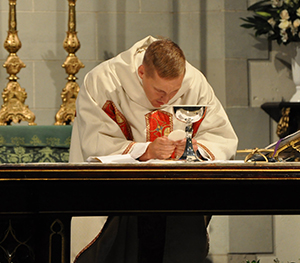
So, the fault lies with us, and now that we know that, we can do something about it. And the big advantage for us is that unlike the magical world of Harry Potter, our story really happened. When we gather together as a community, when I dress up in robes of red, purple or gold, when we say incantations over bread and wine or each other, we are not play-acting. We are doing a real thing, for we know that real magic lies in God's infinite, real power to transform us and the world. And this power is not God's alone. God has given us the power to be co-creators with him, by giving us a range of spiritual gifts. As Paul says in his First Letter to the Corinthians, "Now there are varieties of gifts, but the same Spirit; and there are varieties of services, but the same Lord; and there are varieties of activities, but it is the same God who activates all of them in everyone. To each is given the manifestation of the Spirit for the common good."
Those of you who are familiar with the Harry Potter books or films may remember that each of the four houses at Hogwarts is known for specific gifts, based on the virtues of their founders. Hufflepuffs are loyal. Ravenclaws are smart. Slytherins are resourceful. And, of course, Gryffindors are brave. The Christian tradition likewise credits certain people who have gone before us with spiritual gifts, known as charisms, that have inspired and strengthened subsequent generations. We look to these people to serve as exemplars of holiness and companions for us on our own journeys of faith. Their stories help us to understand our stories better, to see where God may be calling us to serve.
Therefore, one of the fundamental goals of our Christian formation this fall is to help each person identify his or her spiritual gifts and to discern how God is asking us to use them. It's not magic, just attentive listening to God's voice and going where it leads us. Our journey of discernment as individuals and as a community of Christians begins today. And for those who will undertake this journey, they should be mindful when the Sorting Hat is placed on their heads that they are making a commitment to learn and grow into a new creation. So, let's ask God to activate our imaginations and get sorted into our houses!
Abundant blessings,
Fr. Ethan+