Monday, August 24, 2015

A Tale of Knives and Nunchucks

An audio recording of this sermon is available by clicking here.

The letter to the Ephesians commands its hearers to, “put on the whole armor of God, so that you may be able to stand against the wiles of the devil.” In this day and age, this sort of language seems out of place, whether for its militaristic overtones or the medieval worldview that it invokes. The image of Christian soldiers has often made me very uneasy, reminding me of shameful chapters in our history, like the Crusades and the Inquisition, when people have been oppressed and killed in the name of Jesus, the Prince of Peace. Talk of the devil and evil forces, moreover, seems superstitious and outmoded, calling forth visions of damned beings with horns and tails, inhabiting a realm of eternal suffering and unquenchable fire. And yet, I am here to tell you that these images are still compelling and relevant, even to postmodern people who think they have evolved beyond conventional understandings of angels and demons, of heaven and hell.

A brawl breaks out at Starbucks.
On Tuesday, I sat at a table at the Starbucks on Bryn Mawr in Edgewater, waiting for a parishioner to join me to plan adult forums for the rest of the year. As I sat in front of my laptop leisurely sipping my latte, a commotion erupted, and three men ran past me, swearing and knocking over chairs. At one point, one of these chairs became airborne as one man tried to shield himself from the blows of the other two, who were clearly enraged and bent on inflicting verbal abuse and physical violence. The shop’s patrons were alarmed, and so I packed up my stuff, and dashed outside to find a police officer. By the time I came back a few minutes later, a policeman was leading one of the men out of Starbucks in handcuffs. Over the course of the next several minutes, four more squad cars pulled up to offer backup, and the other two men were taken into custody, as well. The anxiety in the room quickly dissipated, and people returned to their drinks, conversations, and mobile devices. But my story doesn’t end there.

After my meeting, I jumped on the Red Line for my usual commute to Grace. When the trained pulled into the Jackson station, we interrupted another altercation already underway. As the platform came into view, I witnessed a woman attempting to defend herself with nunchucks against a man wielding a knife. The doors opened, and an officer in plain clothes whipped out his badge and shouted, “CPD!”  He exited the train and attempted to separate the two combatants and calm them down. Aided by another police officer in plain clothes, he apprehended the man with the knife, who had attempted to seek refuge on the train, all the while spouting obscenities. I thought about how frightened the German couple standing in front of me must’ve been, their school-age daughter in a wheelchair, facing the door where all of this turmoil was occurring. The two officers managed to subdue the aggressor, remove him from the train, and put him in cuffs. The woman, still holding her nunchucks, thanked the police officers, and announced, “he had the devil in him. He had the devil in him, and he showed his true colors.” I’m not making it up; she really said that.

Jesus' temptation in the wilderness.
It was harrowing to watch both of these scenes unfold before me, and to feel powerless to intervene. I was grateful that the police were responsive and professional during these incidents of unexpected violence that endangered so many innocent bystanders. It was fortunate that an officer just happened to be standing in front of the door -- in my train car -- at that precise moment. I don’t know if it was divine grace or dumb luck, and I frankly didn’t care.  But when I become complacent, feeling that the world is safe, moments like this remind me that human beings can still be agents of great suffering and violence, that evil really exists. I am not saying, of course, that the perpetrators of this violence are evil or are somehow not loved by God, but rather, that human beings—and that includes all of us—are susceptible to the lure of all kinds of sins, to selfish motives and evil urges.  We may not all act on these temptations, but they prod and goad us, encouraging us to give in to our baser impulses. This is what the reading from the Ephesians is all about. The devil is all around you, he’s crafty and powerful, so be on your guard and protect yourself, the reading tells us.  You’re kidding yourself if you think you’re immune. After all, Jesus spent 40 days in the wilderness being tempted by Satan, who offered our Lord wealth and power, if only he would bow down and worship him. 

I know that in the twenty-first century, sin is a topic that is out of fashion, and out of sync with contemporary sensibilities. Nobody wants to hear about it. As Jesus’s disciples say to him in this morning’s Gospel, while our Lord is teaching in the synagogue at Capernaum, “this teaching is difficult; who can accept it?”  Sin seems like a topic for fire-and-brimstone sermons from the seventeenth century. Besides, the Church has done so much to make us feel bad about ourselves, because of our sexual orientation, gender, or gender identity, or for using birth control or getting divorced, and a host of other things, that we’ve consigned sin to the theological dustheap. But I’m bringing back Old Time Religion this morning just for a moment, because I think we’ve overlooked something. There is a reason that we make our confession every Sunday before receiving Jesus’s body and blood at the altar: sin is real. It is not only the sin we commit as individuals against each other for which we ask for forgiveness, but it is also for our participation in institutionalized sins, such as racism, misogyny, ecological devastation, and rampant consumerism. We have a lot of sin to repent for.

Jesus's Baptism in the Jordan.
Ephesians offers us jarring language that chafes against our inclination to think of ourselves as just fine the way we are. I have always subscribed to the concept of original blessing, rather than original sin. When God said on the sixth day that everything that she had created was very good, I take God at her word. We ARE very good, but that doesn’t mean we can do without God, that we are self-sufficiently moral without God’s help. Even as good as we are, “the spiritual forces of evil” are formidable, and so we need to be vigilant and disciplined, because sin could crop up anywhere, at Starbucks or on the Red Line. To “take the shield of faith, to “fasten the belt of truth,” and to “put on the breastplate of righteousness” expresses the human aspiration to overcome the temptation to give in to sin. “As shoes for your feet,” Ephesians counsels, “put on whatever will make you ready to proclaim the gospel of peace.” In the face of sin and evil, we wrap ourselves in God, who shelters and protects us like armor.

This topic comes up most poignantly whenever I prepare new Christians, or their parents and godparents, for baptism. “Don’t be put off by the old-timey language,” I tell them. “Your child will face all kinds of evil in her life: human cruelty, apathy to the suffering of others, violence, greed, selfishness, and many other things that will divide her from God and her neighbor. In baptism, we are asking for God’s protection and guidance in such moments.” Indeed, the Baptismal Covenant in the Book of Common Prayer asks the person or sponsor, “will you persevere in resisting evil, and whenever you fall into sin, repent and return to the Lord.” The response is, “I will, with God’s help.” The Prayer Book suggests that the avoidance of sin is impossible, and so we just plug away as best we can and rely on God’s help to set us back on to the path of peace. As the disciples asked Jesus, I now ask you, “this teaching is difficult; who can accept it?”  

Monday, August 17, 2015

In the Fiery Furnace

Growing up in Florida, I am used to the heat and the humidity. I spent my summers as a child running around barefoot in a swimsuit, only jumping out of the pool for an hour or so when the rain made its scheduled appearance late every afternoon. My feet developed asbestos soles from the many games we played unprotected over blacktop roads and concrete driveways. Sunscreen was purely optional. I braved fire-ants and giant, flying cockroaches. I wandered in woods inhabited by eastern diamondback rattlesnakes and alligators. And muggy doesn't even begin to describe the oppressiveness of the air during the summer months. Yet none of this ever seemed to bother me much.

The extreme heat this past week reminded me of how cavalier and resilient I used to be when I was young. When I walked into the church early Sunday morning, I discovered that someone had accidentally turned the heat on overnight. The whole first floor was stifling. Over the course of the morning, I began to feel weak and a little sick. My heart started racing about halfway through the second service, and I realized that I was likely suffering from dehydration. After mass was over, I knocked back several glasses of water and was fine. Later that day, I stretched out on the sunny lawn at the Ravinia Music Festival, eating a picnic lunch and watching Star Trek while the Chicago Symphony Orchestra played the score live. With the temperature in the mid-90s and the sun blazing directly overhead, I was pretty miserable until the sun started to go down. The heat had completely drained me, and I thought, "What happened? I used to be tougher than this."

Shadrach, Meshach, and Abednego in the furnace.
Human beings are delicate creatures. I envision Shadrach, Meshach, and Abednego in the fiery furnace in the Book of Daniel. In this story, the three Jews defy the Babylonian king, Nebuchadnezzar, declaring, "If our God whom we serve is able to deliver us from the furnace of blazing fire and out of your hand, O king, let him deliver us. But if not, be it known to you, O king, that we will not serve your gods and we will not worship the golden statue that you have set up" (Dan 3:17-18). The story emphasizes not only faithfulness to God in the most oppressive and dangerous situations, but also the fragility of human beings and their ultimate reliance on God. It made me mindful of our homeless sisters and brothers who have to suffer the oppressive heat--not to mention the brutality of Chicago winters--without any guarantee of shelter or comfort. How do they cope when the heat is too stifling and their bodies begin to buckle? How do we help to deliver them, in God's name, from the furnace?

Blessings,
Fr. Ethan+


Monday, August 10, 2015

Queen of Miscellany

When I was first discerning my call to the priesthood, the Diocese arranged for me to meet with three seasoned clergy to learn about the working life of a parish priest. One of these priests was the Rev. Suzi Holding, Rector of the Church of Our Savior in suburban Elmhurst, Illinois. We sat in her office, and she told me a lot about her journey to ordination, her hard-fought success in moving the flags out of the chancel, and the rhythm of her week, with its regular tasks and impromptu demands. The image from the conversation that has stuck with me, though, was that of a doll. If I remember the story correctly, Suzi had received the doll as an ordination gift from a clergy colleague, and was duly named the "Queen of Miscellany," for that is what the life of a priest is like, her friend said.  Suzi, if you're reading this, feel free to correct and elaborate the story.

Volunteers setting up for the community breakfast.
In the three years that I've been ordained, I've found that Suzi's doll is an excellent metaphor for priestly ministry, and no more so than this last week. I've heard many times the joke that it must be nice to have to work only one day a week. So, what does a priest do the rest of the week? Well, in the first eight days as Interim Rector of Grace Place Episcopal Church of Chicago, much of the work has fallen under the miscellany category: administrative and staffing issues; meeting with the parish administrator, music director, and accountant; pastoral care visits with homeless residents; and introducing myself to the building's tenants. In the evenings, meeting with the church wardens and with a young couple to help them plan their upcoming wedding. On Saturday morning, unexpectedly staffing the dessert table at the weekly community breakfast hosted by a Methodist church. And just today, I had a delightful lunch with the head or our liturgy committee, proofed this week's Sunday bulletin, made an appointment to administer last rites, and of course, wrote my weekly blog. It is wonderful to see the building almost always full and busy; and I am grateful for every one of these interruptions or surprises, as well as for the things I had planned to do.

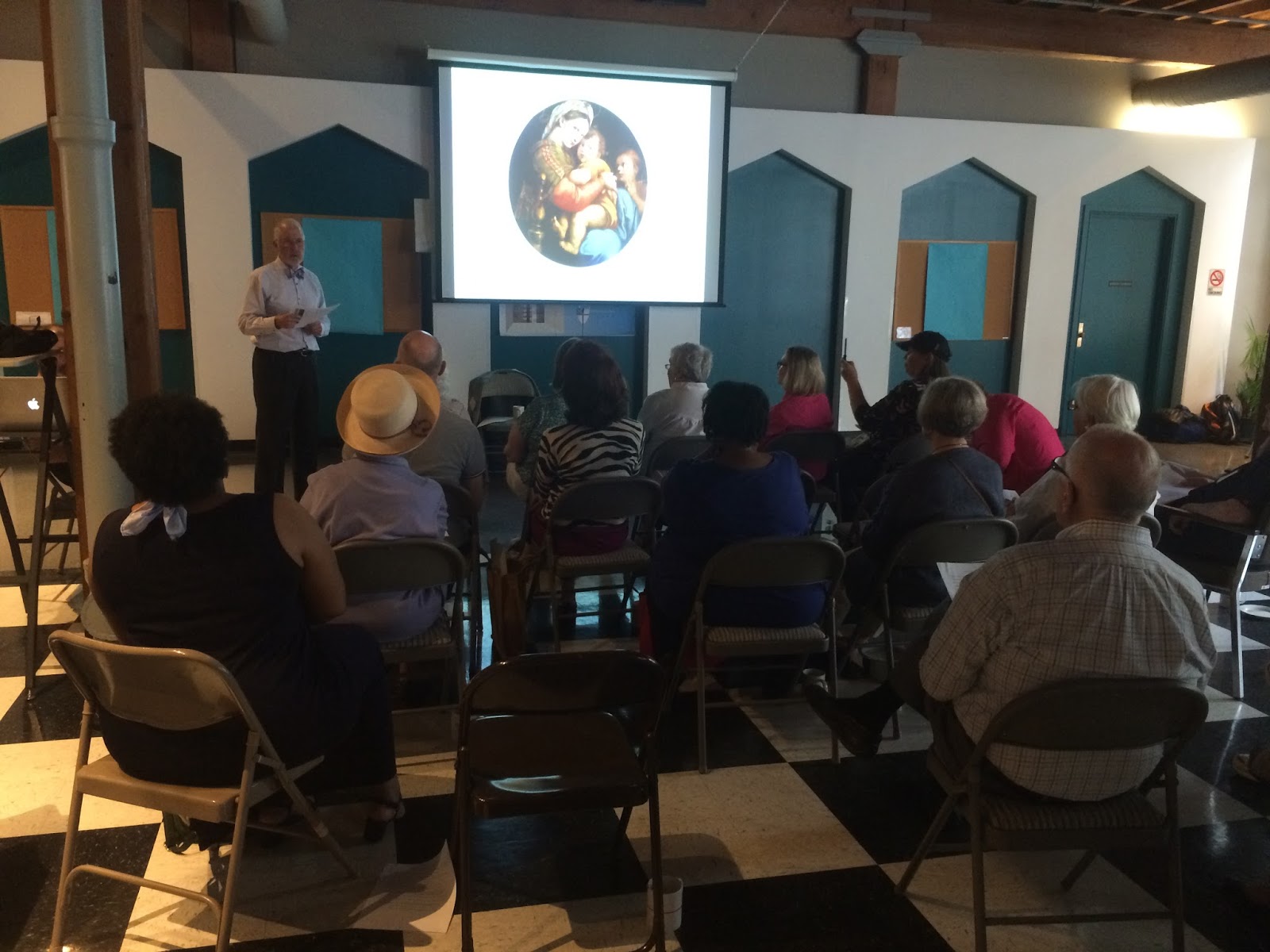
Sunday forum at Grace on Caravaggio's "Supper at Emmaus."
This will come as no surprise to many of my clergy colleagues, for whom this miscellany is the bread and butter of their week. Sermon preparation and presiding at worship are, of course, key responsibilities of the priest, but they often comprise a small part of the job. The nuts-and-bolts of keeping a building running when the boiler breaks (which happened before the first service on Sunday) or printing worship bulletins is just as important to me as being out in front breaking the bread. Sharing lunch or a cup of coffee on a Tuesday is just as important to me as sharing the chalice on Sunday. In fact, I have lunch and coffee appointments every day this week, just to get to know people in a way that I can't on Sunday morning. So, to everyone who's asked what I do all day in this new job, it's a very mixed bag of prayer and process, administration and conversation.  And to the people of Grace, thank you for making time for me to learn about your hopes for the future of the parish and for sharing what's important to you. I hope more of you will do the same.  At the heart of all of this work is a love for God's people and gratitude for all the miscellany and interruptions that come my way. So, keep them coming.

Abundant blessings,
Fr. Ethan+


Monday, August 3, 2015

Baptism and a Broken Clutch

This past weekend, I had the privilege of participating with family in two major milestones, the baptism of my partner's two nephews on Saturday and my first Sunday as Interim Rector of Grace Episcopal Church in Chicago. Both were events of deep joy for me as a priest. And they both illustrated the truth that as much as we may try to plan, organize, and perfect our lives, circumstances can overtake us and thwart our best efforts. Then, we have to improvise. Fortunately, the Holy Spirit does some of her best work on the fly, and often shows up when we feel things are coming apart.

Welcoming the newly baptized.
We had been talking about Jordan's and Jose's baptism for a while, but the timing and logistics had been difficult, particularly because two of the godparents had been living in Alaska. The planets, however, had finally aligned to get the two boys, their parents, and their grandmother to Chicago for a long visit, during which we would do the baptism. The day before, however, the parish's liturgical coordinator--who is a master of executing complex liturgies despite the hindrances of befuddled, but well-meaning, clergy like me--was unexpectedly admitted to the hospital. I walked into church not knowing if I would find everything I needed, who would assist me, or exactly how the liturgy would unfold. But the rector and parish staff pulled together and stepped into the breach to help me. It didn't go as planned, and yet the Holy Spirit showed up, and the experience was beautiful.

Selfie with nearly stranded parents.
Later that day, I received a phone call. Ever since the start date for my new cure had been set, my mother and stepfather, Randy, had been planning to drive from Florida to surprise me on my first Sunday in my new congregation. I answered the phone, and Randy informed me that they were in Chicago. I was stunned and delighted. He explained that they had hoped to amble in on Sunday morning as I was greeting parishioners before the main service at 10 o'clock. But . . . it turned out that, even after a thorough maintenance check prior to leaving, the clutch started to give out somewhere in Indiana; and by the time, they were within ten miles of their hotel in Chicago, the car just gave up. Fortunately, they managed to get it off of the highway and onto a quiet side street. My parents were understandably disappointed that the surprise hadn't gone according to plan. From my perspective, though, I was grateful that the car hadn't died in the middle of a cornfield or 100 miles from the nearest gas station. They were safe, and I was close enough that I could jump in the car and pick them up in a matter of minutes. And I was granted the pleasure of an unexpected dinner with my family.

The next day, I was, of course, excited to worship with my new parish, with my family sitting in the congregation. Although I had read the service bulletin carefully, I found myself at several points in the service falling into old liturgical patterns. For example, I got confused during the Gloria, defaulted to the traditional Lord's Prayer, and neglected to use the special final blessing printed in the bulletin. But God showed up all the same, and it was beautiful. In a touching gesture, members of the vestry presented me with the former rector's white stole, which I kissed and placed over the green chasuble I was wearing, before gathering the community for the Liturgy of the Table. It is in moments like this that I am reminded that improvisation can be a blessing, allowing us to let go and grant the Holy Spirit space to move among us. The fruits of that movement are often unexpected, but beautiful. They remind us that it is sometimes OK for us to relinquish control. It is fine for things not to go as planned, because the Holy Spirit shows up and compensates for our uncertainty and stumbling. In those moments, we can relax, because God is in charge.


Monday, July 27, 2015

A Terrifying Leap of Faith

Zip-lining at Loterie Farm in St. Maarten.
I am terrified of heights, a phobia I trace back to the first grade, when I fell off the monkey bars on the playground and landed on my head. Since then, I have largely avoided high places. On occasion, however, I have tried to set aside this fear and taken a leap of faith. I have climbed to the top of Cologne Cathedral on a rickety, rusty ladder in the dead of winter; I have stood 1,353 feet above Chicago on the Sears Tower's clear, plexiglass Ledge; and even now, I live rather counter-intuitively on the fifty-second floor of an urban high-rise. The view from my living room still makes me a bit woozy. No experience, however, has been more terrifying for me than extreme ziplining in St. Maarten this past New Year's Day.

Working my way to the next platform.
The group of tourists and I piled into the back of a pick-up
truck, which clambered up the side of the mountain through virgin rainforest. The most extreme zipline, we were told, was 930 feet long and a dizzying 120 feet above the ground. The view was spectacular, to be sure, but as we climbed higher and higher into the rainforest's canopy, I felt my anxiety rise, too. After some initial instruction on how to use the harness and navigate safely from platform to platform, I clumsily made my first attempt, whizzing diffidently to the next platform. Interestingly, the zipping itself was pretty effortless, once I had gotten the hang of it. What terrified me was the movement between the platforms, which got higher and higher. Most of them were connected by reasonably sturdy bridges made of rope and wooden planks, although I worried that my foot might inadvertently slip between the rungs. At one point, however, I faced--incredulous--nothing more than a thin, steel wire between two platforms--essentially a tight-rope. My only lifeline was a wire above me to which I could attach my harness, and two thin wires on either side to guide me forward. There was no turning back. I had to either walk the tight-rope or be airlifted out.

At the end of the course, bathed in terror-sweat.
In a moment of supreme self-mastery, I mustered up the courage to tread carefully over the wire, slowly guiding myself meticulously step by step over the wire, while I struggled desperately not to focus on the fact that I was hovering a hundred feet above the ground. I slid my hands over the wires in a death-grip as I plodded carefully forward, placing my feet precisely on the wire. After I got about half-way, I began to believe that I might just make it without slipping from the wire and dangling perilously over the rainforest floor. When my foot made the final step onto the platform, I noticed that my hands were raw and pink where the wires had peeled off layers of skin. I also realized that I was bathed in sweat, my t-shirt sticking heavily to my body. This was not ordinary sweat from exertion or the hot, humid weather, I joked. This was terror-sweat.

Ordained leaders discuss congregations in transition.
Last week, I attended a three-day conference for interim rectors and other transition ministers, like me. Although Episcopalians predominated, there were ordained leaders from several Christian denominations. We studied systems theory, reviewed congregational case studies, and debated a variety of complex issues, ranging from appreciative inquiry and learning styles to the dynamics of congregation size and parish life-cycles. We talked a lot about grief and anxiety in parishes going through transition. One of the most valuable insights of this conference was that congregations, once they have reached a stage of maturity, tend to think that decline is the result of programmatic problems, that if they just developed more and better programs, they would begin to thrive again. George Bullard, however, has noted in his congregational development work that the problem is not usually with programs, but with vision.

As congregations, we often cannot imagine our way forward along a path that seems unsteady, leading to a destination so far away to be almost imperceptible. This path is marked with anxiety, even terror, because we fear that life as we know it may end. Instead of focusing on our strengths, we lose confidence in our ability to adapt to new situations and anticipate the worst-case scenario, fearful that we might slip off of the tight-rope we're walking and plummet to our death. A key to successful transitions, then, is to be visionary, to accept uncertainty as a creative space, as a place to explore a congregation's values, to let go of old dreams, and come up with new ones. The way forward may push us out of our comfort zone for a time, but if we can learn to live with a little anxiety--perhaps even some terror-sweat--we may be surprised by what we're able to achieve.

Abundant blessings,
Fr. Ethan+

Monday, July 20, 2015

All Religion is Local

Vie de Jesus Mafa, The Transfiguration
If "all politics are local," as the old adage goes, it's probably equally true that "all religion is local." Or at least we tend to behave as if that were true.  The day-in and day-out of parish life persuades us that the way we do things in our parish is normative for others in our tribe, such as the Episcopal Church.  The way we worship, the language we use, the hymns and music we sing, the way we run our meetings.  Now, even if we don't assent intellectually to this idea, we can often act unconsciously as if OUR way is THE way. We assume quite innocently that this is just how Episcopalians (or Lutherans, or Baptists) do things.  But religion is, at its heart, deeply contextual.

Bishop Lee installs the new vicar.  Photo from Br. Ron Fox.
Which is why I'm really grateful to gather on occasion with other Episcopalians to be reminded that I am part of a community much larger than what I know and do.  Over the last four days, I've been to three different Episcopal congregations to either lead or participate in worship. What is remarkable to me is the way that each of these communities of faith--as unique as they are--embodies the concept of the Church, with a capital "C."  As member congregations of the Diocese of Chicago, all three are firmly rooted in the Anglican/Episcopal tradition, despite the great variety and diversity of worship styles and cultural contexts.  It can be a wonderful experience to be thrown off kilter, pushed out of our comfort zones, and be invited into something unexpected.

On Thursday evening, I participated in the installation of my dear friend, Fr. Robert Cristobal, as vicar of St. George and St. Matthias Episcopal Church, an historically African American and Afro-Caribbean congregation on the south side of Chicago.  Much of the music was unfamiliar to me, and I noticed several visitors surprised by the exuberant engagement of the congregation with the preacher during his sermon.  And yet, here was the fullness of the Anglican tradition: the bishop, the Eucharist, the Book of Common Prayer, clergy and people of the Diocese worshipping together as one.  It was beautiful and joyous, compelling and powerful.

Chicago Chapter-in-Formation of the Society of Catholic Priests
On Saturday morning, I gathered with other members of the Chicago Chapter-in-Formation of the Society of Catholic Priests at the Church of the Atonement, Chicago for a Mass of the Blessed Virgin Mary, followed by the chapter meeting.  The service was a solid Rite II Eucharist from the Book of Common Prayer with the usual Atonement embellishments. We shared our latest news over brown-bag lunches, talked about the contributions we could make to the life of the Diocese, and engaged in a theological reflection based on the words of the new Presiding Bishop-Elect, Michael Curry.  On Sunday, I drove out into rural/suburban Kane County to celebrate Mass with St. James Episcopal Church in West Dundee, IL, which, as a rural parish, was preparing for its upcoming Rogation celebration.  It had been several years since I had done a Rite I Eucharist, and so I tripped over the King James English, which had at one time been so familiar.  Of course, their customs for celebrating the Eucharist differed a bit from mine, and we laughed over the imperfections and miscommunications we committed, such as when the server failed to do the ablutions after communion, and I forgot to return to the chancel following the dismissal for the announcements. We are all a product of our patterns, our routines, our contexts.

St. James window in West Dundee
I picture for myself the scene at Jesus's Transfiguration.  Matthew 17 records that right after Jesus appears transfigured in dazzling white, flanked by Moses and Elijah, "Peter said to Jesus, ‘Lord, it is good for us to be here; if you wish, I will make three dwellings here, one for you, one for Moses, and one for Elijah.’"  One cannot help but wonder what Peter would have come up with if he had been allowed to build those dwellings.  Would they have all been identical?  Would Jesus, Moses, or Elijah have had any say in what their dwellings looked liked, how they were laid out, or how they were decorated?  Would James and John have been included in the design and building?  Would the three apostles have divided up the work and each taken responsibility for one of these dwellings?  Would they have fought for creative control or would they have collaborated harmoniously?

As it happens, each of them is credited with building a version of the Church in various places, all of which look very different from each other.  These apostles too understood that the Church is contextual, shaped by the unique identities, experiences and situations of the people in a particular time and place.  The lesson for us is to embrace the possibility that the Church can look and behave differently than we are used to, and yet we can find a place for ourselves in this new and unfamiliar incarnation of the Body of Christ.

Peace and blessings,
Fr. Ethan.+


.


Monday, July 13, 2015

If Jesus Rode the El Train

"Christ Among the Wild Beasts" by Moretto da Brescia
Today's Daily Office readings include the story from the Gospel of Mark about Jesus's preaching tour in Galilee.  In classic Jesus fashion, Our Lord goes out very early into the wilderness to pray--to find a few minutes of peace and quiet before tending to the needs of his demanding band of followers.  Simon (aka Peter) and the other disciples notice he is missing and go in search of him.  The Gospel records that, "When they found him, they said to him, ‘Everyone is searching for you.’ He answered, ‘Let us go on to the neighboring towns, so that I may proclaim the message there also; for that is what I came out to do.’ And he went throughout Galilee, proclaiming the message in their synagogues and casting out demons."

The urgency conveyed by the disciples' report, "everyone is searching for you," is matched by the urgency of Jesus's command to go into the neighboring towns to preach the Good News there also. Call and response. The people call to Jesus, and he goes out to meet them where they are with the message of new life.  This story is a powerful illustration of the missionary zeal that characterized both Jesus's ministry and the fledgling Church in its early years.  I sometimes wonder if we in the twenty-first century can really understand the immediacy and intensity of Jesus's hands-on contact with the average person, particularly the suffering and marginalized.   And then I find Jesus in some unexpected place, continuing to preach the Gospel message and cast out demons.

Like I did today.  This afternoon I took the Red Line downtown to meet a parishioner for coffee.  A
young homeless woman walked up and down the subway car asking commuters for spare change.  I took out my wallet, which was empty, and apologized for not being able to help her.  While many travelers pretended not to hear or see her, the man seated next to me greeted her and told her where she could find work.  He told her that a security company on the south side was hiring, and that if she applied, she would likely be hired.  She thanked him for the information, and then scoured the inside of her backpack for a pen.  I offered her the pink highlighter I was using to underline passages in the book I was reading, and she asked him for a phone number.  The man replied that he couldn't remember, but proceeded to give her detailed directions about how to get to the company, while I tried to look up the phone number on my iPhone.  The young lady hurriedly wrote down his directions, returned my highlighter, and then got off the train at the next stop.

As the train pulled away from the station, I thanked the man for his kindness, who had clearly represented Jesus in this encounter as well as (or perhaps better than) a person in a clerical collar.  He looked down at the floor and said, he knew how rough it could be, and how people sometimes just needed a little help.  I was moved by his sincere compassion and solidarity.  He engaged the woman as a peer, with dignity and respect.  No pity, no condescension, just Good News.  It was a simple, and yet exemplary, model of Christian witness.  As Jesus's hands and feet in the world, average people have the the power to heal the sick and cast out demons, to represent Jesus in places where he may be sought, even the unexpected and unconventional ones.

Blessings,
Fr. Ethan+