Tuesday, December 8, 2015

Of Sausages and Saints

As I watched the children rush exuberantly into the sanctuary on Sunday to listen to the story of St. Nicholas, I was reminded of the overwhelming responsibility the Church has to children, on a number of levels.

The most important one is the responsibility to keep them safe from harm. During my homily, I told one of the classic stories of St. Nicholas and children--the one where the evil butcher grinds them into sausages during a famine, and St. Nicholas grinds the sausages back into children to the peoples' amazement and relief. Another version of the story has the butcher curing the children in barrels, and then trying to sell them off as hams. Of course, St. Nicholas foils the butcher's wicked plot in this telling, too. I alerted the congregation ahead of time that the story might be shocking, but that it would turn out just fine in the end. There were understandably several very audible quick intakes of breath and groans when it became apparent where the story of was headed. When I was at St. Nicholas in Elk Grove Village, we told that story just about every year, and the children acted it out with great enthusiasm, running around the sanctuary to wild peals of laughter as they were turned into sausages. The story, of course, is situated in the fourth century when Christianity was the newly minted religion of Constantine's empire, following decades of persecutions and gory martyrdoms at the hands of the Roman state. Life was brutish and bloody, and so the core stories of Christianity were often bloody, too, even the ones that had happy endings.

What makes the story so worthy to be told in the 21st century is the way it emphasizes the church's role in protecting children. Yes, we should all ensure that the parish is a place where sexual misconduct is an impossibility by creating a culture of transparency and accountability, and requiring anyone who works with children to go through Keeping God's People Safe training. But that's just a first step. While I was preaching and offering the mass intention for the day, I was deeply mindful of the many children who suffer from violence on our city streets and around the world, because of gun violence, sexual abuse, neglect, child labor, and human trafficking. Are not these things just as horrifying as the story of the evil sausage grinder? Shouldn't we express our shock and outrage when we hear these things happening on a daily basis? Few of these children have the happy ending they deserve. In the story of the sausages, St. Nicholas, the patron saint of children, swoops in to save the day, and the Church in our day should be prepared to do likewise.

Earlier in the day at the 8 am service, I preached on John the Baptist. In the face of so much abuse of children, his call to repentance, to prepare the way of the Lord, is the perfect response to the story of the sausages. The Forerunner might look wild and scary--perhaps today he'd be a street preacher with a megaphone and a placard scrawled with words of doom--but I would argue that his unapologetic call to repentance and action is completely appropriate in the face of so much evil.  It is also fitting that, on this the feast of the Conception of the Blessed Virgin Mary, we reflect on how we can care for and protect mothers, who in their turn, must often face the same sources of abuse and violence as their children. Today, we commemorate the conception of the baby Mary, whose soul would magnify the Lord, and who would in turn become the Blessed Mother of Our Lord, Jesus. May the Church take seriously its responsibility to protect children, mothers, and all those who suffer from violence and abuse, as Nicholas and other saints great have done throughout the ages. Their stories--gritty, gory and shocking though they may be--still need to be told, so that we might be reminded of our responsibility as the Church to protect the vulnerable among us.

Advent blessings,
Fr. Ethan+


Tuesday, December 1, 2015

Joan of Arc: the Life and Witness of the Maid of Orleans

The lives of the saints are a critical way we connect with the Christian faith, by examining the witness of those who have gone before us, their struggles and their impressive examples of holiness. Over the past six weeks or so, my parish, Grace Episcopal Church in Chicago, has explored several of these in liturgy, preaching, and adult formation.  They ranged from classic saints like Francis of Assisi and Joan of Arc to more contemporary figures, such as Howard Thurman and Flannery O'Connor. They are both the embodiment of the best in human nature and flawed human beings like the rest of us; they are exemplars and companions.  Several folks asked if I could share my slides from my presentation, so I decided to go one step further, and have converted my workshop on St. Joan of Arc to a twenty-minute video with study questions at the end for further discussion. "The Lord is glorified in his saints, O come let us adore him!"


Wednesday, November 4, 2015

All Souls' Day: A Storehouse of Consolation

A Sermon for All Souls' Day.  A link to the audio recording can be found here.

In the name of the Father, and of the Son, and of the Holy Spirit. Amen.

A young man sat across from me last Tuesday on the Red Line train during the evening rush hour. We’ll call him Phil.  Phil was in his mid- to late-20s, with a shaggy ginger beard and huge headphones over his ears. He looked up at me every now and then, and after several stops, finally leaned forward and ventured tentatively:

“You’re a priest, right?”

“I am,” I stated pithily, smiling.

“So, do I call you, Father or Pastor, or what?”

“Those are fine. Or you can just call me Ethan.”

“OK. Can I ask you a question?”

“Sure. Go ahead.”

“I’m not a Catholic or anything, Father, but …”

“Neither am I, actually. I am a priest in the Episcopal Church,” I hastened to clarify.  (I decided not to muddy the waters by explaining Anglo-Catholicism. I knew what he meant.)  Phil’s face brightened with a look of recognition.

“The Episcopal Church. OK, so you don’t have confession, then?”

“Actually, we do,” I said encouragingly.  “But we often call it reconciliation.”

“Hmm. Really?  Well, do you think that the sins and bad stuff we do can affect our physical health? ‘Cause I’ve been feeling kind of sick, lately,” Phil confided. “I’m wondering if there’s a spiritual cause for it?”

“Absolutely,” I agreed.  “I firmly believe that the things that weigh on our consciences can affect our whole selves, emotionally, spiritually, and physically.” Phil seemed genuinely engaged, so I continued. “They damage our souls, and they can turn toxic and work on us over the long haul, if we don’t process them through therapy or sacramental confession.  In fact, I do both, and I highly recommend them.  They can make a huge difference.” Phil’s face, which had been intensely serious, relaxed into a smile.

“OK, thanks,” he said reflectively, as we shook hands and I got off the train.

To those who say that sin is an outmoded, medieval concept, my brief conversation with Phil would suggest, on the contrary, the world is still in desperate need of God’s mercy.  And that’s because sin is real, however much our society might deny its existence.  Sin is a difficult sell these days, because we would prefer to focus on God’s estimation of the created order, including us, as very good, as the book of Genesis records.  But the recognition of human sinfulness does not invalidate God’s original blessing.  Rather, it acknowledges our complexity: that the human experience is fraught with moral failings that we cannot resolve by ourselves.  We may be inherently good, but we are not sufficient unto ourselves.  We need God.

It may be hard for us to discern this hopeful message in the Requiem’s severe language. Contemporary sensibilities are not attuned to the Requiem’s central theme of the wrath and vengeance of divine judgment.  But to really appreciate the extravagant gift of God’s mercy and deliverance from sin, we need to engage equally extravagant language around human brokenness.  If the human condition were expressed in lukewarm terms, then God’s remedy would seem far less dramatic, far less redemptive.  What is deeply beautiful about the Requiem liturgy is the notion that however far we may fall, however much we might deserve divine retribution, God, out of his endless love for us, offers us abundant mercy.  And this is where the liturgy ends up, with the balm of divine absolution.

This evening’s readings are aligned to this hopeful outlook.  They are meant to provide reassurance in the face of fear and despair, doubt and failure.  The Dies irae expresses the intensity of human terror in the face of death and final judgment, and, yet in the Recordare there is a note of humility and tenderness that acknowledges God’s promise of redemption through Jesus’s once-for-all sacrifice on the Cross.  “Remember, kind Jesus, / my salvation caused your suffering; / do not forsake me on that day. / Faint and weary you have sought me, / redeemed me, suffering on the cross; / may such great effort not be in vain.”

A wise priest said to me one day, while instructing me how to hear confessions, “Remember that we come to confession, not for condemnation, but for forgiveness.”  In the face of deserved judgment, God offers forgiveness to those who seek it out in a spirit of sincere repentance.  It is a pity that so few people nowadays avail themselves of the sacrament of confession, because I think it would provide a baseline for understanding how the Requiem amplifies on a cosmic scale the assurance of God’s mercy the priest offers the penitent in life.  In death, too, we are assured of mercy.  We may be broken, but God intervenes to make us whole.  And we are insufficient unto ourselves, not only because we must rely on God, but also because we must rely on each other.  That is what it means to be the Body of Christ and to participate in the great cloud of witness we call the Communion of Saints, which we celebrated yesterday.

The Communion of Saints, however, is often practiced as a one-way street, rather than the mutual relationship of intercession and encouragement that it is.  Yesterday, as we recited or sung the Litany of the Saints, we asked the holy ones who have gone before us for their intercession as we face the strife of our lives here on earth.  Yet, the saints are not just charged with the ministry of conveying our repentance to God, and pleading on our behalf.  They are also sinners with their own brokenness and pain, seeking wholeness and ultimate union with God, for whom we pray.  One theological tradition of the Church has argued that whatever brokenness we have acquired through sin during our lives on earth, we must face it after death in a reality that precedes Heaven.  I have imagined this myself not so much as working off our sins, but God granting us the space to repair the damage to our souls through healing, and learning, and new spiritual insight, so that we may achieve a more intimate union with Him.  In the end, who knows?  What is fairly certain is that we each meet our Maker with a certain amount of woundedness.  So, the living in turn pray for the departed on All Souls’ Day, asking God to show them mercy and heal their brokenness.  The Communion of Saints is about solidarity in the midst of shared sinfulness and vulnerability and hope.

John Mason Neale
The great luminary of the Oxford Movement, John Mason Neale, offered the following guidance in his sermon on All Souls’ Day 1856 to the sisters of the Society of Saint Margaret, of whom he was the founder and first chaplain.  He said,
“But for the great multitude of those who have been redeemed to God … they without us shall not be made perfect.  And it is they, the true Servants of God, but not his Saints, whom we keep in memory to-day.  And what then?  Between them and us is there no fellowship?  Is there such a great gulf fixed, that no prayers, no power or grace of the Church can overleap it?  God forbid!  This it is to hold the Catholic faith; this it is to derive the untold comforts of her storehouse of consolation.  Think now each of you, of the dear ones whom you have lost, and believe this earnestly: that, if they have slept in the Lord, your prayers still avail for them, as much as (or more than) if they were still present in the flesh.  Let it be so, that we cannot tell what their needs are; that we know not what especial increase of grace they lack; in what particular way they desire to be helped.”
The saints, whom Neale calls simply servants, to remind us of our kinship with them, are bonded to us in common care and prayer across the ages. We share in the untold comforts of the Church’s storehouse of consolation in prayer, the sacraments, and our relationships with each other, the living and the departed.

In fact, the prayers of the living and the dead for each other across the ages drives the Church’s core identity as one, holy, catholic and apostolic.  From the apostles, martyrs and confessors of the primitive Church down to Phil, and you and me in this day, we are united in God’s promise of mercy and new life.  “Very truly, I tell you,” Jesus proclaims in the Gospel of John, “anyone who hears my word and believes him who sent me has eternal life, and does not come under judgment, but has passed from death to life.”  The Eucharist that we are about to celebrate is our regular affirmation of this promise of eternal life, when human brokenness is redeemed, ours and the servants who have gone before us.  Bread broken that, in the fullness of God’s time, we might be whole.

Rest eternal grant unto them, O Lord.  And let light perpetual shine upon them.
May they rest in peace.  Amen.

In the name of the Father, and of the Son, and of the Holy Spirit. Amen.

Tuesday, October 27, 2015

On Church Buildings

I currently serve at the Diocese of Chicago's third oldest parish, which was founded in 1851. If you were to pass in front of the building, you might not think it was a church at all, and certainly not one of such great longevity. Grace is now at its sixth location in a converted commercial building in the South Loop's Printer's Row. It houses not only an Episcopal congregation on Sunday, but a number of not-for-profit organizations, a Lutheran satellite campus, a Korean congregation, the South Loop campus ministry (Lutheran/Episcopal), a weekly community breakfast for 200 homeless men and women, yoga, Alcoholics Anonymous, and a number of other activities that vary from week to week. The building is almost always FULL.

For many congregations, though, their buildings are perceived as a burden, rather than an asset. After several years on the diocesan Congregations Commission, I came to appreciate how pivotal a building can be to a congregation's survival and vitality. Many are faced with huge obstacles posed by deferred maintenance: a roof that needs to be replaced, a parking lot that needs to be resurfaced, tuckpointing to preserve a crumbling facade, foundation or other work to stem flooding, electrical upgrades, plumbing repairs, a new boiler or water heater. The list goes on and on. In every congregation where I have been a leader, both as a layperson and as a priest, there have been major physical plant challenges. As a result, some have argued that we need to get out of our expensive Gothic or Romanesque buildings and relocate to spaces that are more economical and better suited to the kind of work our congregations want to do. They're bleeding us dry, people complain.

A community meeting on the 1st floor meeting space.
While that may be true in many cases, the larger question for me is: what does your building make possible? There is no doubt that Grace, a parish that numbers a steady 65 on Sundays, is able to do disproportionately more than other congregations its size because of its extraordinary building. I know you'll indulge me and allow me to brag a little that the parish has a reach and a reputation in the community that most congregations would envy. But even a contemporary building ideally suited to ministry in the wider community has a variety of associated costs. Tenants provide a steady revenue stream, but they also generate costs. Additional wear and tear on the building from increased usage; staffing to provide building security, custodial services, and setup/break-down of the various meeting spaces; infrastructure repairs and upgrades to the physical plant; and legal fees incurred to negotiate contracts and occupancy agreements can also be part of the equation. There is no doubt in my mind that these expenses are worthwhile; and the relationships the parish builds with its community and ministry partners are inestimable. But they can add up to a sizable fiscal note. So, a parish needs to be informed about what's involved and smart about managing it all.

Saturday's community breakfast.
There is no one-size-fits-all solution to the challenges posed by church buildings. Moving out of an historic Gothic building might be more cost-effective, but relocating to a converted printing warehouse might not support the ethos and aesthetic of the traditional liturgy that is central to a particular parish's identity and reputation. On the other hand, it might be just the thing that allows that parish to grow into a more vibrant and stable version of itself. It might encourage the parish to think of itself in new ways, as its members discover what the new building makes possible. In either case, the parish needs to act strategically to ensure that it has the right leadership, resources, and infrastructure to support its mission. As a priest that spends about half of his time doing administration and management, I value the experience and skills sets I developed as a not-for-profit executive. I couldn't do my job without them. I am aware, however, that if we imagine new ways of being church, including the types of buildings we use, seminaries will have to train clergy differently and congregations will need to recruit particular types of expertise to fill leadership roles on vestries, building committees, and other bodies. Church buildings can be a invaluable asset if we honestly evaluate what they make possible, and what they don't, and what they need from us to make them work.

Blessings,
Fr. Ethan+

Wednesday, October 14, 2015

Preserving the Nicene Creed

I am just back in the parish after having been on the road for a solid week, first at the Society of Catholic Priests annual meeting in Denver, and then at the Diocese of Chicago's clergy conference. Both events provided a stirring experience of the universality of the Church, the fact that we live out the Christian faith in our own distinct contexts, animated by different cultural traditions, pieties, and musical styles. And our theologies are often varied, as well. We discussed, debated, and even argued about what constitutes solid Anglican teaching. Are hospitality and justice, for example, sufficient reasons to change, say, the Church's official position on the communion of the unbaptized? Do they provide an adequate justification for revising the marriage rite in the Book of Common Prayer to encompass same-sex couples, or is more theological work needed?  And then, there's the Nicene Creed, another topic on which much digital ink has been spilled this week.

The core issue of the Nicene Creed is its status in a revised Prayer Book. Should it be included, and if so, why? In what form should it be retained? Should it remain a normative and integral part of the primary service on Sundays? Regardless of our different ministry contexts, the Nicene and Apostles' Creeds serve as a focal point of unity in the Anglican Communion. It will probably not surprise you to hear that people of good conscience have expressed a variety of views on this subject. And I am among them. So, here are my top five concerns about the Nicene Creed:

1. Restore the original Niceno-Constantinopolitan Creed. My beloved read the words Niceno-Constantinopolitan over my shoulder and said it sounded like an exotic ice cream medley. I laughed and admitted that this blog entry might seem a bit esoteric and pedantic to some, so if it is, my apologies. But, in all seriousness, I think the Nicene Creed is a topic worthy of thoughtful debate. As "Crusty Old Dean," Tom Ferguson, has colorfully argued on his own blog, the Episcopal Church should decisively get rid of the filioque clause in the Nicene Creed that claims that the Holy Spirit proceeds from the Father AND the Son. For one, the filioque muddles and problematizes orthodox Trinitarian theology. Secondly, it was a unilateral decision to counter the Arianism of the Teutonic Christians, who viewed Jesus as inferior to the Father. Originally added at the Council of Toledo in 589 and later enforced by Charlemagne, the reason it was contrived no longer exists. To revert to the original Creed as formulated at the Ecumenical Councils of Nicaea in 325 and Constantinople in 381 would more faithfully recapture the sensus fidelium of the early Church that we embrace and pass on to future generations.

Archbishop Michael Ramsey
2. Pass the torch. Each generation of the faithful is charged with passing on the core tenets of the faith to the next. Archbishop of Canterbury, Michael Ramsey, wrote on the first page of The Anglican Spirit,
"I want to talk about some of the main enduring characteristics of Anglican tradition, the way in which the Anglican Church has in its life and teaching, theology and sacraments, given over that divine paradosis--which is the Greek word for something that has been 'handed over' or 'passed on.' For when we Christians speak of tradition, we mean the experience of the Christian community lying authentically within that which God through Christ has handed over for the revelation of himself and the salvation of men and women everywhere" (Ramsey, 1).
So, for example, what is the point of the catechumenate if we fail to hand over the core beliefs of Christianity as preserved in the Nicene Creed. In the current version of the catechumenate in the Book of Occasional Services, the direction is given that "it is appropriate that the Apostles' (or Nicene Creed) be given to the Candidates for Baptism on the Third Sunday in Lent and the Lord's Prayer be given to them on the Fifth Sunday in Lent." If we dispense with the Nicene Creed, then exactly what faith are we passing on? What statement of belief are they receiving?

3. Prayer Book revision. This leads me to Prayer Book revision. Dr. Derek Olsen has addressed a number of concerns that have arisen from a recent statement on Prayer Book revision from his colleague on the Standing Commission on Liturgy and Music, The Rev. Dr. Ruth Meyers. Dr. Meyers described the Nicene Creed as a stumbling block for many, and proposed that it not remain a standard feature of Sunday worship. This suggestion ignited the blogosphere and occasioned a flurry of responses, such as in the Living Church and on the Smoking Thurible blog. The Nicene Creed, I would argue, forms part of the esse of the Church, and is therefore not dispensable. Olsen argues, moreover, that Meyer's proposal is symptomatic of a cultural shift away from orthodox Christianity toward a variety of heresies aligned with Moral Therapeutic Deism. C. S. Lewis makes the point in Letters to Malcolm, for example, that "first, [common prayer] keeps me in touch with 'sound doctrine.' Left to oneself, one could easily slide away from 'the faith once given' into a phantom called 'my religion.' [...] By the way, that's another thing to be avoided in a revised Prayer Book. 'Contemporary problems' may claim an undue share. And the more 'up to date' the book is, the sooner it will be dated" (Lewis, 12). If you don't believe Lewis, take a look at Eucharistic Prayer C (referred to by people of diverse churchmanship as the "Star Wars Prayer") in the 1979 Book of Common Prayer, and tell me it doesn't seem dated, despite its often lovely, lyrical imagery. As a guy who grew up in the 1970s, it does have a bit of a ''groovy, man" vibe to me.

4. Foster ecumenism. The current version of the Creed with the filioque is a serious obstacle to ecumenical work. Lest we forget, the filioque was one of the primary disagreements that led to the Great Schism between the Western and Eastern Churches in 1054. The Anglican Oriental Orthodox International Commission met last week in Wales, during which the Anglican representatives agreed to remove the filioque and move the two communions closer togetherDean Ferguson clarifies that the removal of the filioque is not meant simply to placate Orthodox Christians, who have long complained about its use among Roman Catholics and others (like us), but because it's a theological aberration that needs to be remedied. More generally, the Nicene Creed is not just an historical artifact. It remains the second component of the Chicago-Lambeth Quadrilateral of 1886/8 shaped by William Reed Huntingdon as the basis for Anglican ecumenical work: "The Apostles' Creed, as the Baptismal Symbol; and the Nicene Creed, as the sufficient statement of the Christian faith" (BCP, 877). I understand that this document, like the Articles of Religion (Thirty-Nine Articles) is housed in the "Historic Documents" section of the Prayer Book, but unless I've been misinformed, the historic Creeds, along with the Holy Scriptures, the dominical sacraments, and the episcopate, are still foundational principles for our ecumenical efforts.

Niceno-Constantinopolitan Creed
5. Creeds are always necessary but not sufficient. During the Diocese of Chicago's clergy conference, the Rev. Dr. Mark McIntosh, Professor of Christian Spirituality at Loyola University Chicago, pointed out that "creeds are always necessary, but not sufficient." I absolutely agree with this statement--at least inasmuch as the Nicene Creed does not speak explicitly on every topic related to God or the Christian experience. There is much that we affirm about God and our lives as Christians that are not mentioned by the historic Creeds, and so I have at times complemented the Nicene Creed on Sunday morning with other affirmations as a way to encourage people to be reflective. The historic Creeds are the starting point of a spiritual journey. The Chicago-Lambeth Quadrilateral defines the Nicene Creed as the sufficient statement of the Christian faith, which I understand to mean that it supplies the essential foundation without being exhaustive like a multi-tomed systematic theology. But it does something else. In being the foundation, the Creed drives our seeking, leading us to be ever more curious, ever more passionate for God.

I realize that for many people reciting the Nicene Creed is difficult, containing certain theological propositions to which they cannot assent. It's tough for me, too. So, I get Dr. Meyer's point. But reciting the Creed is about more than agreeing intellectually with this or that statement. It's about affirming one's belonging to a heritage of faith and practice over many generations and seeking to live into the unfathomable mystery of God that the Nicene Creed expresses. In this way, the Church would not be the Church without it.

Tuesday, October 6, 2015

Ritual Notes

I have been thinking a lot about ritual lately, both as a priest in a new parish and in light of the upcoming annual conference of the Society of Catholic Priests, which begins this week in Denver. As usual, liturgy will be a primary component of the conference. We will come together from our diverse parishes, each with its unique ritual customs, and do our best not to throw each other off or step on each others' feet.

In seminary, I was taught that even congregations and denominations that do not consider themselves "liturgical churches" still have patterns and customs for worship that over time become normative. They are in their own way rituals, or performance. Worship is performance, not in the sense of entertainment, but rather as the way a worshiping community enacts the theological, relational, and cultural values that are foundational to its identity. From week to week, we see a congregation perform an established repertoire of acts, gestures, and statements that say, "this is who we are."

Growing up as a young Jewish kid at Congregation Kol Ami, I came to know and anticipate every core gesture and to blend in with the rhythm and pacing of every practiced word. But I also noticed the places in the service where there was untidiness, even dissonance. The fact that Judith Sobel sang theAlenu an octave higher than everyone else--and not always on key--and that some people bent their knees and bowed at the designated place in that prayer, and some didn't, were also part of the congregation's identity. Every congregation, no matter how uniform it may look from the outside, is diverse: diverse pieties, spiritualities, theologies, and ritual sensibilities. In Episcopal congregations, for example, at the invocation of the Holy Trinity, some people will make the sign of the cross, or bow, or do nothing at all. In some parishes, certain people will kneel during the Eucharistic Prayer, while others will stand. Some adore "bells and smells," while others would prefer it simple and unadorned. And you may find all of this diversity within one congregation.


From the priest's perspective--at least, this priest's perspective--the challenge is to acknowledge and respect this diversity. In every service, the priest hopes that each person will find something that will spirituality nourish him or her. Perhaps it will be the sermon, or the hymns, or the language we use to talk about God. The ritual actions likewise may resonate with one person, and not another, for theological, aesthetic or cultural reasons. And, perhaps unexpectedly, the congregation's diversity also includes the priest. Like the congregation, the priest is a worshiper who brings his or her theology, relationship with God, personality, and ritual sensibilities to the altar. Anglicanism has always striven for unity without uniformity, and I would add, communion without conformity. Ritual should, therefore, make a generous space for "a bit of me" and "a bit of you." At its best, worship will enable both priest and every member of the congregation to bring something of their authentic selves to their shared encounter with God. 

Abundant blessings,
Fr. Ethan+


Tuesday, September 29, 2015

An Apology of Anglican Catholicity

The new Chicago Chapter of the Society of Catholic Priests
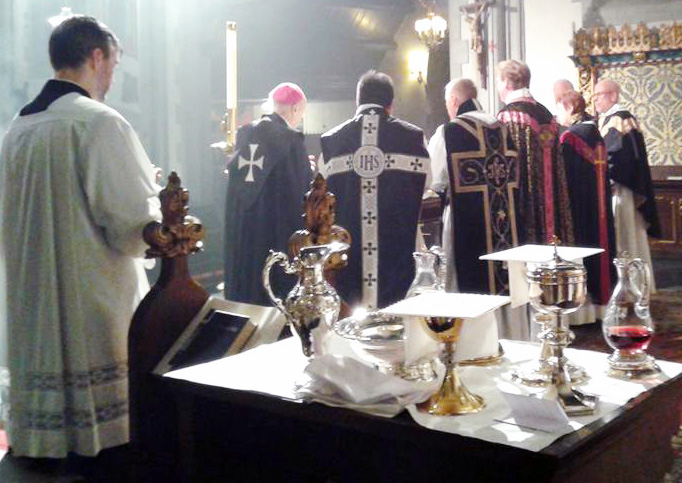
While Philadelphia (and the world) waited with great anticipation for Pope Francis to open the World Meeting of Families last Saturday, my friends and I were preparing for an event of our own here in Chicago. After two and a half years of discussion, discernment, and preparation, we gathered at Grace Episcopal Church in the city's South Loop for a mass to inaugurate the Chicago Chapter of the Society of Catholic Priests. It did not involve barricading downtown streets or ticker-tape parades. None of us drove through adoring crowds in a Pope-mobile. Just bread and wine, hymns and holy smoke, and champagne at the end.

The frenzy of activity and interest in the Pope's visit demonstrates the power that the notion of
Pope Francis greets admirers in Philadelphia
catholicity still has over people generally, and Anglicans, specifically. My Facebook feed filled with commentaries about Francis's statement on same-sex marriage and the ordination of women, the moral example he was setting by snubbing an invitation from congressional leaders to eat with the homeless, and even how his presence would likely influence the upcoming presidential election. In a way, it makes me sad that many Anglicans feel they have to piggyback onto the Roman bandwagon to satisfy their fascination for and experience of the universal Church.

It speaks to the fact that Anglicanism, including the Episcopal Church, is timid about claiming its catholicity. When we do it, it's in a half-hearted and qualified way, as if we're either embarrassed or not quite convinced of it. Maybe we feel insecure that we're so much smaller or that we're a more recent creation. Like the rural cousin that arrives to the fancy gala in her simple homespun dress, we feel we just don't measure up. After all, it's hard to compete with the sheer scale of the Roman Church's presence and of Pope Francis's popularity. But if Francis has taught us anything, it's that the Church is not about riches or pomp or who's got the tallest mitre.

John Jewel
I think about the many great theologians in our tradition that have crafted sophisticated apologies of the Church of England, how they too wrestled with the concept of catholicity. Whether it was an attempt to recapture the purity of the ancient Church, reconnect with the roots of pre-Reformation Sarum, or enter into a more expansive understanding of catholicity, they all had to make sense of the unique place of the ecclesia anglicana in the universal Church. Jewel and Hooker, Newman and Keble, Ramsey and Williams have thought and debated in just the same way we are thinking and debating within the Society of Catholic Priests. As I looked around Grace's sanctuary on Saturday morning, I remarked on the diversity of our members' priestly ministry, the variety of contexts in which we serve at the altar. We are urban and suburban, in mostly white congregations and mostly black, in small parishes and large, in broad churches and Anglo-Catholic churches, in affluent communities and in poor communities. If this doesn't represent the universality of the Church, then I don't know what does.

Abundant blessings,
Fr. Ethan+